Bariatric surgery packages should be compared as a course of care, rather than as a single operating-room price. Assessment, the procedure, hospital services and long-term support can be supplied and billed by different organisations. This guide helps US patients understand written proposals after clinical evaluation. It does not determine eligibility, recommend an operation or predict weight loss. A qualified multidisciplinary team should explain the appropriate options, material risks and continuing responsibilities, allowing the patient to consider cost within an informed treatment decision rather than choosing an operation from an advertisement.
Establish the assessed procedure and care pathway
Ask which operation is proposed and why it is appropriate for your circumstances. Different procedures should not be compared as interchangeable packages solely because they share a bariatric label. The National Institute of Diabetes and Digestive and Kidney Diseases describes several types of weight-loss surgery and the need to discuss follow-up with the surgical team. Ask about alternatives, uncertainty and the practical requirements of the proposed pathway. A personalised recommendation should precede a discussion of booking deposits or package discounts.
Request a plan for preoperative assessment and preparation. Identify consultations, investigations and other evaluations recommended by the team, along with who provides them. Ask which services are included in the package and which require separate appointments or payment. If the plan changes after assessment, request revised clinical advice and an updated estimate. A preliminary price based on an enquiry should not be treated as a final commitment before the team has established what care is appropriate and what other health needs must be considered.
Itemise the surgical and hospital charges
Ask whether the quote covers surgeon, anaesthesia, facility, expected stay and routine supplies. Identify any separate billing organisations and request their estimates too. A hospital package can exclude professional fees, while a surgeon’s quote can exclude the hospital. Ask what happens if additional care, a longer stay or another procedure becomes necessary. The financial explanation should distinguish included routine care from circumstances that create further charges, without presenting any package as a guarantee that clinical complications cannot occur.
For self-pay or uninsured care, ask providers about applicable good faith estimates and retain the written documents. CMS explains that estimates may relate to individual providers or facilities, so one document should not be assumed to include every participant. Request clarification of the covered period and services. An estimate is useful for understanding expected charges, but it does not replace clinical consent or eliminate the possibility of unanticipated care. Keep each estimate with the associated treatment and payment agreement.
Include continuing support and monitoring
Ask what follow-up is planned, who provides it and how long it remains included. Discuss nutritional support, monitoring and other continuing care with the clinical team. Identify separately purchased items or appointments and ask what arrangements apply if you move or cannot return to the original centre. A package concentrated on the surgical day may be incomplete for someone who needs a practical long-term care pathway. The appropriate support should be defined clinically, then reflected in the financial comparison rather than left as an unspecified benefit.
Find out how concerns after discharge are handled, including access outside routine hours and coordination with local clinicians. Follow the team’s individual instructions rather than general recovery schedules found online. If travel is involved, discuss the clinical and practical implications before booking. Include transport, accommodation, time away from work and assistance at home in your own budget. These expenses may not appear on the provider’s estimate but can affect whether the proposed arrangement is manageable during recovery and continuing appointments.
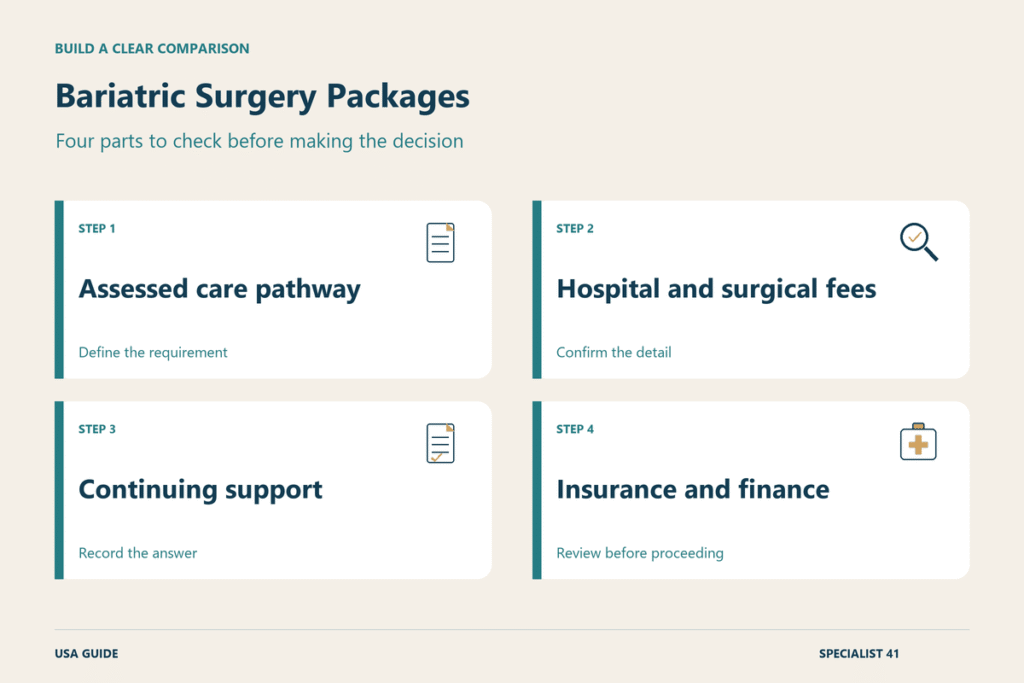
Verify insurance and finance independently
If using insurance, ask the plan about eligibility criteria, authorisation, network participation and the patient’s expected share. Confirm the position of the facility and relevant professionals, not just the surgeon. A provider’s statement that it accepts insurance does not establish coverage for your procedure. Request the implications of a changed plan or additional care. If credit is offered, identify the lender, total repayable amount, interest, fees and cancellation terms. A monthly payment should be compared with the full cost and ongoing care commitments.
Compare centres using assessed suitability, named clinicians, hospital arrangements, follow-up and complete patient costs. Verify relevant professional credentials and ask how outcomes are explained without treating another patient’s experience as a prediction. Allow time to consider the clinical recommendation and obtain further advice where needed. A strong package is a clearly described care pathway with transparent financial boundaries. Its value cannot be determined solely from a starting price, promotional weight-loss photograph or promise that a particular financing plan makes surgery an easy purchase.
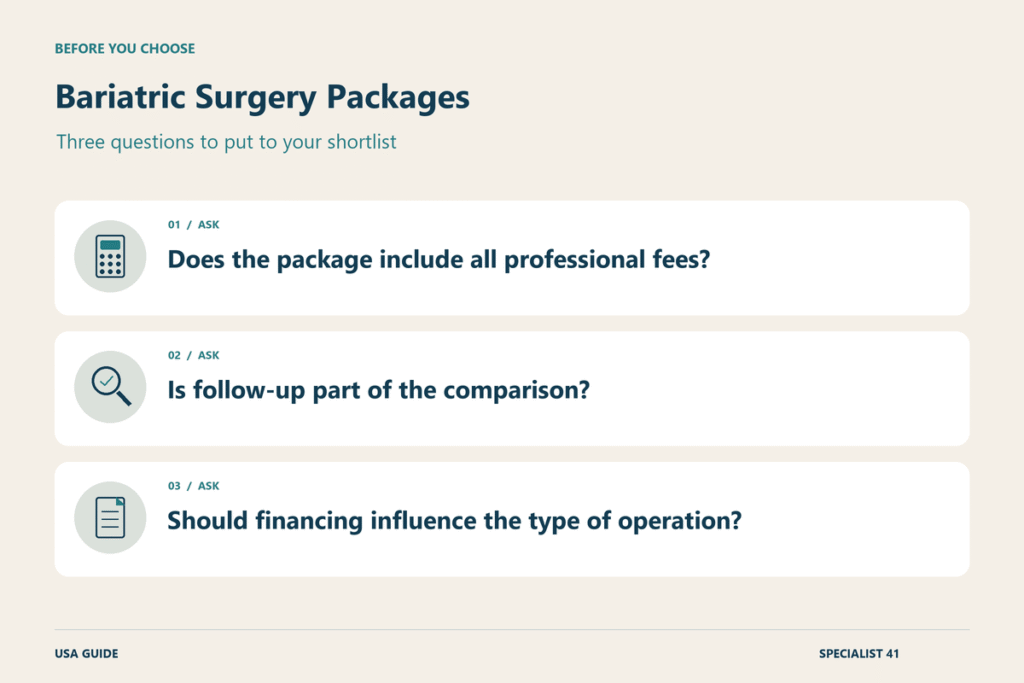
Does the package include all professional fees?
Check surgeon, anaesthesia, hospital and other participating providers separately. Ask for written estimates and identify which organisation bills each service. A combined-sounding package name does not prove that every participant or stage is included.
Is follow-up part of the comparison?
Yes. Ask the clinical team what continuing support and monitoring are recommended, then identify what the package provides and what costs extra. Care after discharge should be planned explicitly rather than assumed from the surgery price.
Should financing influence the type of operation?
Clinical suitability should be assessed with qualified professionals. Payment options can be considered after understanding appropriate choices, risks and continuing care. Affordable instalments do not establish that an operation is the right treatment or that its full cost is manageable.
Further reading
Related reading
- Spinal Fusion Surgery Estimates: Comparing Surgeon, Hospital and Implant Charges (USA)
- Robotic Prostate Surgery Costs: Comparing Hospital Quotes and Insurance Coverage (USA)
- Private Hip Replacement Packages: Comparing Implant Options, Hospital Fees and Rehabilitation (UK)
- Private Hernia Repair Quotes: Comparing Surgeon Fees, Anaesthesia and Aftercare (UK)
Explore more in Private Hospitals and Surgery.