
A commercial lease dispute may concern repairs, service charges, rent, permitted use, a break provision or the end of the tenancy. Those are different instructions with different evidence and costs. Before comparing solicitor quotes, define the problem and the decision the business needs to make. This guide concerns commercial property disputes in England and Wales. It does not interpret a particular lease or establish whether a landlord or tenant can enforce a remedy; the documents and circumstances require individual legal analysis.
Define the property and the immediate risk
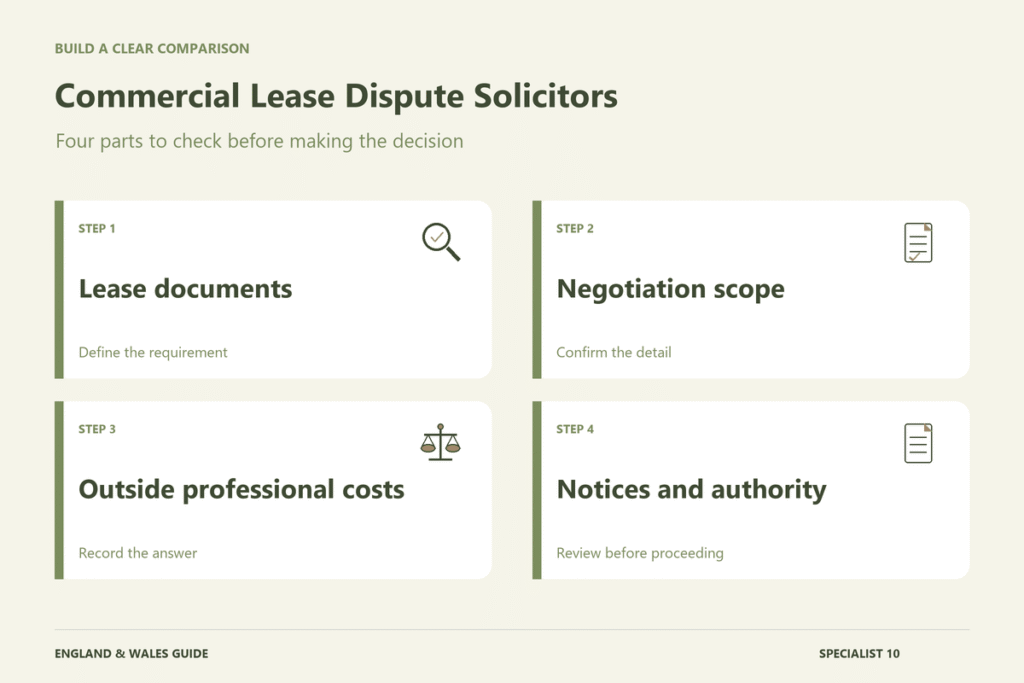
Gather the signed lease, variations, licences, guarantees, notices and relevant correspondence. Include schedules of condition, plans and any surveyor reports already available. Identify whether the business is the tenant, landlord, guarantor or another party. Explain operational concerns such as access, trading disruption or an approaching transaction. The solicitor should identify the urgent legal questions before recommending a course of correspondence. An incomplete summary of a clause can conceal qualifications or notice requirements found elsewhere in the lease.
Ask the firm to distinguish interpretation, factual investigation and commercial negotiation. A repair dispute may need a surveyor; a service charge dispute may require accounts and supporting documents; a break issue may turn on a precise lease provision. Request an explanation of the initial work needed to evaluate your particular problem. Do not assume that a template letter or a general property consultation includes advice on every related guarantee, statutory issue or business consequence.
Compare advice and negotiation packages
A defined first stage can be useful: document review, advice on options and one agreed communication. Ask about limits on document volume, meetings, revisions and follow-up questions. Identify whether the proposed fee includes speaking with the other side’s solicitor or only drafting a letter for you to send. If negotiation is offered on an hourly basis, request expected tasks and budget checkpoints. The objective is to understand what the business can decide after the initial stage and what would require another instruction.
Ask how the firm evaluates non-court options and whether specialist processes may be suitable. The lease or dispute context may affect the available route. A proposal should not assume that issuing proceedings is the first useful step, nor guarantee that informal discussion will resolve everything. Have the solicitor explain the practical consequences of each option, including interruption to trading, access to the premises, relationships with other occupiers and the uncertainty of a contested outcome.
Budget for professional and outside costs
Request rates for the likely team and clarify whether VAT is included where applicable. Court fees, counsel, surveyors, accountants and specialist reports may sit outside the solicitor’s estimate. Ask when those services become necessary and who authorises them. For a repair or dilapidations dispute, obtain a description of how legal and surveying work will be coordinated. Paying two professionals to review the same issue without defined responsibilities can obscure both accountability and the financial value of the advice.
Discuss costs exposure separately from the merits. A lease may contain provisions concerning legal expenses, and proceedings can create additional issues about recovery. Ask what you may owe under the engagement, what another party might seek and which elements remain uncertain. Check relevant insurance or contractual support rather than assuming it applies. A favourable interpretation of one clause is not the same as an assurance that all legal spending will be recovered from the other side.
Check notices and authority to act
If a notice has been received or is being considered, flag it immediately and provide the complete document and delivery information. Ask who assesses validity, response dates and service requirements. Avoid relying on a general article or sending a self-drafted notice on the assumption that wording is unimportant. Also identify who may instruct the solicitor for the company, partnership or property owner. The firm should establish the client entity and any conflicts before undertaking sensitive work or contacting the other party.
Compare proposals using scope, relevant lease experience, coordination with other advisers, urgency and budget control. Verify professional status and obtain a written engagement. Ask the solicitor to explain what new information could change the assessment and how recommendations will be reviewed if negotiation fails. A good service makes legal risk understandable in the context of the business’s premises and priorities. It does not reduce a complex lease to a confident promise based on one quoted sentence or an incomplete email chain.
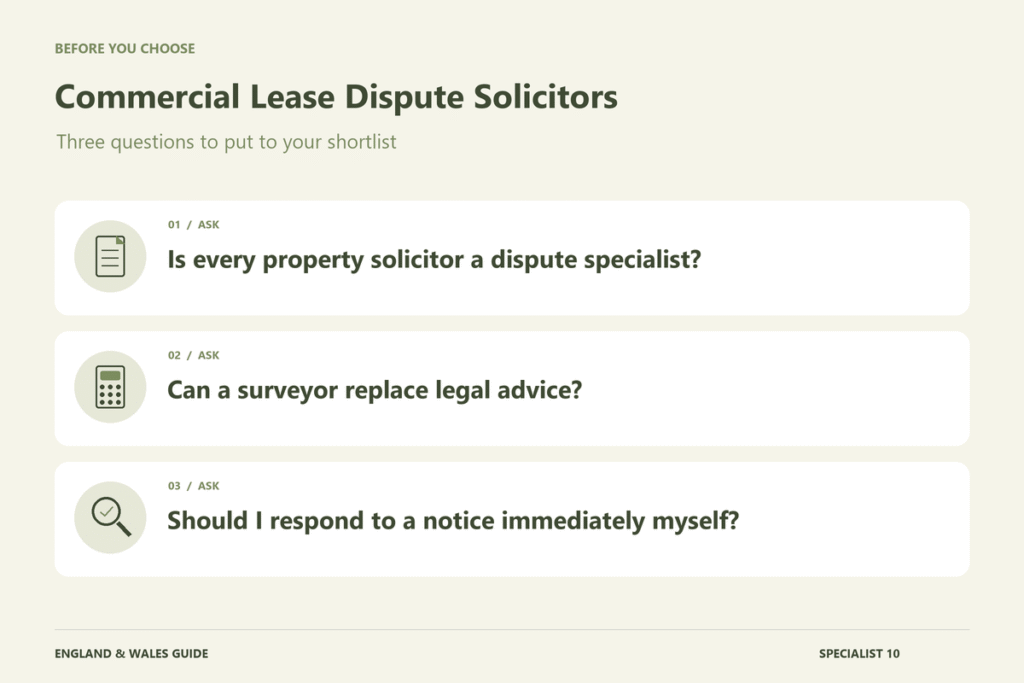
Is every property solicitor a dispute specialist?
Transactional and contentious work involve different tasks. Ask who handles lease litigation or negotiations of this type and who would appear if proceedings become necessary. Relevant experience should match the actual dispute rather than the value of the building alone.
Can a surveyor replace legal advice?
A surveyor may address condition, valuation or technical property issues, while a solicitor assesses legal rights and procedure. Ask how their responsibilities fit together. The appropriate combination depends on the issues requiring investigation and the decision you need to make.
Should I respond to a notice immediately myself?
Obtain prompt advice on the notice and any deadline. Preserve the document and delivery details. Avoid assuming that an informal acknowledgement, payment or proposed compromise has no legal effect; ask the solicitor what response is appropriate for your circumstances.
Further reading
Related reading
- Unfair Dismissal Solicitors: Comparing Fixed Fees, Hourly Rates and Funding (England & Wales)
- False Claims Act Whistleblower Lawyers: Comparing Experience and Fee Agreements (USA)
- Probate Litigation Attorneys: Will Contest Fees and Representation Options (USA)
- High-Asset Divorce Attorneys: Comparing Business Valuation Costs and Retainers (USA)
Explore more in Business, Employment and Family Lawyers.