An unfair dismissal dispute can require advice, negotiation, early conciliation, document preparation and a hearing. Solicitors may price those tasks differently, so a quote for an initial assessment should not be confused with a complete representation package. This guide is for readers in England and Wales comparing employment legal services. Eligibility, procedure and time limits depend on the facts and current law. Seek prompt advice about your own position rather than treating a general article as a deadline calculation.
Start with the employment timeline
Prepare the contract, relevant policies, dismissal correspondence, appeal documents and a short chronology. Record employment dates, the reason given for dismissal and any steps already taken. Include information about notice, pay and communications with the employer. Ask the solicitor which potential claims need assessment and which are outside the proposed advice. A dismissal dispute may overlap with discrimination, whistleblowing, wages or contractual issues, but those should be analysed rather than automatically bundled into a promise of a large claim.
Tell the adviser about any internal appeal, Acas contact or tribunal papers. Acas explains that early conciliation and tribunal time limits interact, and that working out the final deadline can be complicated. Ask who is responsible for calculating and monitoring dates during the engagement. Do not assume that negotiations or an internal grievance protect every time limit. A useful initial proposal identifies urgent tasks before discussing a long sequence of optional services or attempting to estimate a final hearing budget.
Compare the same stages of work
Request separate descriptions of initial merits advice, settlement negotiations, early conciliation, drafting a claim or response, disclosure, witness preparation and hearing representation as relevant. A fixed fee may cover only one defined stage. Ask how many documents, meetings and revisions are included and what would trigger an extra charge. If you are expected to do part of the work yourself, obtain a practical description of that responsibility so you can judge whether the arrangement fits your capacity.
For hourly proposals, ask who will work on the matter and at which rates. A lower partner rate is not necessarily a lower total if the team expects more time or substantial specialist input. Request an estimate tied to the likely work, including preparation and correspondence. Where a barrister might be instructed, clarify whether the quote includes that fee and who obtains approval. A budget with stated assumptions is more informative than either an unrealistic fixed total or an entirely open-ended hourly estimate.
Examine funding and settlement deductions
Check whether legal expenses insurance, trade union assistance or another existing arrangement might apply. Bring the relevant information to the consultation rather than assuming a privately paid retainer is the only option. If an outcome-based agreement is offered, ask what happens at success, failure and early termination. Have the solicitor explain any deduction from settlement and expenses charged separately. The legal label used in advertising is less useful than the actual obligations in the documents you will sign.
Discuss how settlement work will be priced, including review of a proposed agreement and negotiations about wording or money. An employer’s contribution towards independent advice may have limits and may not cover every service you want. Ask what your own additional costs could be. Also clarify whether tax questions, references, confidentiality provisions and future employment concerns will be considered within scope. You should receive an explanation of the agreement’s effect rather than be encouraged to sign solely because a payment has been offered.
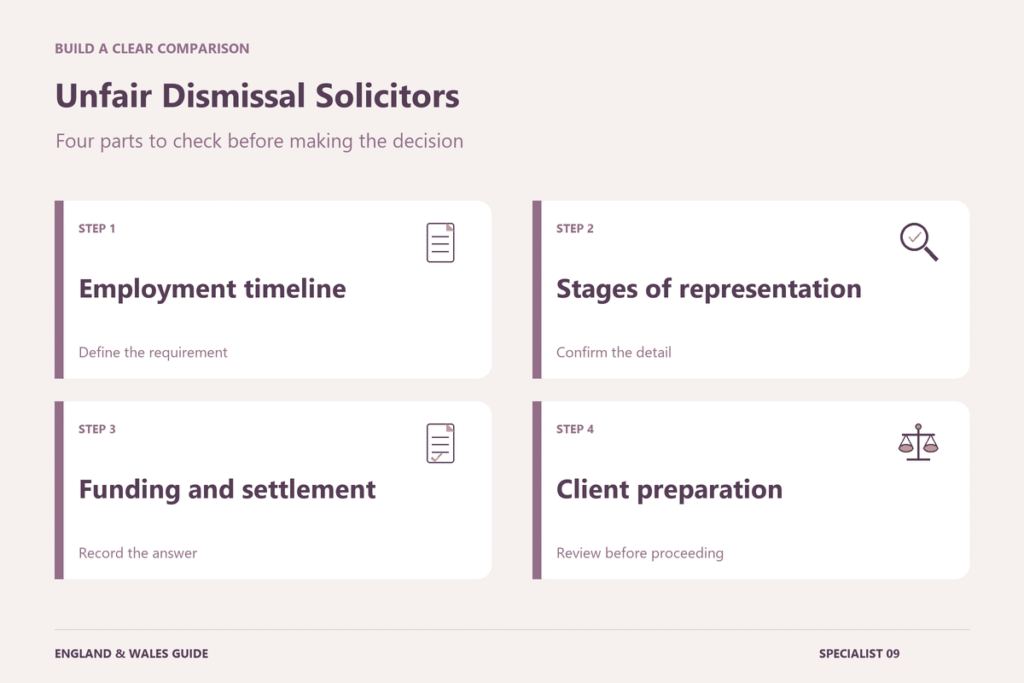
Check preparation and client involvement
Ask who will help identify relevant evidence, organise a chronology and prepare witness material. Tribunal work can involve significant input from the client, even with full representation. Discuss how documents will be shared and how the team will explain tasks and response dates. If health, disability or access issues affect participation, raise them early. The firm should explain the practical arrangements it can offer, without treating the client’s ability to manage paperwork as an unspoken assumption behind the price.
Compare providers on the merits assessment, scope, funding explanation and responsiveness to urgent issues. Verify professional regulation and obtain a clear engagement letter. Ask for realistic discussion of both strengths and weaknesses and how a settlement decision would be evaluated against further costs and uncertainty. Avoid using another employee’s award as a benchmark for your case. The appropriate representation is one that connects the employment facts to a proportionate strategy and keeps you informed about decisions that affect time, expense and possible outcomes.
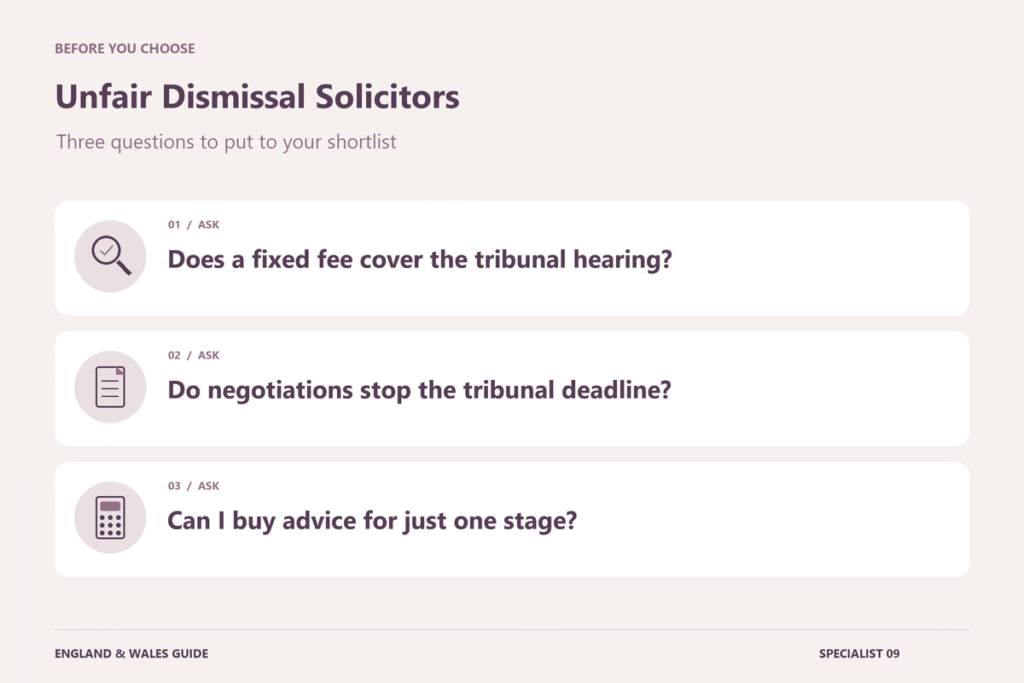
Does a fixed fee cover the tribunal hearing?
Only if the written scope says so. Ask about preparation, counsel, additional hearing days and postponements. A fixed fee for an initial review or conciliation stage should be compared with equivalent work, rather than with a full litigation package.
Do negotiations stop the tribunal deadline?
Do not assume that they do. Ask a qualified adviser to calculate the relevant dates and explain any effect of Acas early conciliation. Keep records of notification and certificates and confirm who is responsible for the next procedural step.
Can I buy advice for just one stage?
Some providers offer limited services. Ask exactly what advice or documents you receive, what remains your responsibility and whether later representation would require a new engagement. A staged approach works best when those boundaries are explicit.
Further reading
Related reading
- Commercial Lease Dispute Solicitors: Comparing Advice, Negotiation and Litigation Costs (England & Wales)
- False Claims Act Whistleblower Lawyers: Comparing Experience and Fee Agreements (USA)
- Probate Litigation Attorneys: Will Contest Fees and Representation Options (USA)
- High-Asset Divorce Attorneys: Comparing Business Valuation Costs and Retainers (USA)
Explore more in Business, Employment and Family Lawyers.