
A divorce involving a privately owned business needs a legal budget that accounts for financial investigation as well as negotiations. The difficult work may concern ownership, valuation, income or access to reliable records. Comparing attorneys only by hourly rate can conceal those differences. This US guide explains how to assess proposed representation when substantial assets or business interests are involved. State law and individual circumstances govern the legal analysis; the value of an asset does not itself determine how a court will treat it.
Map the ownership and financial issues
Prepare an outline of companies, partnerships, investment accounts, real estate, compensation arrangements and debts. Identify ownership dates, other shareholders and any agreements you already have. Distinguish personal records from confidential company material you are not authorised to obtain. Ask prospective attorneys how they would assess the information needed for disclosure and valuation. A firm should explain which questions are legal, which need accounting expertise and which cannot yet be answered from the documents available at an initial meeting.
Different business structures can create different practical problems. A minority interest, a professional practice and a company dependent on one spouse’s work may require distinct valuation questions. Ask about experience handling the relevant structure rather than simply requesting examples of expensive divorces. Find out how the attorney would address compensation, distributions, retained earnings and personal expenses paid by a company where those issues are material. The discussion should investigate facts, without assuming that every unusual transaction conceals misconduct.
Examine the valuation proposal
Request an explanation of the potential role of a business appraiser or forensic accountant. Ask who selects the expert, what information the assignment requires and how disagreements over assumptions might be handled. A preliminary review and a report suitable for contested proceedings may have very different scopes. Establish whether the proposed budget includes expert meetings, questions from the other side and attendance if required. An attractive initial quote is incomplete if it assumes that none of those later tasks will occur.
Ask how the team avoids unnecessary duplication between lawyers and financial specialists. Someone should coordinate document requests and maintain an organised list of missing information. If valuations could change during proceedings, discuss when updates might be justified and what they could cost. Also ask how settlement options would be evaluated without treating every disagreement as a reason to commission another report. Financial investigation should support informed decisions about a realistic dispute, not become an open-ended exercise with no agreed purpose.
Understand retainers and billing controls
A retainer payment may be an advance against future bills rather than a fixed total price. Request the engagement terms, billing rates by role and rules for replenishing funds. Ask about minimum billing increments, internal conferences, travel and administrative charges. For substantial anticipated work, request a phased budget covering initial advice, disclosure, negotiation and contested proceedings. The budget can acknowledge uncertainty while still identifying assumptions. Agree on the point at which the firm will contact you before a material increase.
Business appraisals, tax advice, specialist counsel and court-related expenses may be billed separately. Identify which organisation invoices each item and whether the legal firm adds any charge. Discuss how proposed settlements will be checked for tax and practical consequences by appropriate advisers. An attorney’s involvement does not mean every financial issue is automatically within the engagement. Ask who coordinates those outside services and how recommendations will be explained before you approve a transaction or sign an agreement affecting ownership.
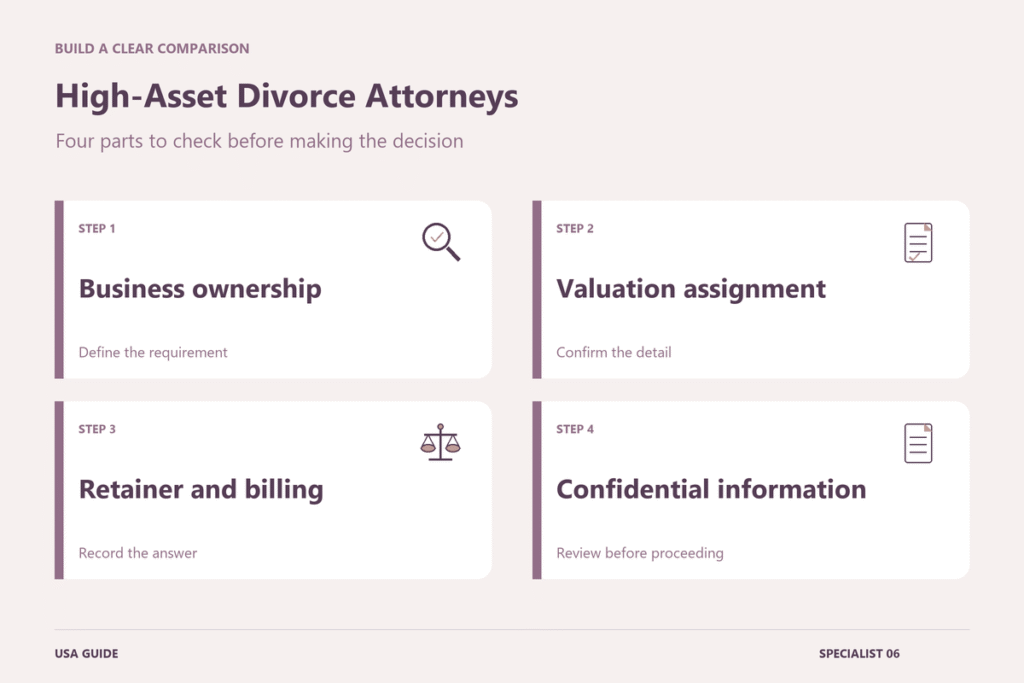
Assess discretion and case management
High-value financial disputes can expose sensitive personal and commercial information. Ask about secure document exchange, access permissions and steps considered for confidential business records. If the company has employees or other owners, discuss how the legal team plans to minimise avoidable disruption while meeting disclosure obligations. Do not accept suggestions to conceal, alter or destroy material. A sound representation plan addresses lawful information handling and proportionate investigation, even when relations between spouses have become difficult.
Compare attorneys using a short written matrix: relevant business experience, proposed valuation work, staffing, budget controls and communication. Verify licensing in the appropriate state. Ask who will manage negotiations and who would handle a hearing if one becomes necessary. The lawyer should explain the range of procedural possibilities without promising an asset division or settlement amount. A carefully scoped engagement makes it easier to judge later recommendations against the actual financial questions rather than against an initial sales pitch.
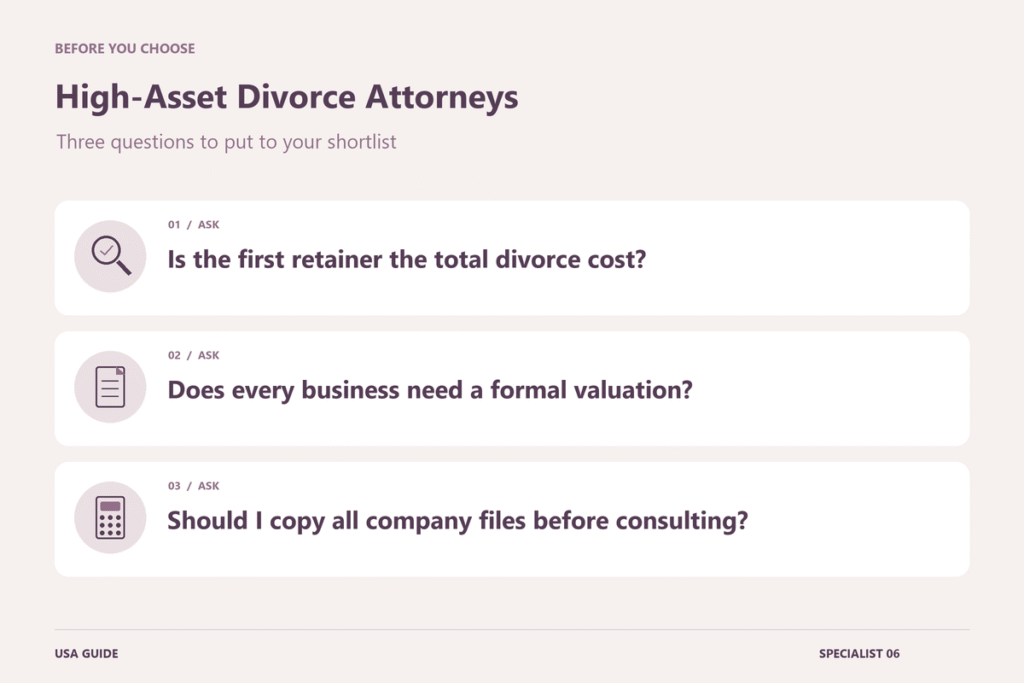
Is the first retainer the total divorce cost?
Not necessarily. Read whether it is an advance, a minimum charge or a fixed fee for specified work. Ask what triggers further payments and whether expert expenses sit inside or outside the quoted amount.
Does every business need a formal valuation?
That depends on the dispute, available information and applicable law. Ask counsel to explain the purpose, likely scope and alternatives before commissioning work. The most expensive report is not automatically the most proportionate next step.
Should I copy all company files before consulting?
Only provide information you can lawfully access and share. Tell the lawyer what records exist and who controls them. Obtain advice about proper disclosure and preservation rather than attempting to gather restricted material yourself.
Further reading
Related reading
- Probate Litigation Attorneys: Will Contest Fees and Representation Options (USA)
- False Claims Act Whistleblower Lawyers: Comparing Experience and Fee Agreements (USA)
- Unfair Dismissal Solicitors: Comparing Fixed Fees, Hourly Rates and Funding (England & Wales)
- Commercial Lease Dispute Solicitors: Comparing Advice, Negotiation and Litigation Costs (England & Wales)
Explore more in Business, Employment and Family Lawyers.