
A private hernia repair quote should describe the type of hernia, assessed procedure and included care. A price for one straightforward operation may not apply to a recurrent, complex or different hernia. This guide helps UK patients compare written proposals after medical assessment. It does not diagnose a hernia, determine urgency or recommend a repair method. If symptoms suggest an urgent problem, seek appropriate medical help rather than waiting for private quotes. The financial comparison belongs within a clinical plan that explains options, benefits, risks and reasonable alternatives.
Confirm the diagnosis and treatment decision
Ask the clinician to explain what has been found and which options are appropriate. Not every hernia or patient has the same decision to make. NHS decision support material for inguinal hernia is intended to be discussed with a healthcare professional, rather than used as a universal instruction. Ask why surgery is recommended now, what the alternatives involve and what further assessment is needed. A clearly understood diagnosis gives the cost proposal context and helps avoid comparing unrelated procedures as equivalent services.
Request the planned technique, anaesthetic arrangement and setting, with the clinician’s reasons. Open and keyhole approaches can involve different considerations, but a patient should not select one solely from a price list. Discuss previous operations, health conditions, medicines and any concerns about the proposed materials. If the recommendation changes after examination or investigation, ask for revised information and fees. An initial enquiry price may be provisional; the assessed plan and written agreement should govern the actual comparison.
Break the quote into clinical stages
Identify consultation, investigations, preoperative assessment, surgeon, anaesthetist and hospital charges. Ask whether all participating professionals are included and who sends each invoice. Clarify how planned materials and routine supplies are treated. Two providers can use the same procedure name while including different stages. A surgery-only total should not be compared with a complete assessed package without reconciling the omissions. Ask the billing team to explain the full expected course of care in a form you can retain and review.
Discuss the expected admission arrangements and the financial position if an overnight stay or other unplanned care is needed. Ask about changes in technique during surgery, additional procedures and transfer arrangements where relevant. The clinician should explain medical possibilities, while the provider clarifies package conditions. A fixed-price offer does not mean that complications cannot occur. It should instead make clear which care the commercial agreement includes, for what period and under what circumstances further charges may arise.
Examine recovery and review provisions
Ask what follow-up appointments are planned and who assesses concerns after discharge. Request the treating team’s individual advice on activity, work and recovery rather than following a generic timetable from another patient’s experience. Identify included reviews and any separately billed appointments or investigations. If you live at a distance, discuss how urgent or routine assessment will be arranged. The package should make access to postoperative care understandable, rather than assume every question can be resolved through an administrative telephone line.
Include transport, time away from work, help at home and travel for reviews in personal budgeting. Ask about practical requirements associated with the anaesthetic or discharge plan. These arrangements can affect whether care can proceed, even when the surgical fee is affordable. If instructions are difficult to follow because you live alone or have other responsibilities, raise that during assessment. The appropriate response is an individual discussion with the team, not an assumption that the cheapest short-stay package must fit your circumstances.
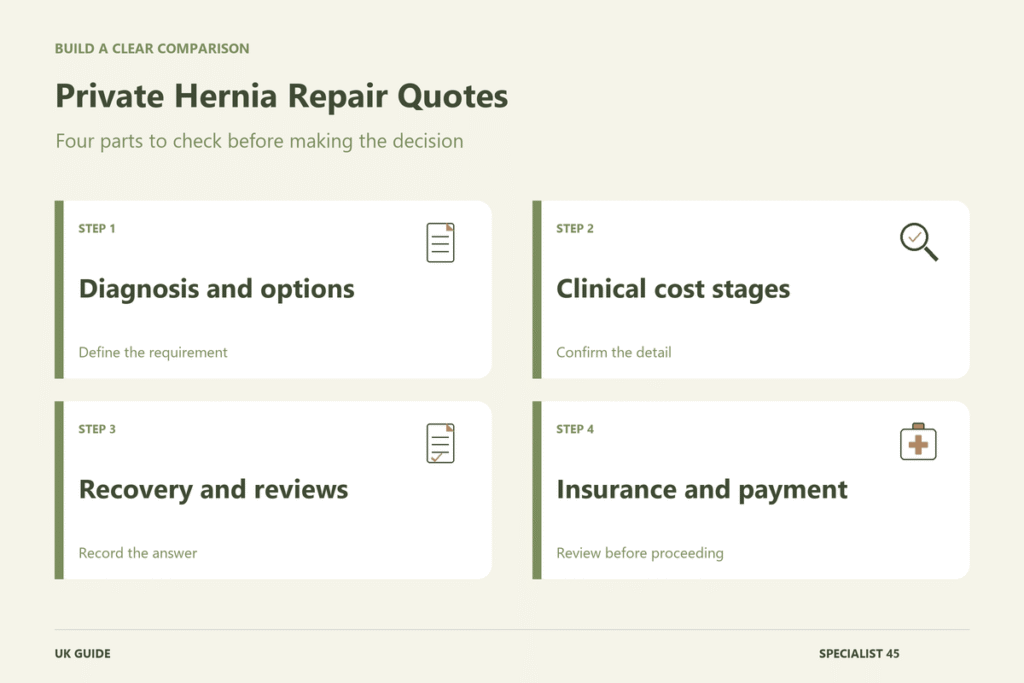
Verify insurance, regulation and payment
Where insured, confirm authorisation, recognised consultants, eligible hospital and expected personal contribution with your plan. Ask how exclusions, limits and additional care would be treated. A provider’s insurance partnerships do not establish cover under your specific policy. For self-pay care, read deposit, cancellation and refund terms, including what happens if the clinical assessment means the planned operation cannot proceed. If credit is offered, assess total repayment, interest and fees independently of the clinical decision and avoid committing while important questions remain unanswered.
Check relevant professional registration and the provider’s applicable regulator. In England, CQC reports can help you investigate the hospital; other UK nations use different systems. Compare assessed plans on explanation, inclusions, aftercare, exclusions and complete cost. Seek further clinical advice where recommendations are difficult to reconcile. A useful quote is transparent about both routine care and uncertainty. It helps the patient choose among appropriate options without presenting a promotional price, surgical technique or rapid appointment as evidence that one package is suitable for everyone.
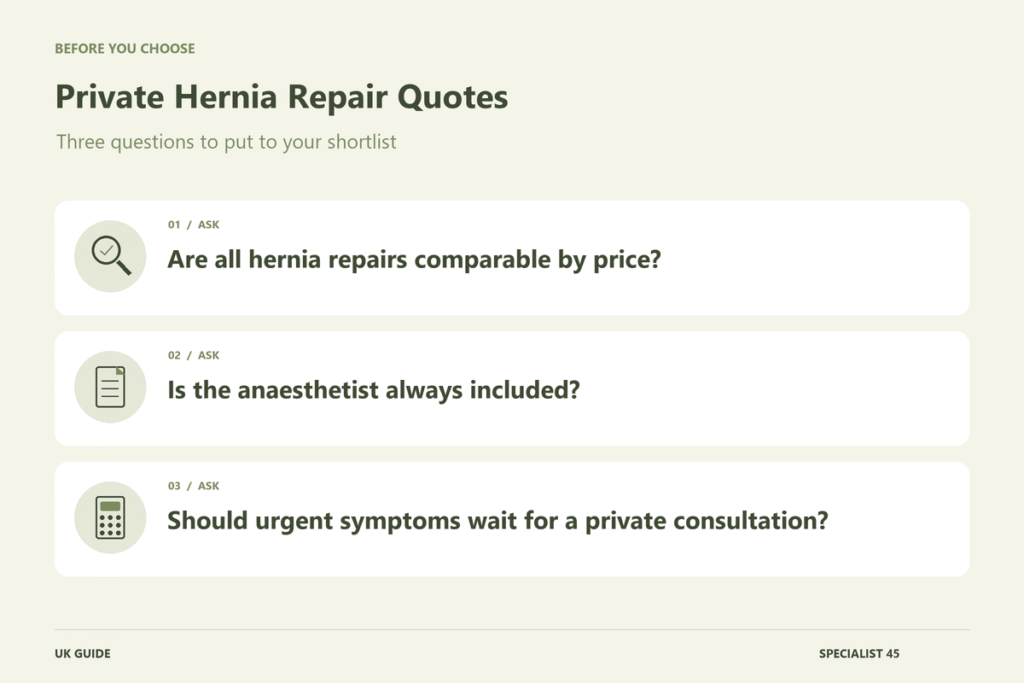
Are all hernia repairs comparable by price?
No. Hernia type, recurrence, complexity, technique and patient needs can differ. Compare assessed plans and ask why the proposed operation is appropriate before treating two advertised prices as equivalent offers for the same care.
Is the anaesthetist always included?
Check explicitly with the provider and obtain the relevant estimate or package confirmation. Professional and hospital charges can be separate. A procedure headline should not be assumed to settle every participating clinician’s fee.
Should urgent symptoms wait for a private consultation?
No. Seek appropriate medical assessment for an urgent concern. Comparing elective treatment packages should not delay necessary care. A general financial guide cannot determine whether a particular symptom or hernia requires prompt intervention.
Further reading
Related reading
- Private Hip Replacement Packages: Comparing Implant Options, Hospital Fees and Rehabilitation (UK)
- Robotic Prostate Surgery Costs: Comparing Hospital Quotes and Insurance Coverage (USA)
- Spinal Fusion Surgery Estimates: Comparing Surgeon, Hospital and Implant Charges (USA)
- Bariatric Surgery Packages: Comparing Hospital Fees, Follow-Up Care and Financing (USA)
Explore more in Private Hospitals and Surgery.