Private hip replacement packages can combine surgery, hospital accommodation and part of the recovery pathway, but their boundaries differ between providers. A starting price is therefore only the beginning of a useful comparison. This guide helps UK patients assess written proposals after a clinical consultation. It does not determine whether replacement is appropriate, choose an implant or recommend an operation. Discuss diagnosis, alternatives, benefits and material risks with qualified clinicians, and consider the financial arrangements only in the context of a treatment plan suited to your circumstances.
Establish the proposed operation and implant plan
Ask the surgeon to explain the condition, the reason for the proposed operation and reasonable alternatives. Identify whether the plan involves a primary replacement or another type of procedure, because those should not be treated as interchangeable quotes. Request an explanation of the implant and approach proposed, including the factors affecting suitability. An implant brand or a marketing description of technique is not a sufficient basis for choosing care. The clinician should connect the recommendation to your health, anatomy and treatment goals.

Ask which preoperative assessments and investigations are needed and who provides them. Explain existing conditions, medicines and previous surgery fully. If the assessment changes the planned setting, operation or stay, request updated clinical advice and a revised financial proposal. A package price obtained before consultation may rest on assumptions that do not fit your circumstances. The useful comparison is between assessed plans, with their limitations made clear, rather than between advertised totals for a broadly named procedure.
Identify professional and hospital inclusions
Request a written breakdown showing consultation, surgeon, anaesthetist, implant, theatre, accommodation and other planned services. Ask whether professionals invoice separately and whether VAT or other charges apply where relevant. Identify the expected hospital stay and financial treatment of a longer stay or unplanned care. A fixed-price label needs a defined scope and conditions. Have the provider explain what is included and excluded rather than assuming the phrase means every possible clinical event is covered indefinitely.
Read provisions about complications, readmission, further procedures and transfer to another facility. Ask who makes clinical arrangements and how associated costs are handled. These questions should support understanding without creating an expectation that a package prevents complications. Request the duration of any included aftercare and what conditions apply. If insurance is being used, obtain the insurer’s separate confirmation of authorisation, consultant recognition, facility eligibility and patient contribution. The hospital’s willingness to work with an insurer does not establish the terms of your own policy.
Compare rehabilitation and recovery support
Ask the clinical team what physiotherapy, mobility support and reviews it expects to recommend. Identify which sessions, equipment or home services are included and which are separately charged. The NHS explains that recovery from hip replacement can take time; your individual plan should come from the treating professionals. Do not select a package solely because it advertises a short stay. Appropriate discharge depends on clinical and practical circumstances, including whether necessary support is available after returning home.
Discuss the layout of home, transport, work and assistance with the team where relevant. Ask whom to contact with concerns and how appointments are coordinated if you live far away. Include travel, support and time away from usual activities in personal budgeting. A nearby service with accessible rehabilitation may have different practical value from a distant lower-priced package. The financial comparison should reflect the care pathway you can actually follow, while clinical instructions remain specific to your treatment and recovery needs.
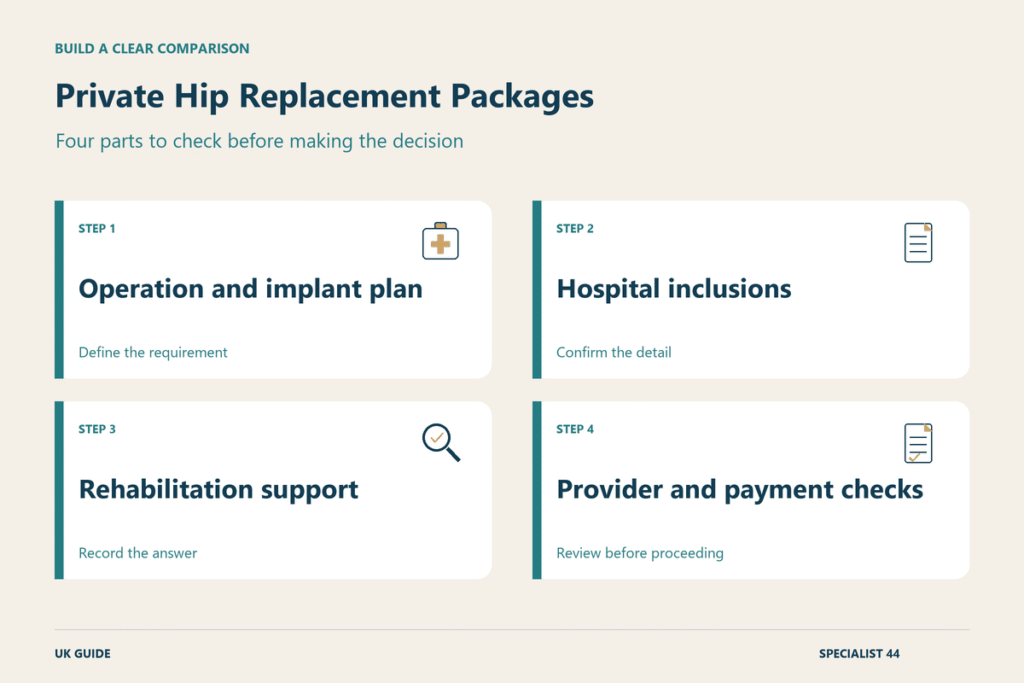
Check provider information and payment terms
Verify the surgeon’s professional registration and relevant credentials. For hospitals in England, CQC inspection information can support diligence; other UK nations have their own regulators. Read the report and service details rather than relying on a rating logo without context. Ask how the provider describes its experience and outcomes and what those figures do and do not show. Testimonials can illustrate individual experiences without proving the expected result or quality of every aspect of care for another patient.
Compare assessed proposals on clinical explanation, complete inclusions, aftercare, exclusions and personal cost. Read deposits, cancellation and refund arrangements, especially if assessment could change the plan. Review any credit agreement separately, including total repayment and fees. Allow time for questions rather than booking because a price is presented as temporarily available. A useful package provides a transparent route through appropriate surgery and rehabilitation, with clear responsibilities when care extends beyond the original plan. The cheapest headline total alone cannot establish that value.
Can I choose an implant by comparing package names?
Implant selection requires clinical advice. Ask the surgeon why the proposed option is appropriate and what alternatives are relevant. A premium-sounding brand or technique should not replace discussion of your circumstances, evidence and treatment goals.
Is physiotherapy always included?
Check the number, location and duration of sessions covered. Ask what the clinical team recommends beyond the included package and who pays. A general aftercare statement may not describe the rehabilitation pathway you will actually need.
Does a fixed price cover every complication?
Read the conditions and ask about unplanned care, transfers, readmission and time limits. A fixed package defines commercial inclusions; it is not a guarantee of an uncomplicated recovery or unlimited funding for every future treatment.
Further reading
Related reading
- Private Hernia Repair Quotes: Comparing Surgeon Fees, Anaesthesia and Aftercare (UK)
- Robotic Prostate Surgery Costs: Comparing Hospital Quotes and Insurance Coverage (USA)
- Spinal Fusion Surgery Estimates: Comparing Surgeon, Hospital and Implant Charges (USA)
- Bariatric Surgery Packages: Comparing Hospital Fees, Follow-Up Care and Financing (USA)
Explore more in Private Hospitals and Surgery.