
Robotic prostate surgery pricing should be considered within an individual treatment plan, including the reason for surgery and the care needed afterwards. The word robotic describes an approach; it does not establish suitability, clinical superiority or a guaranteed outcome. This guide helps US patients compare written proposals and insurance information. It does not recommend surgery or select a cancer treatment. Discuss diagnosis, staging where relevant, reasonable alternatives and material risks with qualified clinicians before comparing packages or committing to a provider on the basis of technology advertising.
Confirm the procedure and its purpose
Ask the urologist to identify the exact operation and the condition being treated. Surgery for different prostate conditions should not be compared as though it is the same service. If cancer is involved, request an explanation of the available options in the context of your findings, health and priorities. The National Cancer Institute describes several treatment approaches. A robotic platform should not replace that broader clinical discussion or be presented as a reason to skip consideration of suitable alternatives.

Discuss expected benefits, uncertainty and possible effects on function with the clinical team. Ask how experience, follow-up and patient-specific factors are considered when recommending an approach. A provider’s published outcomes or patient testimonial may raise useful questions without predicting your result. Allow time to understand the plan and obtain another opinion if needed. The financial comparison should follow an informed treatment discussion, rather than create pressure to choose a procedure because a particular surgical package is available soon or advertised at a discount.
Reconcile hospital and professional fees
Request estimates for the surgeon, facility, anaesthesia and any other anticipated participating services. Ask how pathology, imaging, tests and equipment-related charges are treated. A hospital quote may cover only its own services, while a professional estimate may exclude the hospital. Identify the organisation responsible for each charge and request written clarification. This prevents a technology-specific package from appearing comprehensive when it actually leaves important diagnostic or professional components to be billed separately.
Ask which postoperative period the quote includes and what assumptions it makes about the hospital stay and routine recovery. Clarify financial arrangements for unexpected care, additional procedures or a changed plan. For people not using insurance, ask providers about good faith estimates and their coverage of expected services. Retain the estimates and payment terms. The document can support a clearer understanding of anticipated charges, but it is not a clinical guarantee or evidence that every possible service has already been priced.
Verify insurance for the actual team
Contact the insurer about authorisation, network status and patient responsibility for the planned operation. Confirm both the hospital and relevant professionals rather than assuming one in-network participant establishes the position for everyone. Ask how the plan handles the proposed approach and any separate services identified by the provider. Keep the written responses and reference numbers. A hospital’s ability to submit a claim is not the same as confirmation that the insurer will cover every charge or that the patient will owe only a quoted estimate.
Where a provider offers a self-pay alternative, ask how choosing it affects insurance submission and the treatment of related care. Compare the full obligations, not simply an immediate cash discount. If finance is offered, identify the creditor and total repayment terms. The care contract, insurance relationship and credit arrangement are distinct commitments. Understand cancellation or refund provisions if the clinical plan changes before surgery, and avoid signing a financing document while important questions about the treatment or package remain unanswered.
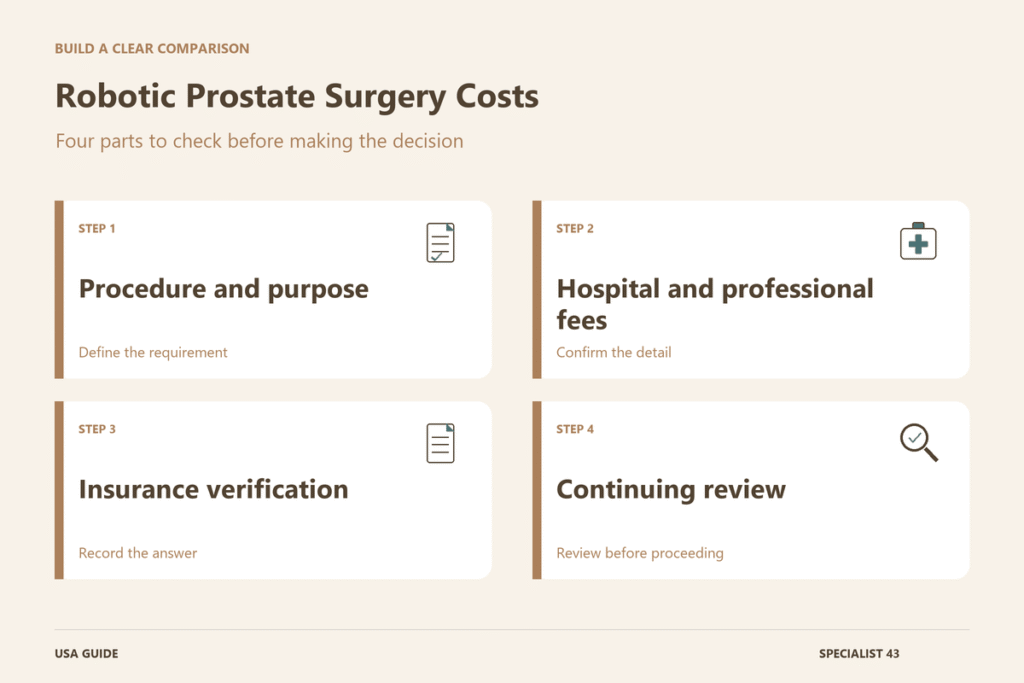
Include functional support and continuing review
Ask what follow-up is planned, who provides it and which services could be needed beyond the surgical episode. Discuss support for urinary or sexual function where relevant, alongside any cancer monitoring or additional treatment decisions. The appropriate plan requires clinical advice; the financial task is to identify included appointments and separate costs. Ask how concerns after discharge are assessed and who coordinates with local clinicians if you live far from the treating centre. Follow individual instructions rather than relying on another patient’s recovery schedule.
Compare suitable providers using the assessed operation, qualifications, care arrangements and complete personal cost. Check professional standing and ask for clear explanations of claims about experience or technology. Include travel, help at home and time away from work in practical planning. A strong proposal connects the surgical day to dependable continuing care. Its value should be judged by what is clinically appropriate and transparently provided, rather than by assuming a robotic label makes two operations equivalent or guarantees a better result for every patient.
Does robotic automatically mean a better outcome?
It should not be treated as a personal guarantee. Ask the clinician to explain why the approach is appropriate, the evidence relevant to your situation and reasonable alternatives. Technology is one part of a broader treatment and care decision.
Are pathology and follow-up included in the price?
Check each service and participating provider. Ask for the period covered by the package and the arrangements for continuing review. A surgery headline does not settle the cost of every test or appointment connected with the condition.
Can an insurance estimate be relied on as a final bill?
Treat it as an estimate subject to plan terms and the care actually provided. Confirm network and authorisation details and keep written records. Ask how changes in procedure or additional services could affect the patient’s financial responsibility.
Further reading
- National Cancer Institute: Prostate cancer treatment, patient guide
- CMS: Understanding medical bill rights without insurance
Related reading
- Spinal Fusion Surgery Estimates: Comparing Surgeon, Hospital and Implant Charges (USA)
- Bariatric Surgery Packages: Comparing Hospital Fees, Follow-Up Care and Financing (USA)
- Private Hip Replacement Packages: Comparing Implant Options, Hospital Fees and Rehabilitation (UK)
- Private Hernia Repair Quotes: Comparing Surgeon Fees, Anaesthesia and Aftercare (UK)
Explore more in Private Hospitals and Surgery.