An SBA 504 project should be compared as a financing structure, not as a single advertised interest rate. Businesses may need to coordinate a Certified Development Company, a senior lender and their own project contribution, with different documents and costs attached to each. This US guide explains how to organise competing proposals for an eligible fixed-asset project. It does not establish programme eligibility or quote current fees. SBA rules and fee schedules can change, so obtain the applicable requirements directly from the participating professionals.
Start with the project budget
Prepare a schedule of the property or equipment, acquisition costs, proposed improvements and other project expenses. Identify which amounts are supported by contracts and which remain estimates. Ask the CDC and lender to distinguish eligible project costs from items the business must fund separately. The SBA describes 504 financing as supporting qualifying major fixed assets, rather than general working capital or inventory. A useful proposal makes those boundaries visible before the borrower compares payments or assumes the entire budget can be financed.
Ask who is responsible for each financing component and when funds become available. A headline description of a combined structure may conceal different approval conditions, security requirements and timing. Identify the senior loan, the CDC-related component and any interim financing needed to complete the transaction. Request a clear explanation of what happens if the property purchase closes before all permanent financing is in place. The business needs to understand who carries timing risk and which additional costs could arise.
Compare charges across the whole structure
Obtain itemised proposals for lender charges, programme-related fees, legal work, valuation, environmental review and other third-party services relevant to the project. Ask which charges can be financed and which must be paid from available cash. A financed fee still increases what must ultimately be repaid. Avoid treating two proposals as equivalent because they show the same nominal loan amount; the cash released to the project and the borrower’s upfront contribution may differ once costs are accounted for.
Have the providers identify whether figures are firm, estimated or dependent on a later event. Ask about charges if the project is withdrawn, delayed or declined and whether deposits are refundable. Programme fee treatment may depend on the current schedule and borrower circumstances, so do not rely on a general online percentage. Request dated information applicable to the proposed transaction. Maintain a single cost worksheet that prevents the same expense being omitted, assumed included or accidentally counted under two separate components.
Examine repayment and early exit
Compare the term, amortisation, rate basis and repayment schedule of each component. Ask which rates are fixed, which can change and when a quoted rate is actually determined. A payment estimate is incomplete if it assumes future conditions without making that assumption clear. Request illustrations for the period before permanent funding and for the final structure. Include recurring charges and any balloon or refinancing exposure, where relevant, so management understands the commitments at each stage of the project’s life.
Discuss what happens if the business sells, refinances or repays early. Different parts of the structure can have different prepayment provisions. Ask for a written explanation, including how any charge is calculated and when it changes. Also identify guarantees, collateral and continuing reporting requirements. A proposed loan should be evaluated against the business’s likely use of the asset, not merely against its ability to make the first payment. Independent legal and accounting advice may help assess obligations outside the lender’s commercial explanation.

Test approval conditions and completion risk
Request a list of remaining conditions: financial information, property findings, ownership arrangements, construction documentation or other project-specific matters. Ask who tracks each condition and which party can approve changes. If works are involved, discuss budget overruns, contractor payment and evidence of completion. A lender’s interest in the project does not replace the borrower’s own diligence on the asset or contractor. Keep the financing timetable aligned with purchase deadlines and obtain advice before making commitments that depend on unconfirmed funding.
Compare the total structure on a common project budget and set of dates. Record the cash contribution, financed costs, upfront spending, repayment assumptions and unresolved conditions. Confirm that you are dealing with appropriate participating organisations through SBA resources. Before signing, reconcile final documents with the proposal and ask about every material change. A strong decision record explains how the project remains affordable if completion is delayed or costs increase, while recognising that approval and final terms remain subject to the actual programme and lender requirements.
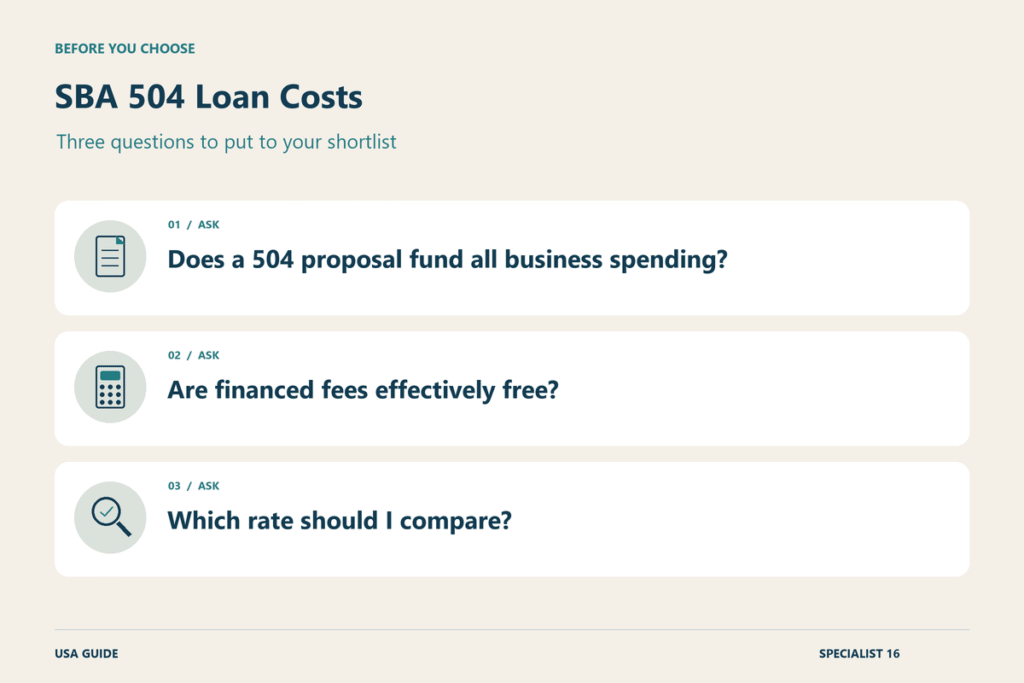
Does a 504 proposal fund all business spending?
No. Ask the CDC to assess eligible uses for the specific project and identify costs requiring separate funding. Fixed-asset project financing should not be assumed to cover general cash-flow needs simply because those needs arise around the same purchase.
Are financed fees effectively free?
No. Financing changes when the business supplies cash, but the amount may become part of the debt and its repayment cost. Compare both cash needed at completion and total obligations rather than focusing on one of those figures alone.
Which rate should I compare?
Assess every financing component, including any interim period, rate assumptions and recurring charges. Ask for a combined cash-flow illustration while retaining the separate terms, because one headline rate may not describe the whole structure.
Further reading
Related reading
- Equipment Financing vs Leasing: Comparing Deposits, Buyout Terms and Total Cost (USA)
- Invoice Factoring Companies: Comparing Discount Fees, Recourse and Contract Terms (USA)
- Property Development Finance: Comparing Drawdown Fees, Monitoring Costs and Exit Terms (UK)
- Auction Property Bridging Loans: Comparing Broker Fees, Valuations and Repayment Costs (UK)
Explore more in Commercial Finance.