Equipment financing and leasing can both help a business obtain machinery without paying the full purchase price immediately, but they do not necessarily leave it with the same rights or costs. Ownership, maintenance, end-of-term options and early termination can matter as much as the monthly payment. This guide helps US businesses compare actual offers for a defined asset. It does not determine the best tax or accounting treatment, and product labels should be checked against the contract rather than assumed to describe a standard arrangement.
Specify the asset and operating requirement
Give providers the same equipment specification, supplier quote, installation needs and expected start date. Include software, delivery, commissioning, training and essential accessories where applicable. Ask whether each item is eligible for the proposed financing or must be paid separately. A proposal based only on the machine’s list price may not reflect the cash needed to put it into production. Also identify expected useful life, operating intensity and how easily the equipment could be replaced if the business’s requirements change.
Establish the commercial objective. A business planning long-term ownership may evaluate an arrangement differently from one needing frequent upgrades or temporary capacity. Ask who owns the equipment during the term and what rights the business receives. Clarify restrictions on location, modification, subletting or sale. The Small Business Administration identifies buying and leasing as options businesses may need to consider, but the relevant contract determines what each proposal actually provides. Do not substitute an assumption about ordinary leases for the written terms.
Compare the complete payment schedule
Request the initial deposit or advance payment, all scheduled payments, administrative charges and any final amount. Identify whether payments are due before the asset is delivered or accepted. Ask how delayed installation or supplier failure is handled and whether the funding agreement remains payable while the equipment is unusable. Supplier promises and finance obligations may appear in separate contracts. Understanding that separation before signing can be more important than achieving a small reduction in the advertised monthly amount.
Use the same assumed term and asset cost when comparing proposals. Ask providers to explain any payment factor, interest rate or other pricing measure in terms of the actual cash schedule. A factor is not automatically equivalent to an annual percentage rate. Where the timing of payments differs, have an accountant help compare the effective cost on a consistent basis. Keep tax benefits separate from the commercial price unless a qualified adviser has assessed them for the business’s circumstances.
Examine ownership and end-of-term options
Ask what happens at the scheduled end: ownership transfer, a stated purchase option, renewal or return. If a purchase amount depends on future value, identify who determines that value and how disputes are handled. Check notice periods and whether continued payments can arise if the business fails to make an election on time. A low monthly lease payment may accompany a substantial final ownership cost. Compare the desired end position, rather than assuming every agreement eventually transfers title for a nominal amount.
If returning the asset is an option, request condition standards, inspection arrangements, transport obligations and deinstallation responsibilities. Consider data removal for equipment containing storage or customer information. Ask who pays for damage beyond acceptable wear and what evidence is used to assess it. Those details can change the economics of an otherwise attractive short-term arrangement. A return clause should be assessed against how the machine will actually be used, including modifications or integration into a production line.
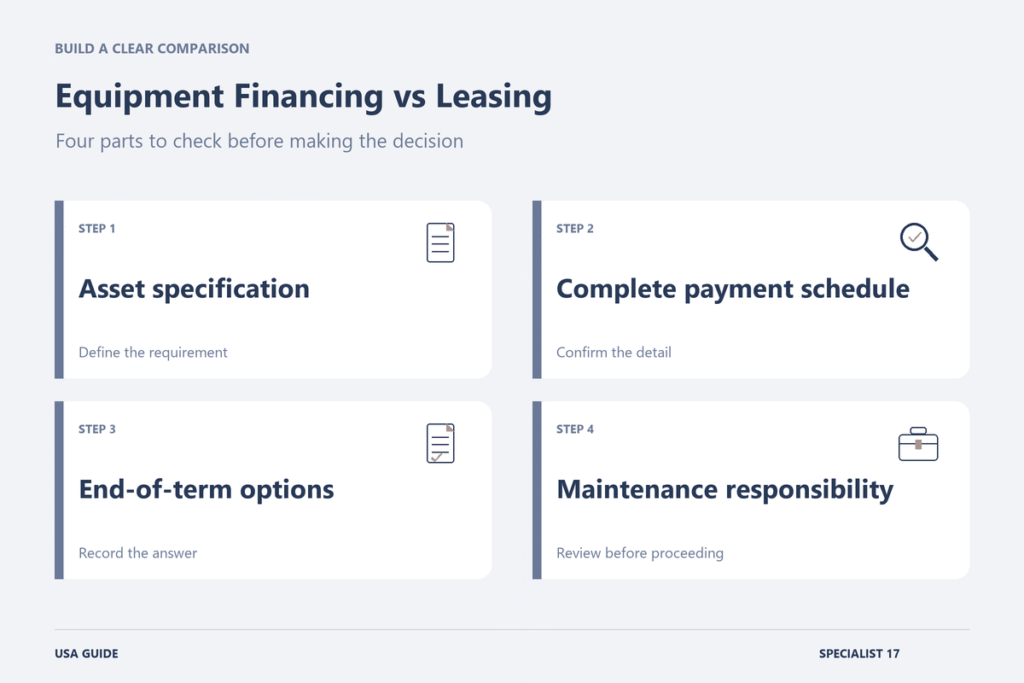
Allocate maintenance and interruption risk
Identify who maintains, repairs and insures the asset and whether support is included or separately purchased. Ask what happens during breakdown, loss or an insurance claim. Equipment finance is not automatically a maintenance service, and a warranty may not cover lost production. If the asset is essential, consider backup capacity and realistic repair access. The finance provider’s security interest or ownership does not necessarily mean it takes operational responsibility when the business cannot use the equipment.
Review early settlement, termination, default and any personal guarantee with appropriate advisers. Compare an early exit scenario as well as completion of the full term. Keep copies of supplier promises, acceptance records and finance terms, and check that final documents match the quote. A sound choice balances total cash cost, operational rights and the intended end position. The lowest initial payment is useful only when the business also understands the commitments required to keep, replace or return the asset.
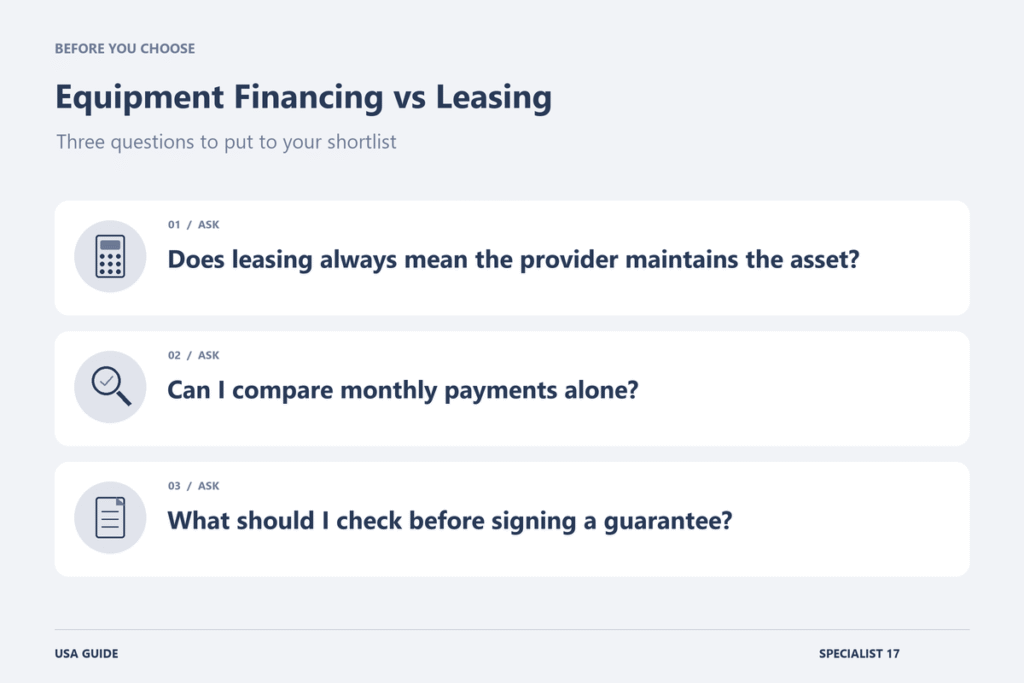
Does leasing always mean the provider maintains the asset?
No. Maintenance can be excluded or supplied under a separate agreement. Check the responsibilities for servicing, repairs, insurance and replacement equipment. The owner named in the contract is not automatically responsible for every operating cost.
Can I compare monthly payments alone?
That overlooks deposits, fees, timing and end-of-term obligations. Build the full payment schedule and compare the same asset and intended ownership outcome. Ask for assistance where different pricing measures make the effective cost difficult to understand.
What should I check before signing a guarantee?
Obtain independent advice about who is liable, the obligations covered and how release or enforcement operates. A company purchasing equipment does not mean every obligation remains limited to company assets if someone also provides a personal commitment.
Further reading
Related reading
- SBA 504 Loan Costs: Comparing Lender Fees, Closing Expenses and Financing Structures (USA)
- Invoice Factoring Companies: Comparing Discount Fees, Recourse and Contract Terms (USA)
- Property Development Finance: Comparing Drawdown Fees, Monitoring Costs and Exit Terms (UK)
- Auction Property Bridging Loans: Comparing Broker Fees, Valuations and Repayment Costs (UK)
Explore more in Commercial Finance.