Invoice factoring turns eligible receivables into earlier cash under an agreement with a factor, but the headline advance does not show the full commercial trade-off. Fees, reserves, recourse, customer communication and exit provisions can materially affect the value to a US business. This guide explains how to compare proposals using actual invoices and collection patterns. It does not recommend a provider or determine the legal or accounting classification of an arrangement. Read the contract and obtain professional advice where responsibilities are unclear.
Identify which receivables qualify
Prepare an aged receivables list, customer concentration information, typical payment terms and records of credits or disputes. Explain the business’s sales process and whether customers can offset payments, return goods or reject work. Ask the factor which invoices it will accept and what limits apply to individual debtors. A proposed facility size is not the same as cash available against every invoice. The useful comparison starts with the receivables the business actually has and the conditions attached to funding them.
Ask whether the agreement covers selected invoices, particular customers or a broader receivables book. Identify minimum volumes, exclusivity and restrictions on using another financier. Review existing liens or finance obligations with advisers before assuming invoices are available for sale or assignment. A factor’s approval of a customer does not resolve every issue in the supplier’s own contracts. Where notification or assignment provisions matter, obtain a proper review rather than relying on a sales representative’s summary of standard industry practice.
Reconcile the advance, reserve and fees
Request a worked illustration showing invoice value, initial cash advanced, reserve held, each fee and final settlement after customer payment. Use a clearly labelled hypothetical invoice or an anonymised actual example with permission. Ask when the fee starts, whether it increases with time and which minimum charges apply. Two providers advertising similar fees may use different calculation bases. The illustration should identify cash the business receives at each stage, rather than treating the invoice’s face value as immediately available funding.
Include due diligence, account setup, transfer, audit, administration and termination charges where present. Ask whether a monthly minimum creates a cost when sales are quiet. Model normal payment, late payment and a disputed invoice, using the same assumptions for each proposal. A fee described as a small percentage can have a meaningful effect on margin if it repeats over short collection cycles. Compare the cost against the amount and duration of cash actually obtained, with accounting assistance if needed.
Read what recourse really means
Ask which events require the business to repay an advance, repurchase a receivable or replace an invoice. Recourse and non-recourse labels do not answer every question about disputes, fraud, returns or customer insolvency. The agreement may protect against one credit event while leaving commercial disputes with the seller. Have the provider identify the relevant clauses and exclusions. Avoid assuming that selling an invoice transfers every possible risk connected with the underlying transaction or the customer’s refusal to pay.
Find out how reserves may be adjusted, how chargebacks are recorded and whether the factor can stop advances while obligations remain outstanding. Discuss personal guarantees, security and rights over collections with legal advisers. The business needs to understand the position if its largest customer becomes slow to pay, because that is precisely when cash may already be under pressure. A helpful proposal explains the adverse scenario and the factor’s powers, rather than describing only a smooth invoice-to-payment cycle.

Evaluate the customer-facing service
Ask who contacts customers, how payment instructions are verified and what tone is used in collection activity. Factoring can affect important commercial relationships, particularly where customers are accustomed to dealing with the supplier directly. Review the escalation process for disputed invoices and how the business accesses account information. Confirm how payments sent to the wrong account are handled. A provider’s collection support should be assessed as a service with practical responsibilities, not simply as an invisible mechanism for releasing cash.
Compare the agreement length, renewal, notice periods and release of reserves on exit. Ask how liens or assignments are discharged and what happens to unpaid invoices when the relationship ends. Keep a cash-flow forecast that does not assume every customer will remain eligible indefinitely. Choose based on transparent settlement calculations, contractual risks and service fit. Factoring can address a timing gap, but it cannot by itself repair unprofitable sales, persistent invoice disputes or a customer base unable to meet its obligations.
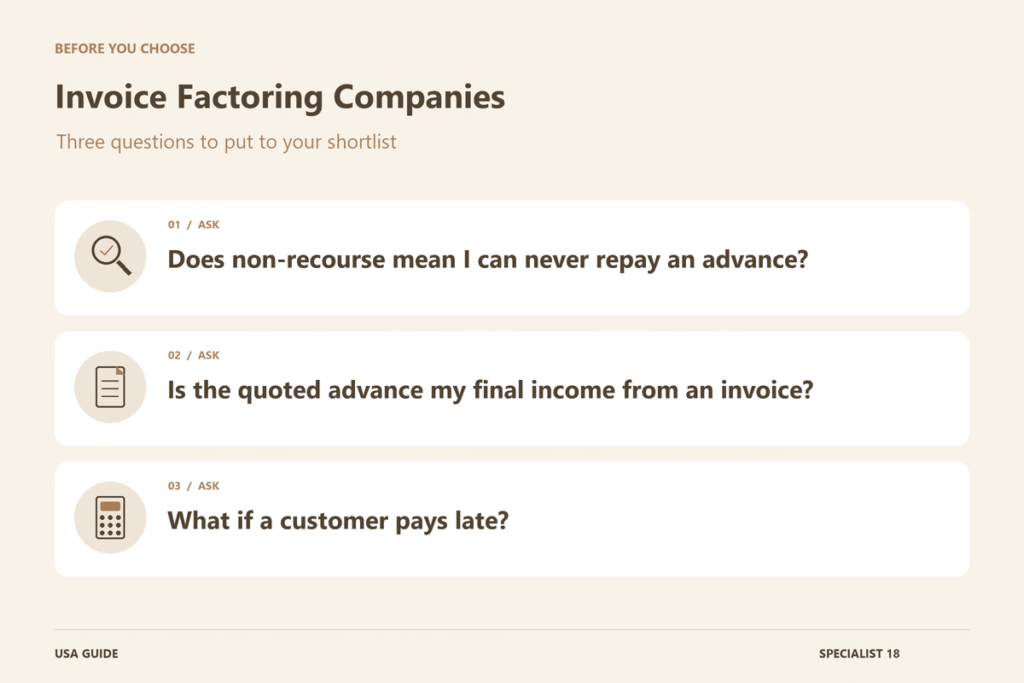
Does non-recourse mean I can never repay an advance?
Do not assume that. Ask which specific risks the factor accepts and which events still create repurchase or repayment obligations. Credit insolvency, invoice disputes and inaccurate representations may be treated differently under the actual agreement.
Is the quoted advance my final income from an invoice?
The advance is one stage of the settlement. Request a calculation showing the reserve, deductions and later payment. The business should reconcile the total it receives with the invoice amount and every charge applied by the factor.
What if a customer pays late?
Ask how fees, eligibility, reserves and recourse change as time passes. Run that scenario before signing, particularly for concentrated customer books. Funding that looks affordable at normal collection speed may behave differently when receipts slow down.
Further reading
Related reading
- Equipment Financing vs Leasing: Comparing Deposits, Buyout Terms and Total Cost (USA)
- SBA 504 Loan Costs: Comparing Lender Fees, Closing Expenses and Financing Structures (USA)
- Property Development Finance: Comparing Drawdown Fees, Monitoring Costs and Exit Terms (UK)
- Auction Property Bridging Loans: Comparing Broker Fees, Valuations and Repayment Costs (UK)
Explore more in Commercial Finance.