Property development finance should be assessed against the project’s cash requirements from acquisition through completion and exit. A quoted rate does not reveal whether funds will be available when a contractor needs payment or whether the borrower has enough cash to absorb delays. This guide helps UK developers compare proposed facilities. It does not recommend borrowing, confirm eligibility or determine regulatory treatment. The project, borrower, security and purpose need professional review, including independent legal advice on the actual facility documents.
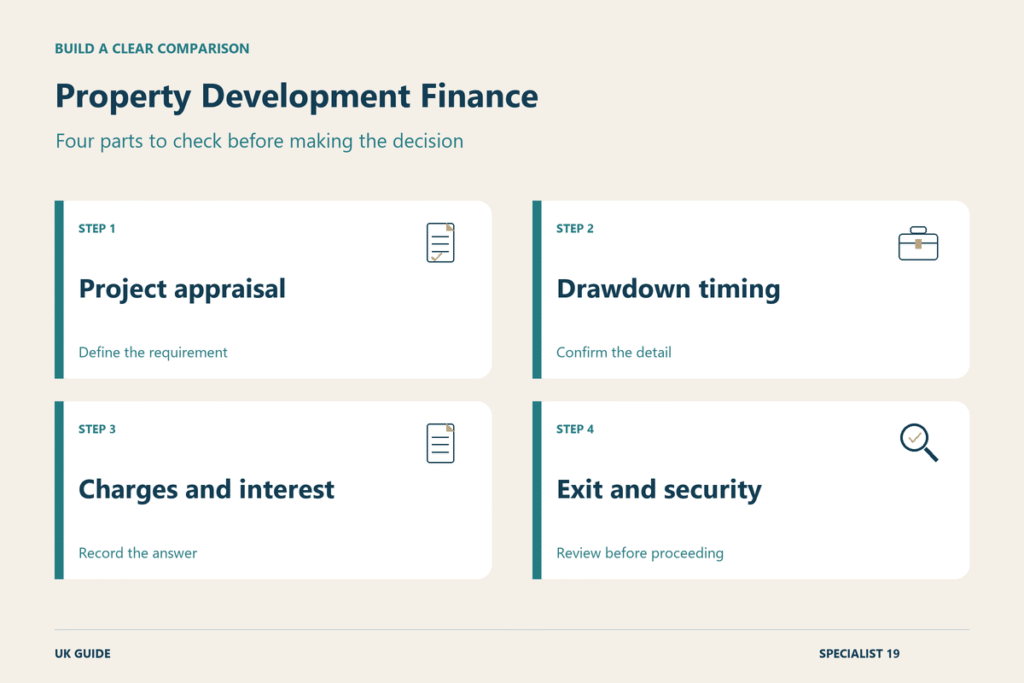
Present a consistent project appraisal
Prepare the acquisition budget, planning position, construction scope, professional appointments and realistic programme. Distinguish committed costs from estimates and identify the source of contingency funds. Explain the developer’s experience and the intended exit, such as sales or refinancing, without presenting an uncertain transaction as guaranteed. Give each lender the same information. Otherwise an apparently cheaper proposal may assume a different construction timetable, end value or borrower contribution, making the headline terms difficult to compare meaningfully.
Ask how the lender assesses project value and the borrower’s equity. Different measures can refer to different stages and amounts, so request definitions for any loan-to-cost or loan-to-value figure. Identify whether fees and retained interest sit inside the stated facility or require additional cash. The gross loan may not equal the amount available for acquisition and works. Have the lender show a schedule connecting the agreed facility to the actual funds the developer can use at each stage.
Examine drawdown mechanics
Find out which costs must be paid before the first advance and which can be funded later. Ask how progress is certified, who appoints the monitoring surveyor and how long drawdown processing is expected to take once information is complete. Identify fees for inspections or additional visits. A facility can be adequate in total yet create a working-capital gap if the developer must pay invoices before reimbursement. Build that timing into the cash forecast rather than assuming each approved cost is paid immediately.
Discuss changes to works, contractor problems, delays and cost overruns before they occur. Ask who approves variations and whether additional lending would require a fresh decision. A contingency in the project budget is not the same as a lender commitment to increase the facility. Identify the borrower’s obligation to inject more funds and any circumstances permitting advances to be suspended. Those provisions can become important when the project is under pressure, so they deserve the same attention as the initial interest quotation.
Compare all charges and retained interest
Request arrangement, exit, valuation, monitoring, legal, broker and administration costs where applicable. Ask how interest is calculated on drawn and undrawn amounts, whether it is serviced or retained and what happens if the term extends. A monthly rate should be translated into a dated cash-flow illustration using the same drawdown pattern for each proposal. An illustration based on immediate full borrowing may not represent a staged construction facility. Record the assumptions so later changes can be evaluated consistently.
Ask whether fees are based on the facility, the drawn balance or another value. Identify taxes and professional expenses separately and clarify refundable deposits. Review repayment and partial-release provisions if units will be sold individually. The way sale proceeds reduce debt can affect cash available to continue remaining works. Have advisers explain any release conditions before relying on expected receipts. A development appraisal should reconcile the sales plan with the lender’s actual repayment priorities, rather than assuming all proceeds return freely to the developer.
Stress-test the exit and security
Assess the consequences of slower sales, lower proceeds or delayed refinancing. Ask what extension options exist without assuming they will be approved, and identify potential charges or changed terms. Review guarantees, charges and cross-security independently. The lender’s valuation and underwriting protect its position; they are not an independent assurance that the project will make a profit. The borrower still needs its own review of demand, construction risk, professional advice and the ability to fund adverse scenarios.
Compare proposals using the same appraisal, dates and drawdown assumptions, with a separate list of conditions still outstanding. Verify the identities and relevant permissions of intermediaries where appropriate and ask how they are paid. Before completion, reconcile the legal documents with the offer. A well-chosen facility supports the project’s actual funding sequence and a credible exit, while leaving the developer clear about obligations if the optimistic timetable fails. The decision should remain workable beyond the first advance and initial headline rate.
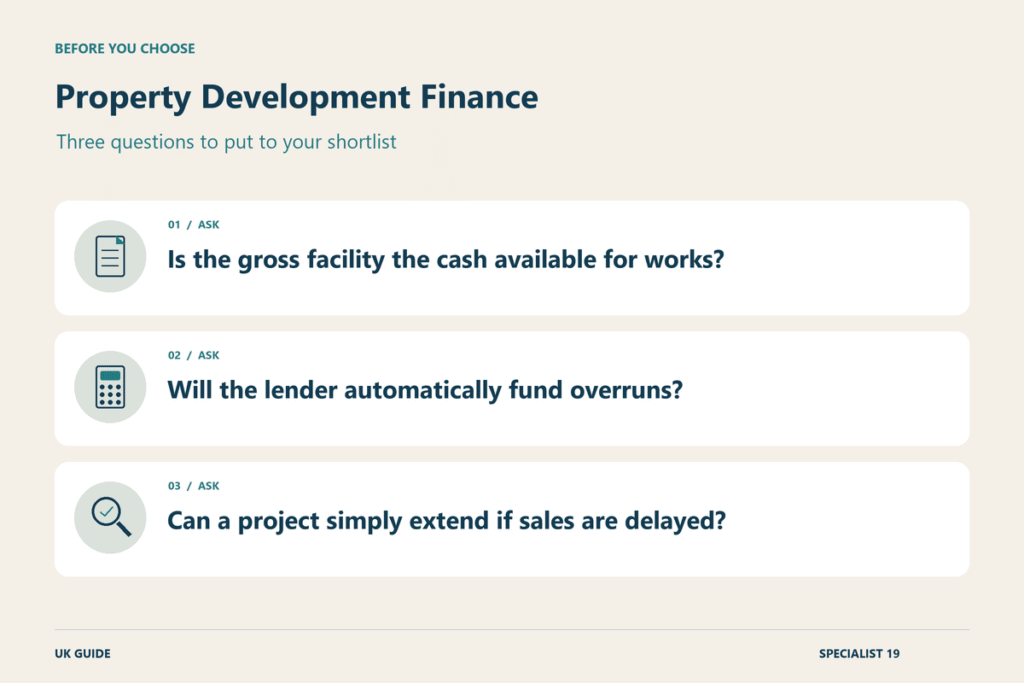
Is the gross facility the cash available for works?
Not necessarily. Fees, retained interest and acquisition spending may consume part of it. Request a breakdown showing net usable funds and the timing of each advance, together with costs the developer must pay from another source.
Will the lender automatically fund overruns?
Do not assume additional lending is committed. Read the facility conditions and ask about equity injections, contingency and approval of changes. The developer should have a plan for costs exceeding the original appraisal.
Can a project simply extend if sales are delayed?
An extension may require approval and different terms. Ask about options and costs before borrowing, then model a delayed exit. A planned refinance or sale should be treated as a risk to manage rather than a guaranteed event.
Further reading
- British Business Bank: Commercial finance brokers and specialist property finance
- British Business Bank: Choosing financial advisers
Related reading
- Auction Property Bridging Loans: Comparing Broker Fees, Valuations and Repayment Costs (UK)
- Invoice Factoring Companies: Comparing Discount Fees, Recourse and Contract Terms (USA)
- Equipment Financing vs Leasing: Comparing Deposits, Buyout Terms and Total Cost (USA)
- SBA 504 Loan Costs: Comparing Lender Fees, Closing Expenses and Financing Structures (USA)
Explore more in Commercial Finance.