A warehouse insurance proposal should reflect how the premises are used, who owns the assets and what would interrupt trading. A building limit alone does not describe protection for stock, handling equipment, customer goods or lost income. UK businesses comparing quotes should start with those operational distinctions. This guide provides a purchasing framework for discussion with an insurance adviser. It does not value a building, determine a sum insured or establish that a particular loss is covered under any policy.
Map responsibility for the premises and goods
Identify the owner, tenant, operator and any third-party logistics relationships. Bring the lease and relevant customer contracts to the insurance discussion. Ask who is responsible for insuring the structure, tenant improvements, equipment and goods in storage. Items that belong to customers may require different consideration from stock the company owns. The objective is to identify responsibilities explicitly, rather than assume that the landlord’s policy or a general business package covers every asset present in the warehouse.
Describe the goods, storage methods, maximum values and seasonal fluctuations. Include hazardous or temperature-sensitive products, high-value items and goods awaiting dispatch if relevant. Explain racking, handling operations, battery charging and any activities beyond storage. Give the same facts to each quoting provider. A proposal based on average stock may need different arrangements for peak periods, and a broad warehouse description may not reveal an activity that changes the insurer’s assessment. Ask how variations must be notified during the period of cover.
Compare valuation and settlement assumptions
Discuss rebuilding assessment with an appropriate professional where needed, rather than substituting market sale value. Ask how the policy treats debris removal, professional fees and other costs associated with reinstatement. For contents and stock, clarify valuation bases, limits and any underinsurance provisions. Two quotes can use different assumptions while appearing to offer the same protection. Record who supplied each value and when it was reviewed, so an unexplained number is not copied into future renewals indefinitely.
Ask about flood, theft, escape of water, fire and other relevant causes, along with exclusions and excesses. The practical significance of a condition depends on the operation: security, alarm response, occupancy and maintenance arrangements may be important. Have the broker explain which requirements are conditions of the proposed cover and whether the business can meet them consistently. An agreement made to obtain a quote should be checked against actual working practices, including weekends, contractor access and periods when part of the site is unused.
Build a realistic interruption comparison
The Association of British Insurers describes business interruption insurance as addressing lost income during periods when business cannot operate normally following an insured event. The actual trigger and calculation still depend on the policy. Ask how the proposed wording connects interruption to property damage or other specified events. Identify waiting periods, indemnity periods and any relevant extensions. Do not assume that every operational shutdown, supplier problem or closure is insured simply because the schedule includes a business interruption heading.
Consider how long relocation, rebuilding, replacement equipment and restored customer activity could take. Ask whether additional costs of working and dependencies on other premises or suppliers are addressed. Have an adviser explain the financial definitions used in the policy; accounting terminology and insurance calculations may not align automatically. Build scenarios using the company’s own operation rather than selecting an interruption limit because it matches last year’s turnover. The aim is to test how the proposed arrangement would respond to a plausible disruption.

Examine claims administration and service
Ask how urgent losses are reported, who appoints adjusters and what consent is needed before substantial expenditure. Establish a process for retaining inventory records, photographs, maintenance information and relevant contracts. This should support routine business management as well as a possible claim. If several insurers or policies could be involved, ask who coordinates notification. A warehouse operator benefits from knowing how to manage damaged customer goods and business continuity without making assumptions about another party’s insurance arrangements.
Compare quotations with the same declared operation, values, excesses and interruption assumptions. Include taxes, broker charges and important conditions in the comparison. Before accepting, check the final schedule, endorsements and answers on the proposal form. Retain a list of gaps the business has decided to manage itself. The best purchasing record explains why the chosen cover fits the warehouse, who will maintain its requirements and when changes in stock, occupancy or activities will trigger a review.
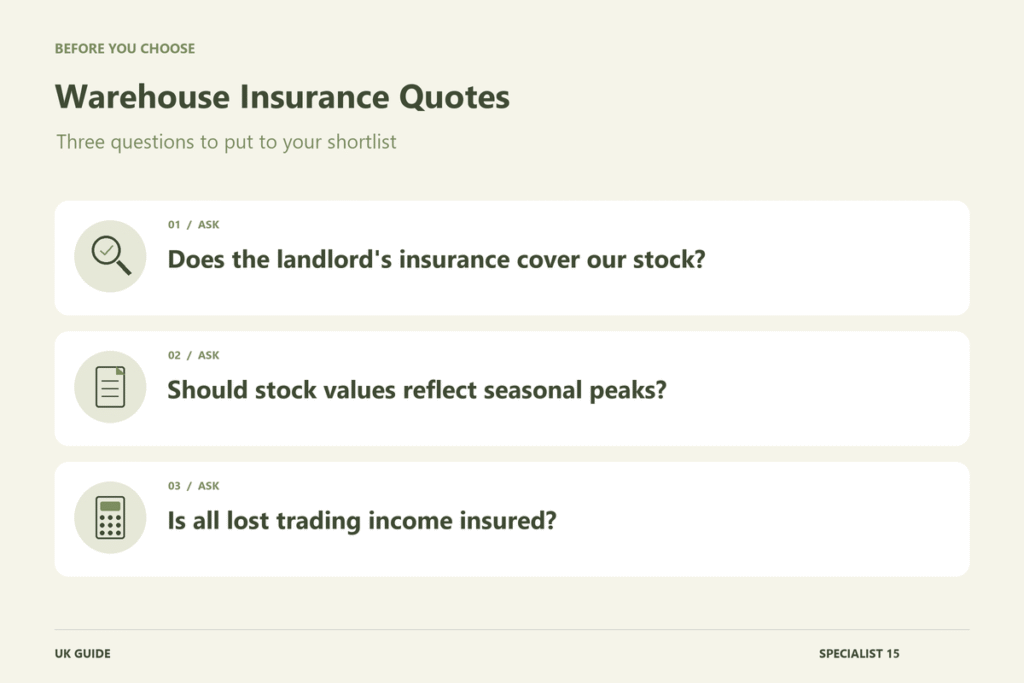
Does the landlord’s insurance cover our stock?
Do not assume it does. Check the lease and policy responsibilities with advisers. Buildings, tenant contents, owned stock and goods held for customers can involve different interests and arrangements, even when everything occupies the same premises.
Should stock values reflect seasonal peaks?
Explain peak values and fluctuations to the adviser and ask how the proposed cover handles them. The right approach depends on the policy and operation. An average inventory figure may not describe the amount exposed at a busy time.
Is all lost trading income insured?
No broad assumption is appropriate. Ask about the insured trigger, financial definition, limits and duration. A warehouse can suffer disruption from events outside its purchased cover, so continuity planning should address those possibilities too.
Further reading
Related reading
- Key Person Insurance for Limited Companies: Comparing Premiums and Policy Structures (UK)
- Product Liability Insurance for Manufacturers: Comparing Recall Exclusions and Coverage (USA)
- Directors and Officers Insurance: Comparing Defence Costs and Policy Limits (USA)
- Cyber Liability Insurance Quotes: Comparing Ransomware Cover, Exclusions and Deductibles (USA)
Explore more in Specialist Business Insurance.