Construction estimating software should be evaluated against how the team measures work, builds rates and manages revisions. A cheap licence can become expensive if quantities must be re-entered or a tender cannot be audited. This guide helps UK contractors and estimating teams compare proposals. It does not rank products or certify that software follows a particular measurement standard. Demonstrate the intended workflow with representative project information and obtain current licensing terms before deciding whether the proposed system improves the team’s actual estimating process.
Define the estimating workflow and project types
List the trades, project sizes and tender formats the team handles. Identify whether work begins with PDFs, drawings, models, bills of quantities or a combination. Ask vendors to demonstrate a representative estimate from source material through pricing and final output. A polished takeoff screen does not establish that the software supports labour build-ups, subcontractor quotations or the way your business submits a tender. The comparison should follow an actual estimator’s tasks rather than a generic feature checklist.
Ask how scale, drawing revisions and linked quantities are managed. Test an amendment to a source drawing and identify what changes automatically and what requires review. If model-based quantities are offered, assess the source model’s suitability and the assumptions behind extraction. Automation can reproduce an incorrect scale or unsuitable model classification very quickly. The estimator still needs a traceable method of checking quantities and explaining what is included or excluded from the price presented to a client.
Evaluate rate libraries and measurement rules
Identify the measurement conventions and cost structure the business uses. RICS’s New Rules of Measurement provides established measurement and cost-management guidance, but selecting software does not itself demonstrate compliance with a standard. Ask how the team would represent descriptions, units, waste, labour, plant, materials and overheads in the proposed system. Test items that do not fit a simple default. A useful product allows competent users to apply and document their method rather than hiding assumptions inside an unexplained total.
Ask who supplies and maintains any rate library. Identify whether prices are included, subscribed to separately or entered by your staff. Check location, date, specification and procurement assumptions before relying on supplied rates. A national database can be useful reference information without being a current quote for a particular project. Record how supplier and subcontractor prices are updated and approved. The business should know which rates are verified, which are allowances and which require further enquiry before tender submission.
Compare licences, collaboration and training
Request the billing model for full users, viewers, administrators and shared resources. Ask about named or concurrent licences, minimum commitments and access for temporary estimators. Include cloud storage, integrations and specialist modules where relevant. A plan that appears affordable for one estimator can have different economics once the commercial manager and other project staff need access. Test permissions and simultaneous work rather than assuming collaboration is included simply because files are stored online.
Request an implementation plan covering templates, data conversion, training and pilot tenders. Ask how much internal preparation is needed and whether existing spreadsheets or assemblies can be migrated meaningfully. Importing a file is not the same as recreating its calculation logic correctly. Have the team validate sample outputs against known work and document discrepancies. Include training time and temporary productivity loss in the cost comparison, particularly where a small estimating team must continue submitting live tenders during the change.
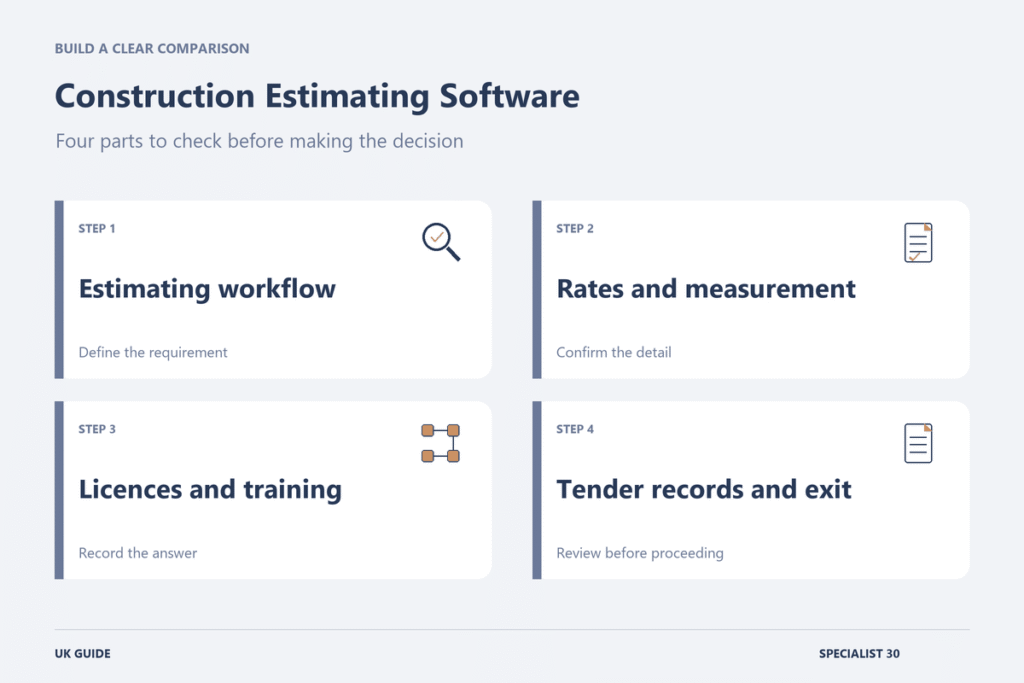
Check integrations, records and tender risk
Demonstrate export to the systems used for procurement, project management or accounts. Ask which data travels with the estimate and how errors are reported. A generic spreadsheet export may not preserve assumptions, formulas or classifications needed downstream. Identify responsibility for any custom integration and its maintenance. Also check how versions, approvals and audit records are retained, so the business can explain the basis of a submitted price after drawings, rates or personnel have changed.
Compare proposals over the same user count and planning period, including setup, data work, licences, support and renewal. Ask how estimates and libraries can be exported on exit and whether access remains available for archived projects. Choose the product that supports a transparent and checkable workflow for your actual projects. Software can improve consistency and reduce manual work, but responsibility for scope, measurement and commercial judgment remains with the team preparing and approving the tender, rather than with an attractive interface or automated total.
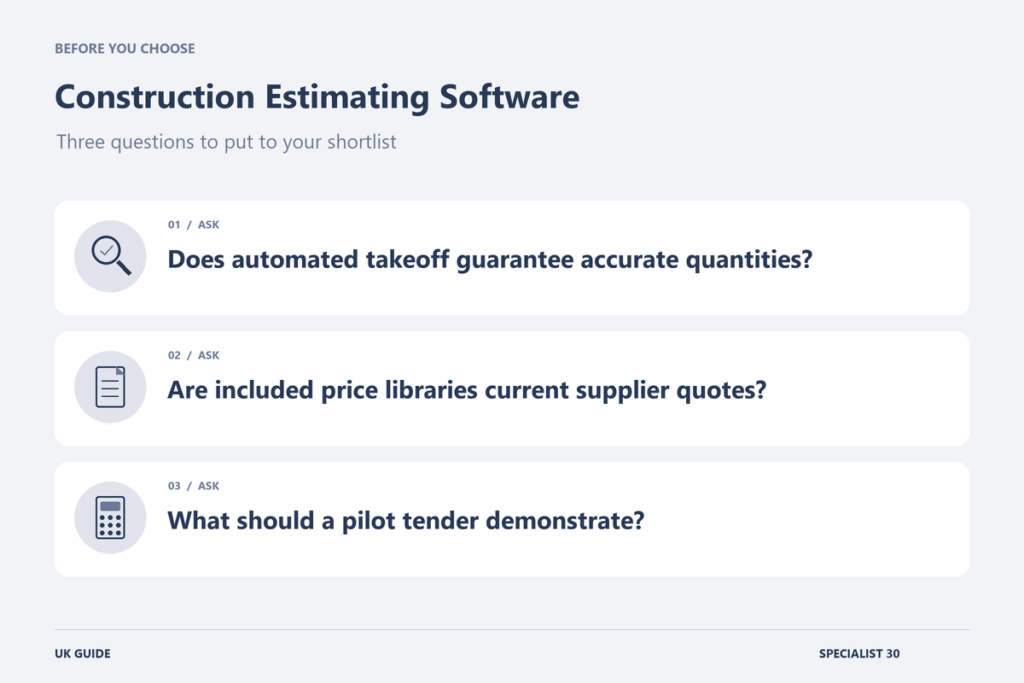
Does automated takeoff guarantee accurate quantities?
No. Scale, source quality, classification and scope still need checking. Test representative drawings and revisions, record assumptions and confirm how the estimator can inspect and correct results before quantities feed into pricing.
Are included price libraries current supplier quotes?
Do not assume they are. Check the source, date, location and specification. Use appropriate verification for important tender inputs and distinguish reference rates from committed quotations for the actual project and delivery period.
What should a pilot tender demonstrate?
It should cover measurement, rate build-up, revisions, review and final output, including difficult items. Compare results with a known process and investigate differences. A successful import or visually impressive takeoff is only one part of that assessment.
Further reading
Related reading
- Employer of Record Services: Comparing Employment Costs, Deposits and Exit Fees (UK)
- E-Discovery Software Pricing: Comparing Data Processing, Hosting and Review Charges (USA)
- Manufacturing ERP Software: Comparing Implementation, Migration and Licence Costs (USA)
- Contact Centre Software Pricing: Comparing Dialler, Recording and Usage Charges (USA)
Explore more in Business Software and Outsourcing.