A SaaS penetration test should investigate defined security questions about the application and its environment. Comparing provider quotes by testing days alone can miss differences in coverage, authorisation and follow-up. This guide helps US software businesses scope a purchasing decision. It does not describe how to attack systems or certify that an application is secure. Testing must be explicitly authorised, with appropriate access and safeguards. The objective is a useful assessment that the engineering team can act on, rather than a report purchased only to satisfy a sales checklist.
Describe the application and trust boundaries
Give providers an architecture summary, application roles, authentication flows and relevant APIs. Identify tenant separation, administrative functions, payment or data integrations and important recent changes. Explain which environments can be tested and which contain sensitive information. A single web address may represent a much larger attack surface than a quote assumes. Ask the tester to describe included components, user roles and assumptions so the proposed work can be compared with another firm’s scope rather than merely its day rate.
Decide what question the assessment needs to answer. A pre-release check, annual customer assurance exercise and targeted review after a major architectural change may justify different work. Ask how authenticated testing, business logic and API coverage will be addressed where relevant. Automated scanning and a manual penetration assessment are not necessarily equivalent services. The provider should explain how its approach fits the application rather than simply listing tools or promising a certificate with no meaningful account of what will be examined.
Agree authorisation and operating constraints
Identify who has authority over every system in scope, including cloud and third-party services. Obtain necessary permissions and confirm provider rules before testing begins. Document permitted activities, times, contacts, exclusions and emergency stop arrangements. The commercial agreement should define handling of discovered sensitive information and the response to an unexpected operational impact. A responsible engagement balances useful investigation with safeguards; the ability to perform a technique is not authority to apply it to every connected service.
Ask how production and staging differences affect the findings. A test environment can reduce operational risk while failing to reproduce important configuration or integration conditions. Discuss those limitations explicitly and decide how to address them. Provide appropriate test accounts and representative workflows without exposing unnecessary personal information. The NCSC’s guidance describes scoping, testing, reporting and follow-up as parts of an engagement. Use that structure to make responsibilities clear, while tailoring the actual assessment to the SaaS service and its authorised boundaries.
Compare reporting and remediation support
Request an anonymised sample report and assess whether findings explain impact, evidence, affected components and actionable remediation. Ask how severity is assigned and how uncertain conclusions are handled. A technical report should help engineers investigate and fix issues, while an executive summary should accurately describe scope and limits. A large vulnerability count is not a reliable measure of assessment quality. The value lies in identifying substantiated weaknesses relevant to the service and communicating them in a form the business can use.
Define the reporting timetable and process for urgent findings. Ask whether the quoted price includes a walkthrough with engineers, clarification questions and retesting after fixes. Identify deadlines or limits on that retest and whether it covers only original findings. A correction in one area may justify further assessment, but it should not be assumed that a short retest is a complete repeat of the engagement. Agree what evidence will be supplied to confirm resolution and how remaining uncertainty is documented.
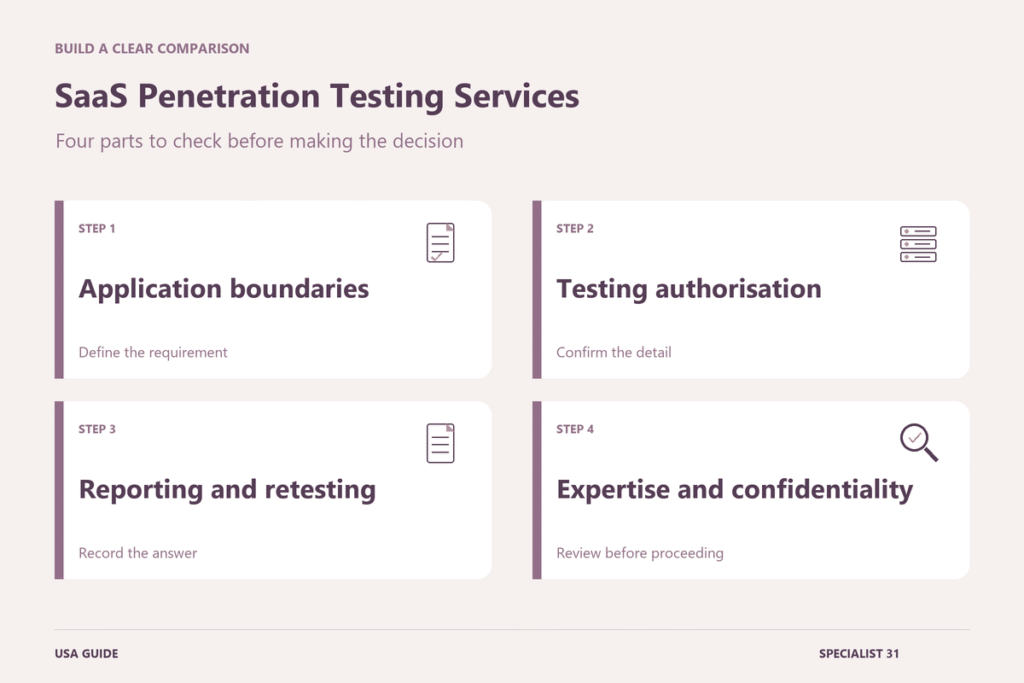
Evaluate expertise, confidentiality and cost
Ask about experience with your technology and multi-tenant application model. Qualifications and company accreditations can inform diligence, but they do not replace discussion of the assigned testers and their work. Check subcontracting, information storage, retention and secure transfer arrangements. Identify travel, specialist review and additional reporting charges where applicable. The engineering effort needed to prepare accounts, support testing and remediate findings should also be budgeted, because buying an assessment does not automatically supply capacity to address everything discovered.
Compare proposals using the same scope, environment, timing and deliverables. Record exclusions and differences in retesting rather than treating all penetration tests as one product. Obtain clear acceptance criteria and identify the owner of remediation decisions. A completed test provides evidence about the defined work at a particular time; it is not a guarantee against future compromise. The most useful provider leaves the SaaS business with understandable findings, practical follow-up and a clear account of what was outside the assessment.
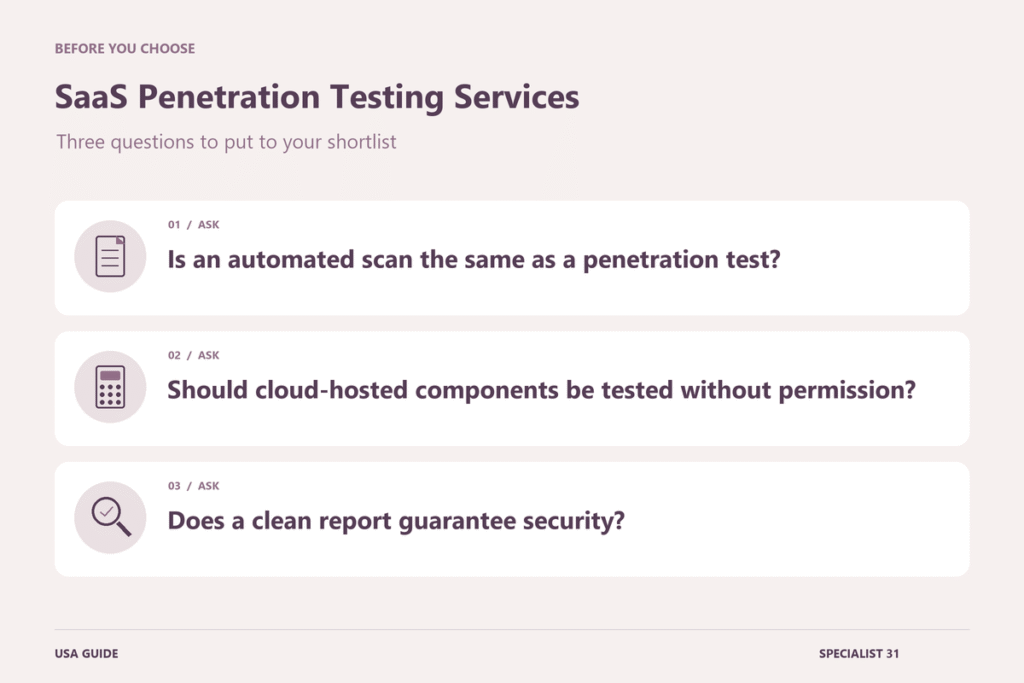
Is an automated scan the same as a penetration test?
Not necessarily. Ask what manual investigation, authenticated coverage and business-logic review are included. Compare the proposed activities and deliverables rather than assuming two providers use the same meaning for a familiar security-service label.
Should cloud-hosted components be tested without permission?
No. Confirm authority and applicable service-provider rules for all systems involved. Record the boundaries and permitted work in the engagement. Ownership of an application does not automatically authorise testing every third-party platform or connected environment.
Does a clean report guarantee security?
No assessment can provide that assurance. Read the scope, timing and limitations and maintain ongoing security practices. A report can support decisions and remediation without establishing that every possible weakness has been examined or will remain absent.
Further reading
Related reading
- SOC-as-a-Service Pricing: Comparing Monitoring, Incident Handling and Contract Limits (USA)
- SASE Providers: Comparing Network Security, Deployment and Per-User Costs (USA)
- Cloud Migration Consultants: Comparing Discovery, Migration and Ongoing Support Fees (UK)
- ISO 27001 Consultancy Costs: Comparing Gap Assessments, Implementation and Audit Preparation (UK)
Explore more in Enterprise IT and Security Services.