SOC-as-a-service proposals often promise continuous monitoring, but the practical difference between providers lies in what they observe and what they do when something looks wrong. A business should compare responsibility for investigation and action alongside price. This guide helps US organisations evaluate outsourced security operations. It does not endorse a provider or promise that monitoring prevents every incident. A useful agreement defines assets, data, response authority and collaboration with internal staff, making the service understandable before an urgent alert reaches someone outside normal working hours.
Define the monitored environment
Inventory endpoints, servers, identity systems, cloud accounts and critical applications. Identify which logs or security tools the provider needs and who pays for them. Ask which platforms are supported directly and which require additional integration. A per-endpoint quote may not include monitoring of the cloud or identity systems where important activity occurs. Compare coverage against the actual estate rather than counting licensed agents alone. Record any assets deliberately excluded and the business’s plan for monitoring or otherwise managing them.
Ask how data collection is validated after onboarding. Installing a connector does not establish that expected events are arriving, correctly timed and usable. Request procedures for detecting collection failures and changes in the environment. If a log source stops working, identify who is alerted and who restores it. Continuous monitoring should include attention to the health of the monitoring itself. Otherwise a service dashboard may appear normal while an important system is no longer providing the information needed for investigation.
Distinguish alert handling from incident response
Have the provider explain the path from an event to investigation, escalation and action. Ask which tasks analysts perform and what is passed to the customer. A notification service and an authorised containment service can impose very different demands on internal staff. Specify who can isolate an endpoint, disable an account or change access, where appropriate. Those actions need defined permissions and business context. Outsourcing monitoring does not automatically grant a provider authority to interrupt a critical service or make legal decisions.
Request examples of escalation based on representative scenarios, using simulated or appropriately protected information. Ask what the customer receives: raw alerts, analysis, evidence, recommended steps or a staffed response call. Identify support outside business hours and expectations for the customer’s own availability. CISA’s guidance for managed service customers discusses clear authorisation and response planning. Apply that principle to the actual contract so both parties understand what happens when the ordinary contact cannot be reached during a potentially serious incident.
Compare service targets and retained work
Read how response targets are defined and measured. An acknowledgement target is different from a promise to investigate, contain or resolve an incident. Ask which severity categories apply, how disagreements are handled and what exceptions exist. Avoid evaluating the service solely by one rapid-sounding metric. The organisation needs to know when a human has assessed the evidence and what work remains for its own administrators, incident responders, legal advisers or business continuity team after escalation.
Ask how detection rules are tuned, false positives reviewed and new systems added. Request regular reports that describe material findings, coverage changes and unresolved customer actions rather than only a high volume of processed events. If threat hunting or forensic work is advertised, define its scope and any separate hours or charges. A service can be useful without including every specialist task, but those boundaries should be explicit. Otherwise the first serious event may reveal a costly gap between monitoring and hands-on recovery.
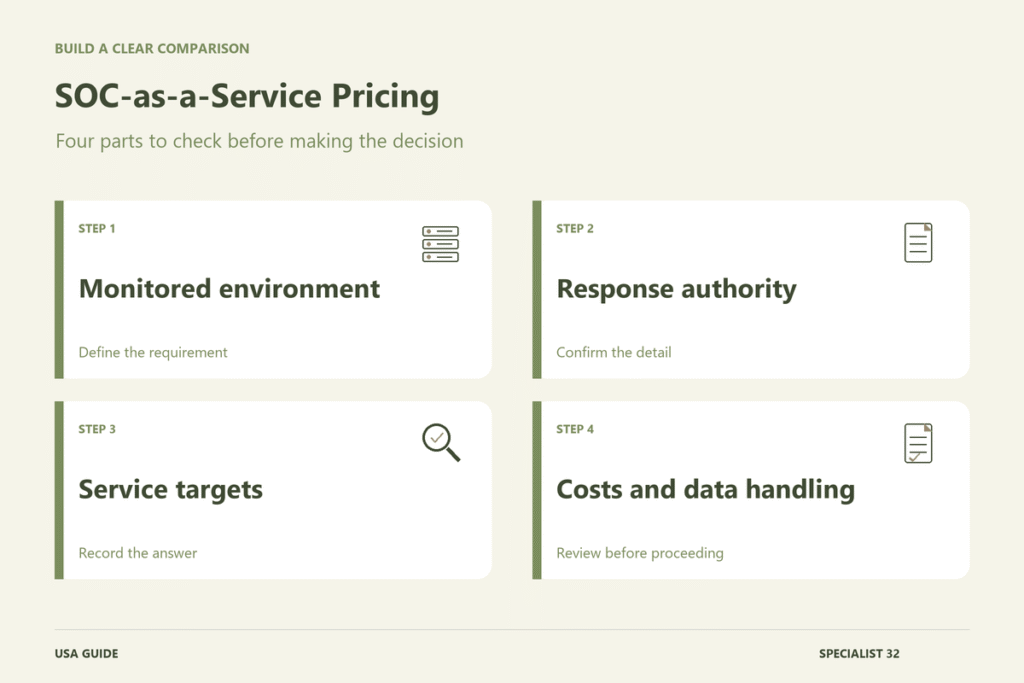
Build the total cost and data plan
Identify licence, onboarding, integration, log ingestion, storage and retention charges. Ask how growth, unusually high event volume and new locations affect price. Consider internal effort for maintenance, investigations and remediation. Review access controls, data location, subcontractors and incident handling for the provider itself. The service may hold sensitive information and powerful access, so diligence should reflect that role. A security supplier’s marketing claims do not remove the need to examine its actual operational arrangements and contractual commitments.
Compare providers using a common environment inventory, simulated incident and expected service volume. Agree on an onboarding acceptance test, escalation contacts and review schedule. Ask how logs, configuration and access are handled on termination, including continuity while switching providers. A strong SOC service gives the organisation useful visibility and clearly allocated action. Its value is measured by the work performed and the decisions it supports, rather than the number of alerts generated or a general assurance that someone is watching around the clock.
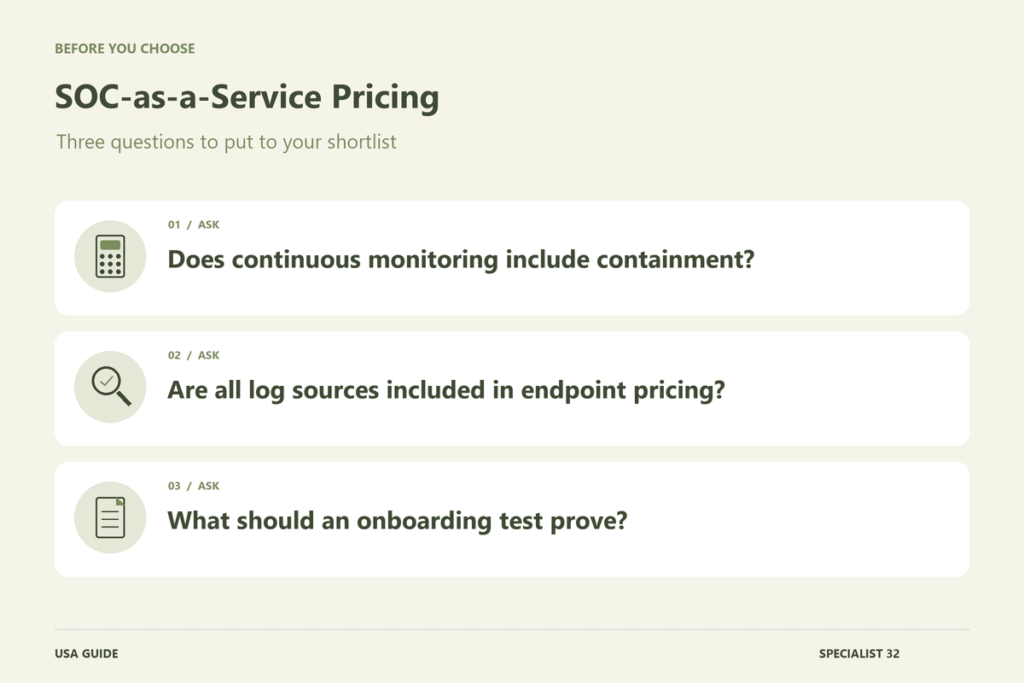
Does continuous monitoring include containment?
Only if the agreement grants and defines that service. Ask which actions the provider may take, when approval is required and what internal capability must remain available. An alert escalated quickly can still require substantial customer investigation and response.
Are all log sources included in endpoint pricing?
Do not assume so. Identity, cloud, network and application data may have separate support or charges. Map the quote to the actual environment and ask how collection health and unsupported sources will be handled.
What should an onboarding test prove?
It should verify agreed coverage, usable data, access arrangements and the escalation process. Use authorised simulations to confirm that both provider and customer can perform their responsibilities. Connector installation alone is not complete operational acceptance.
Further reading
Related reading
- SaaS Penetration Testing Services: Comparing Scope, Retesting and Provider Quotes (USA)
- SASE Providers: Comparing Network Security, Deployment and Per-User Costs (USA)
- Cloud Migration Consultants: Comparing Discovery, Migration and Ongoing Support Fees (UK)
- ISO 27001 Consultancy Costs: Comparing Gap Assessments, Implementation and Audit Preparation (UK)
Explore more in Enterprise IT and Security Services.