SASE proposals combine networking and security capabilities in ways that can be difficult to compare from licence names alone. A business needs to identify the access paths, controls and operational responsibilities included in the actual offering. This guide helps US organisations evaluate secure access service edge providers. It does not certify an architecture or rank vendors. Product capabilities and commercial packaging change, so use current documentation and practical trials. A successful purchase should solve defined access and security requirements rather than simply replace several familiar acronyms with one new label.
Map users, sites and applications
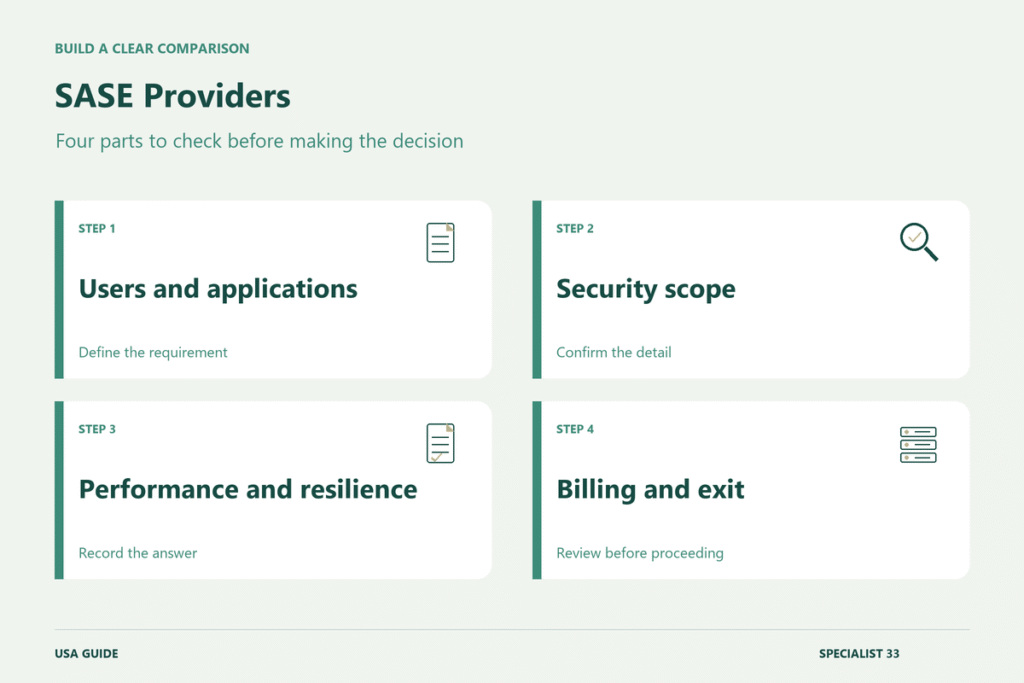
List employees, contractors, branches and other locations needing access, along with the applications and data they use. Distinguish internet services, private applications and site-to-site traffic. Identify managed and unmanaged devices and expected geographic patterns. Ask providers to show how each required path works in their design. A platform with strong web filtering may not automatically satisfy a private application access requirement. The evaluation should start from business flows rather than assume every SASE-branded package includes the same components.
Describe the identity systems, device management and networks already in place. Ask which integrations are supported and what information is used when access decisions are made. NIST’s zero trust architecture guidance emphasises users, assets and resources rather than implicit trust based solely on location. That does not mean a product purchase automatically creates a zero trust architecture. Assess how the proposed service fits a broader design, including account lifecycle, device state, application permissions and the organisation’s ability to investigate exceptions.
Compare security scope and deployment work
Request a capability map separating included functions from optional modules and external dependencies. Ask about private access, web controls, cloud application visibility, data protections and network functions where relevant. Have the vendor explain how policies are administered and applied across users and locations. A unified sales proposition can still involve multiple consoles or licences. The operational question is whether administrators can understand the effective policy and investigate why a particular request was allowed or blocked.
Ask what must be installed or changed: endpoint clients, connectors, branch equipment, routing or identity configuration. Identify ownership of those tasks and the professional services needed. Plan how existing remote access or security products will coexist during transition. A rapid pilot is useful but does not establish a full migration plan. Include exception cases such as legacy applications, specialist devices and external collaborators, so the business does not discover late that a critical workflow depends on an unsupported access method.
Test experience and resilience
Use representative users in relevant regions to assess application performance and reliability. Test the actual business workflow, including large transfers, real-time communication or applications with unusual connection requirements where appropriate. Ask how traffic paths and service locations affect the design. A general network footprint map does not predict every application’s experience. Agree on measurements and acceptance criteria before the trial, and distinguish problems caused by the service from local connectivity or application behaviour.
Discuss outages, degraded service and emergency access. Ask whether controls fail open, fail closed or behave differently under specified conditions. Establish how administrators obtain help and how users continue critical work. Review logging, retention and integration with incident monitoring. Security controls should produce information the organisation can use, with access and privacy handled appropriately. A service can enforce policy effectively while still creating an operational gap if investigation records are inaccessible, incomplete or priced outside the assumed package.
Understand the billing model and exit
Request the units used for users, sites, bandwidth, connectors, data or optional functions. Ask how occasional users and contractors are counted, and whether commitments can decrease as well as increase. Include implementation, hardware, support and overlapping costs during migration. A per-user price is incomplete when branch or network charges also apply. Model expected growth and a busy period on the same assumptions across vendors, identifying usage thresholds and the consequences of exceeding contracted allowances.
Compare proposals against the access map, tested workflows, operational model and complete cost. Review data location, subcontractors, incident provisions and termination assistance with appropriate teams. Ask how policies and logs can be exported and how access is maintained while moving away. A defensible decision documents remaining dependencies and limitations. SASE can consolidate useful functions, but the value comes from a design that works for the organisation’s users and applications, supported by clear responsibilities, rather than from the breadth of terminology printed on a product sheet.
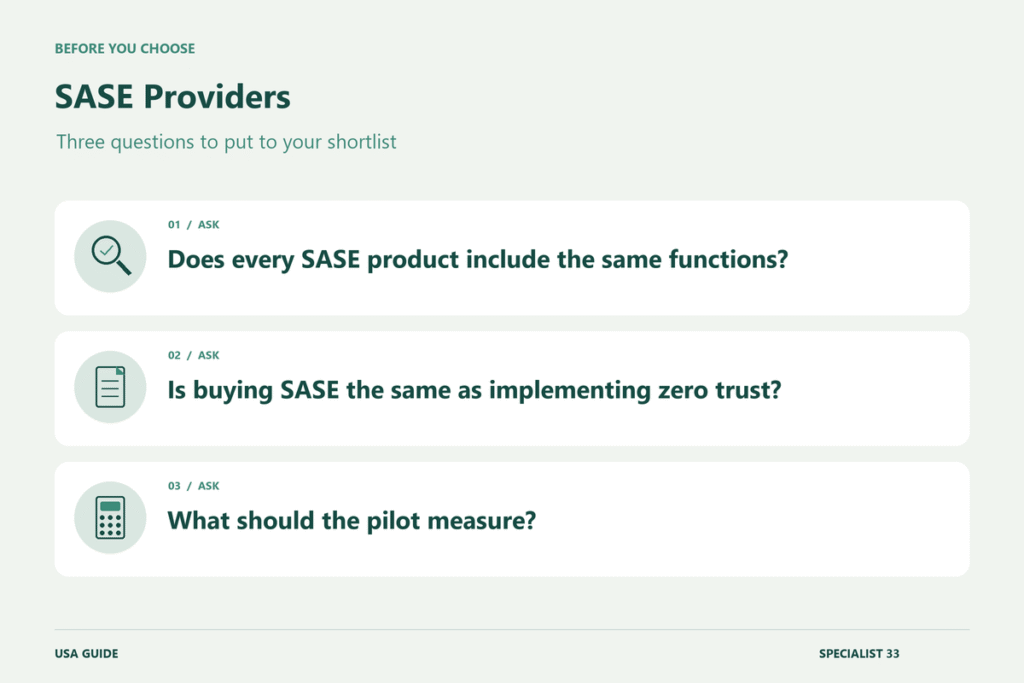
Does every SASE product include the same functions?
No. Ask for a map of included, optional and dependent capabilities. Demonstrate the actual access paths and policy requirements. A shared product category does not make different licensing bundles or architectures directly equivalent.
Is buying SASE the same as implementing zero trust?
No. A broader architecture also involves identity, device, application and operational decisions. Assess the service’s role in that design rather than treating the purchase as evidence that all trust assumptions and access risks have been resolved.
What should the pilot measure?
Use real business workflows, relevant locations, policy exceptions and outage scenarios with agreed criteria. Include administration and investigation tasks as well as user experience. A successful login from one office is only a small part of production readiness.
Further reading
Related reading
- SOC-as-a-Service Pricing: Comparing Monitoring, Incident Handling and Contract Limits (USA)
- SaaS Penetration Testing Services: Comparing Scope, Retesting and Provider Quotes (USA)
- Cloud Migration Consultants: Comparing Discovery, Migration and Ongoing Support Fees (UK)
- ISO 27001 Consultancy Costs: Comparing Gap Assessments, Implementation and Audit Preparation (UK)
Explore more in Enterprise IT and Security Services.