Manufacturing ERP software affects purchasing, production, inventory and financial reporting, so its cost cannot be measured by licences alone. Data preparation, process decisions and implementation support can determine whether the system becomes usable. This guide helps US manufacturers compare proposals against their own operation. It does not rank systems or claim that a particular product fits every factory. Request current demonstrations, contracts and implementation assumptions, and distinguish the software supplier’s responsibilities from those of a separate consulting or integration partner.
Define the production processes that must work
Map the activities the system needs to support: bills of materials, routing, scheduling, procurement, inventory, quality and costing as relevant. Include multiple sites, subcontracting and traceability requirements where they apply. Ask vendors to demonstrate a representative product moving through the process, not simply a dashboard. A factory making standard units can need different workflows from one building complex orders. The evaluation should expose those differences before the business commits to a licence bundle that later requires substantial custom development.
Identify the people and devices that need access. Office staff, production supervisors, warehouse teams and shop-floor stations may have different licensing arrangements. Ask what counts as a full user, limited user, device or external connection. Include test and training environments, reporting tools and any additional modules in the proposal. A lower cost per full user does not establish a lower overall cost when the alternative includes functionality that the cheaper headline offer prices separately.
Scope implementation and ownership of decisions
Request a written implementation plan covering discovery, configuration, integrations, data migration, testing, training and launch support. Identify which activities are fixed-price and which are estimates. Ask who is responsible for business decisions, sign-off and resolving changes in scope. A partner can configure the software, but the manufacturer still needs knowledgeable staff to define processes and validate results. Include the cost of freeing those staff from normal duties so implementation effort is visible rather than treated as unlimited internal capacity.
Ask how the partner evaluates standard functionality before proposing customisation. Custom work can be necessary, but it should have a stated purpose, maintenance owner and upgrade plan. Require an explanation of assumptions behind integrations with machinery, ecommerce, logistics or existing finance systems. A connector listed in a brochure may not cover your data mappings or transaction volumes. Demonstrate the important exchange of information and agree on measurable acceptance, including what should happen when a transaction fails.
Treat migration as a business workstream
Inventory legacy data, including products, suppliers, customers, balances and open transactions. Decide what must move and what can remain in a controlled archive. Ask who cleans duplicates, reconciles totals and validates historical information. Migrating incorrect data quickly does not produce a reliable system. Request trial migrations and a plan for final cutover. The proposal should explain how data ownership, approval and exceptions are managed, rather than suggesting that migration is simply an automated upload performed near launch.
Microsoft’s implementation guidance highlights testing across functionality, integration, performance, security and migration. Apply that principle to the proposed project regardless of vendor. Ask for realistic end-to-end tests covering difficult as well as ordinary scenarios. Confirm who prepares expected results and how defects affect launch decisions. A demonstration that one purchase order can be entered does not establish that production planning, stock valuation and financial posting work together correctly under the organisation’s actual volume and permissions.
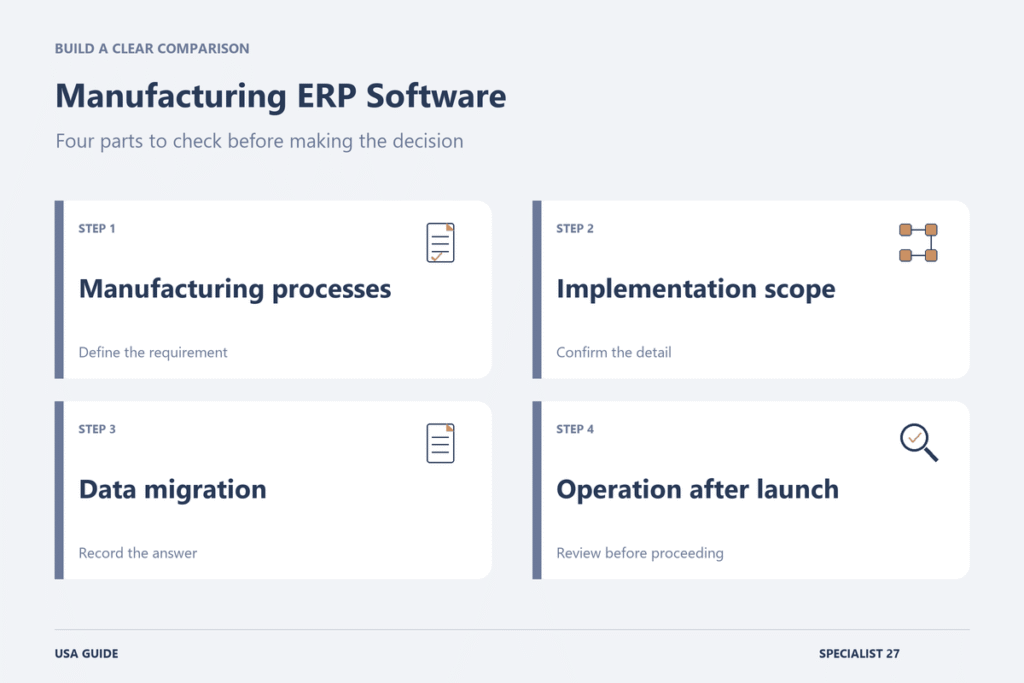
Budget for operation after launch
Request support terms, upgrade responsibilities, service limits and the price of additional assistance. Identify recurring charges for hosting, storage, integrations, analytics and specialist modules. Ask how licence needs and subscription commitments can change as the business grows or reorganises. Consider who maintains internal expertise after consultants leave. The handover should include configuration records, user guidance and access arrangements so the manufacturer can operate the system without depending on an undocumented set of decisions held by one consultant.
Compare total cost over a common planning period using the same processes, users and assumptions. Separate one-off implementation from recurring operation, and include an allowance for internal effort and project uncertainty. Request references relevant to your manufacturing model, while recognising that another customer’s success does not prove your requirements are covered. Choose the proposal that makes delivery and ongoing responsibilities clear. A useful ERP investment is a functioning set of business processes supported by dependable information, not simply the purchase of a familiar software brand.
Is a fixed implementation price a fixed project cost?
Only within its defined assumptions and scope. Check exclusions, internal work, change requests and specialist services. Compare what each partner promises to deliver and what the manufacturer must supply before treating fixed-price proposals as equivalent.
Should all historical data be migrated?
Not automatically. Define business, legal and reporting needs and assess archive options. Migration scope should include data quality and validation, because moving a larger volume can add cost without making daily operations or financial information more reliable.
What is meaningful acceptance testing?
Use representative end-to-end processes with agreed expected results, realistic permissions and relevant integrations. Include exception cases and reconcile financial and stock outcomes. A sequence of successful screen demonstrations is not a substitute for testing the operation the business will actually run.
Further reading
Related reading
- Contact Centre Software Pricing: Comparing Dialler, Recording and Usage Charges (USA)
- E-Discovery Software Pricing: Comparing Data Processing, Hosting and Review Charges (USA)
- Employer of Record Services: Comparing Employment Costs, Deposits and Exit Fees (UK)
- Construction Estimating Software: Comparing Takeoff Tools, Licences and Training Costs (UK)
Explore more in Business Software and Outsourcing.