Contact centre software pricing is often presented as a cost per user, but a working service also consumes telephony, storage, integrations and support. A business can select a modest licence price and still build an expensive operation if usage assumptions are wrong. This guide helps US buyers compare proposals for a defined contact centre. It does not rank providers or quote current prices. Features, billing rules and availability change, so use dated vendor documentation and the actual commercial agreement for the final comparison.
Define users, channels and operating hours
List agents, supervisors, administrators and anyone else needing access. Describe full-time, part-time and seasonal staffing, including peak simultaneous users. Ask each provider how those roles are counted for billing: named seats, active users, concurrent capacity or another method. Two offers labelled per user can use different definitions. A team with many occasional agents may experience a different cost pattern from one with a stable full-time workforce, even when both handle the same total number of customer contacts.
Prepare channel volumes and destinations for inbound calls, outbound calls, messaging, email and chat as relevant. Include operating hours, expected growth and unusually busy periods. Ask whether numbers, minutes, carrier charges or underlying platform services are included. A contact centre licence should not be assumed to contain all telephony. Request a usage model based on your own traffic, separating subscription charges from metered services so a busy month can be assessed without rebuilding the comparison from scratch.
Compare dialler and routing capabilities in practice
Specify the workflows the system must support: queue routing, callbacks, outbound campaigns, transfers and escalation. Ask vendors to demonstrate them with representative data and permissions. A feature name on a comparison chart does not establish that it works with your channels or subscription tier. If an outbound dialler is required, assess the legal and consent requirements with qualified advisers separately from the software purchase. A platform’s technical ability to place calls is not approval for every calling practice.
Identify integrations with customer records, identity systems and reporting tools. Ask whether connectors, API usage, custom development or ongoing maintenance are separately charged. A successful demonstration using a sample account may conceal substantial work to connect the production environment. Request responsibilities, delivery assumptions and acceptance criteria for that work. Include internal staff time and training in the budget rather than treating the implementation as an incidental task automatically absorbed by the software supplier’s advertised seat price.
Calculate recording, storage and analytics costs
Define which interactions need recording, how access is controlled and the intended retention period. Ask how storage, transcription, quality management and analytics are priced. Confirm whether exporting recordings is supported and what it costs. Privacy, consent and retention require an organisation-specific assessment; more storage is not always a reason to keep data longer. The comparison should reflect a documented business requirement and appropriate controls, rather than selecting an unlimited-sounding feature without understanding how information will be governed.
If AI assistance is offered, ask which functions are included, how usage is measured and what happens when allowances are exceeded. Request information on data handling, administrative control and how staff review outputs before relying on them. Test with representative interactions rather than accepting a sales demonstration as an accuracy measure. A feature may reduce one task while adding review or configuration work. Price it against the actual workflow and service quality you expect, including the option to disable it.

Review support, resilience and exit
Ask what support hours, response targets and escalation routes are included. A platform availability commitment does not necessarily cover every carrier, integration or local connectivity problem. Identify responsibilities for outages and how the team would continue handling customers. Discuss number porting, training environments and change management before launch. A low subscription can become poor value if the business needs expensive professional services for routine changes that it assumed administrators would be able to make independently.
Build a total-cost comparison for expected usage and a busier scenario. Include setup, migration, licences, communications, storage, integrations and support, with renewal and minimum commitments clearly shown. Ask how data and numbers can be transferred on exit and what notice is required. Reconcile the final order form with the demonstrated features. The right proposal makes the cost of serving your actual customers understandable over the contract, rather than relying on one attractive per-seat number that leaves essential operating charges unexplained.
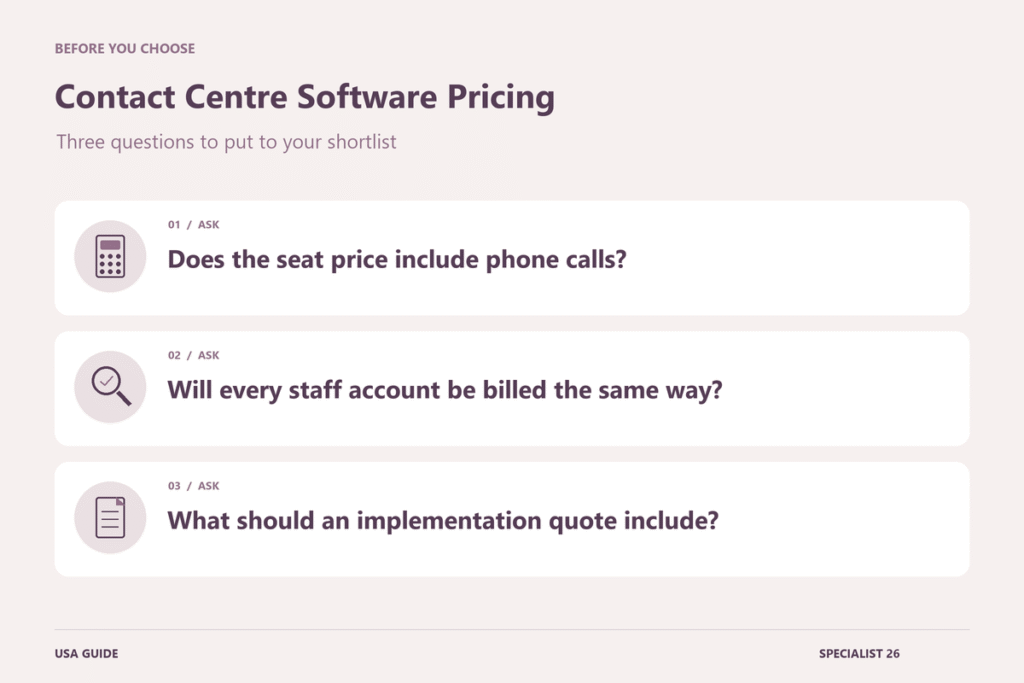
Does the seat price include phone calls?
Check the actual plan. Telephony, numbers and related platform services may be metered or supplied separately. Ask for a traffic-based illustration that distinguishes licences from usage instead of assuming the advertised user price is the complete monthly bill.
Will every staff account be billed the same way?
Not necessarily. Providers can count named, active or concurrent users differently, and supervisors or administrators may also create charges. Model your real staffing pattern and ask what happens when temporary users are added or removed.
What should an implementation quote include?
Look for migration, integrations, configuration, training and acceptance work, with responsibilities and exclusions. Identify ongoing maintenance of custom components. A subscription offer and a production-ready deployment are different commercial scopes and should be assessed together.
Further reading
Related reading
- Manufacturing ERP Software: Comparing Implementation, Migration and Licence Costs (USA)
- E-Discovery Software Pricing: Comparing Data Processing, Hosting and Review Charges (USA)
- Employer of Record Services: Comparing Employment Costs, Deposits and Exit Fees (UK)
- Construction Estimating Software: Comparing Takeoff Tools, Licences and Training Costs (UK)
Explore more in Business Software and Outsourcing.