Buying UK property while living overseas adds practical questions about income currency, documents, identity checks and property use. An expat mortgage quote should be assessed against those requirements as well as its advertised rate. This guide helps prospective borrowers compare proposals for UK property. It does not recommend a product, determine tax residence or provide cross-border legal advice. Eligibility and available terms vary by lender and circumstances, so obtain dated information and professional advice on the actual transaction rather than assuming one expat programme fits every overseas applicant.
Describe residence, nationality and property use accurately
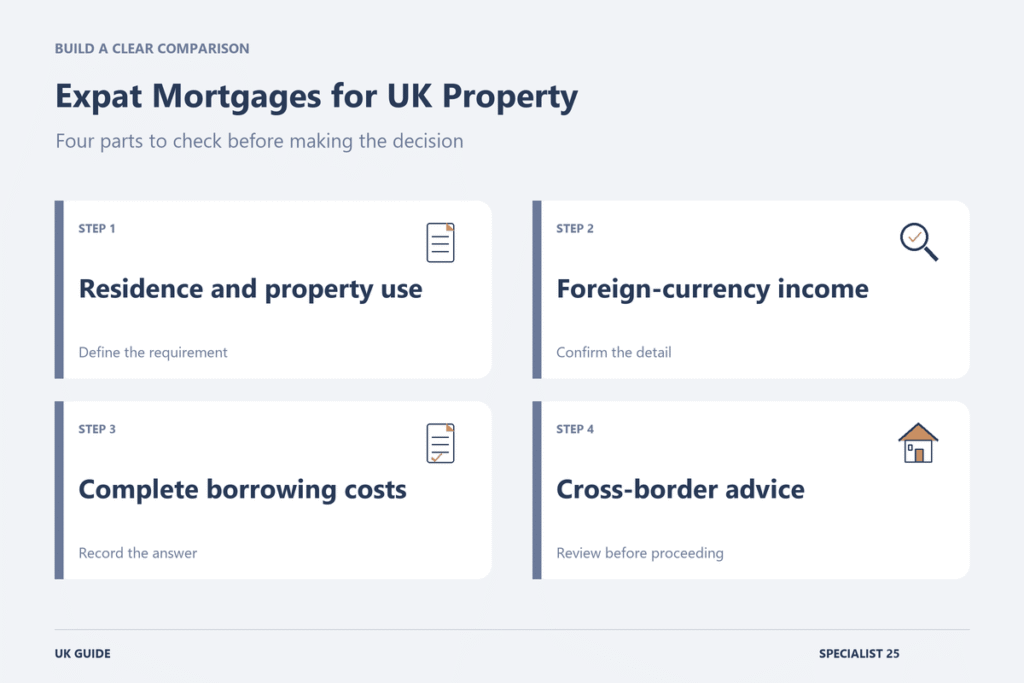
Explain where you live, work and pay tax, along with citizenship and relevant residence status. Identify whether the UK property will be your home, a future home, a rental investment or another permitted use. Those distinctions can affect the appropriate product and underwriting. Ask which countries and employment arrangements the lender accepts. A provider offering expat loans may still have restrictions that exclude a particular jurisdiction or borrower. Confirm the basic fit before paying for specialist reports or extensive documentation.
Ask how the lender handles the application from overseas. Establish acceptable identity documents, address evidence, certification, translation and signatures. Find out whether any tasks require physical presence or a particular professional to certify copies. A convenient online enquiry is not the same as an entirely remote completion process. Build the practical requirements into the timetable, especially when different time zones and local holidays could slow communication with employers, banks, lawyers or the property’s seller.
Understand foreign-currency income assessment
Provide a clear record of income currency, payment frequency, employment contract and any variable compensation. Ask which income elements the lender accepts and how they are converted or discounted in its assessment. A favourable exchange rate today may not remain available when payments fall due. Prepare your own budget for sterling mortgage costs under less favourable currency conditions. The lender’s calculation is relevant to approval, but the borrower still needs a personal plan for exchange-rate changes and international transfer costs.
If some funds come from investments, business ownership or multiple countries, ask what further evidence is required. Explain existing debts and financial commitments in all relevant currencies. Do not omit an overseas obligation because it does not appear in a UK credit report. Ask how a limited UK credit history affects the process and what information can support assessment. A specialised lender should explain the accepted evidence, rather than imply that overseas status removes the need to establish repayment capacity.
Compare charges beyond the interest rate
Request product, valuation, legal, intermediary and transfer-related costs. Identify whether a broker searches a limited panel or a broader market and how it receives payment. If a banking relationship or minimum balance is required, include associated costs and restrictions. Compare offers on the same property price, deposit, term and rate basis. A lower advertised rate may come with fees or account commitments that change the overall result, particularly if the expected holding period is relatively short.
Ask about fixed or variable rate terms, early repayment charges and future product options. Do not assume that refinancing later will be straightforward if residence, employment or lender policy changes. If a product ends while you remain overseas, understand the possible next rate and what information would be needed to obtain another deal. Consider how the mortgage would be serviced if you move again. A realistic long-term comparison should address more than the initial purchase date and first monthly payment.
Coordinate property, legal and tax work
Use appropriate UK conveyancing support and obtain tax advice for both UK and overseas circumstances where relevant. Mortgage advice does not automatically include analysis of purchase taxes, rental reporting, ownership structures or future disposal. Identify who handles each question and what falls outside the engagement. If the property will be let, discuss tenancy, management and insurance requirements separately. An approval to borrow does not establish compliance with every obligation associated with owning and using property while resident abroad.
Keep a transaction checklist identifying each professional, document, deadline and outstanding condition. Compare providers on practical accessibility, currency treatment, total cost and the resilience of the plan if circumstances change. Before signing, reconcile the final offer with the intended use and actual financial information. An expat mortgage can provide a route to UK property, but the sound decision is grounded in evidence, workable administration and an affordable sterling commitment, rather than a promise that overseas applicants can bypass ordinary lending considerations.
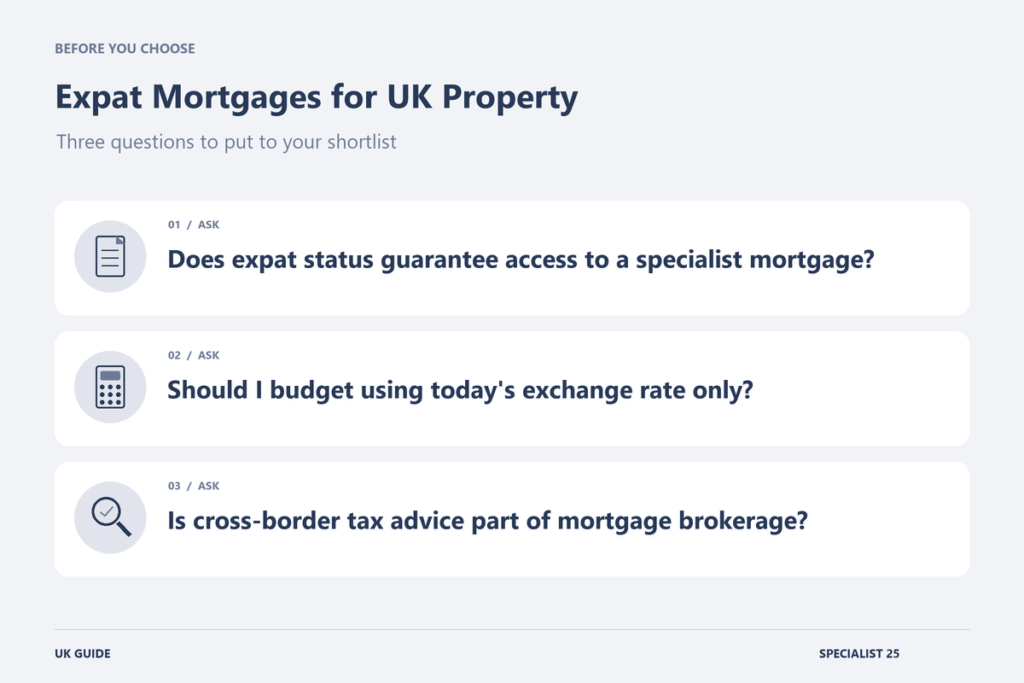
Does expat status guarantee access to a specialist mortgage?
No. Lenders can set criteria for residence, income, profession, nationality and property use. Ask for confirmation of your basic eligibility before relying on an illustration or assuming that another overseas buyer’s terms will apply.
Should I budget using today’s exchange rate only?
Consider less favourable rates as well as transfer charges and timing. A sterling payment can become more expensive in your income currency. Ask appropriate advisers about managing that exposure without treating any future exchange rate as certain.
Is cross-border tax advice part of mortgage brokerage?
Only where explicitly provided by a suitably qualified adviser within the engagement. Clarify the scope and obtain separate advice where needed. Loan approval does not settle questions about tax residence, ownership or reporting in either country.
Further reading
- HSBC Expat: Mortgages for buying in the UK
- FCA Handbook: Mortgage Credit Directive and foreign-currency definitions
Related reading
- Mixed-Use Commercial Mortgages: Comparing Deposit Requirements, Valuations and Broker Fees (UK)
- Non-QM Mortgages for Self-Employed Borrowers: Comparing Bank Statement Loan Offers (USA)
- DSCR Rental Property Loans: Comparing Rental Income Tests, Rates and Prepayment Terms (USA)
- Physician Mortgage Loans: Comparing Down Payments, Mortgage Insurance and Lender Fees (USA)
Explore more in Specialist Mortgages.