E-discovery pricing can begin with a simple per-gigabyte figure and expand into collection, processing, hosting, review and production charges. A legal team needs to know which volume is measured and at what stage before comparing vendors. This guide helps US buyers build a purchasing framework for software and associated services. It does not provide legal advice about discovery obligations or validate a platform’s defensibility. Counsel should define the matter’s requirements, and technical claims should be demonstrated using authorised, appropriately protected test information.
Define the information and legal workflow
Identify custodians, systems, data types, likely volumes and the tasks the platform must support. Email archives, collaboration messages, mobile material and structured records can require different collection and review capabilities. Ask which sources are supported directly and which need additional tools or services. The EDRM framework distinguishes activities such as collection, processing, review and production; a vendor providing one stage should not be assumed to cover the entire workflow. Map the proposed product to the actual work the matter requires.
Discuss preservation and collection with legal and technical advisers before moving information. Establish who authorises access, documents provenance and maintains appropriate records. Ask the provider how it preserves relevant metadata and handles exceptions. Do not upload confidential client information into a trial simply because a sales account is available. A platform evaluation should have agreed data handling, permissions and deletion arrangements. The responsibility for lawful collection and appropriate legal decisions does not disappear when a vendor offers an automated connector.
Identify every billing unit
Request definitions for ingested, processed, hosted, archived and exported data. Ask how compression, duplicates, extracted text and derived files affect measured volume. A per-gigabyte rate is not comparable until both vendors use the same basis. Include minimum commitments, workspace charges and user licences. Have the provider calculate a clearly labelled scenario showing data at each stage, with assumptions written down. This makes it easier to understand why an invoice could change after processing even when the original collection size remains unchanged.
Ask about specialist handling for unsupported files, passwords, damaged material, image recognition, audio or translation. Find out whether these tasks are included, metered or manually quoted. A routine processing price can conceal significant exception work for an unusual matter. Agree on approval thresholds and reporting before a vendor performs chargeable work. The buying decision should assess how problems are surfaced and resolved, not merely how quickly ordinary documents appear in a review queue during a controlled demonstration.
Price review and production realistically
List the users, permissions, coding structures, redaction needs and quality checks required. Ask whether analytics, assisted review, transcription or other advanced features are included. Where AI functions are offered, assess data handling, validation and supervision rather than treating a product label as proof of reliability. The legal team should decide how tools fit a defensible process. Request cost information for iterative review, changed searches and second-pass checks, because those activities can be normal parts of a developing matter.
Define the production formats and reporting required by counsel or agreement. Ask whether export charges include load files, metadata, redactions, document identifiers and exception handling. Verify that representative material can be produced and validated. A successful search demonstration does not show that the final production meets the matter’s requirements. Identify who checks the output, corrects errors and pays for rework. Include the cost of secure transfer and retention after production rather than assuming those services are automatically part of the hosting rate.
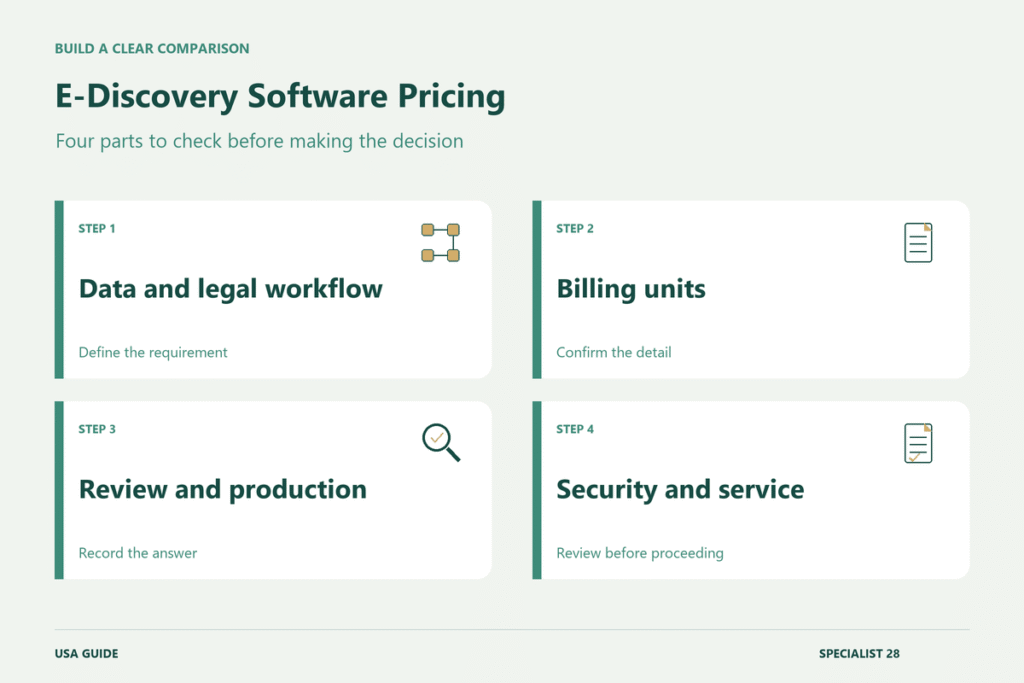
Evaluate security and service responsibility
Request information about access controls, audit records, data location, encryption, incident handling and subcontractors. Assess these against the organisation’s requirements rather than relying on a security badge alone. Ask about support hours and escalation during urgent production work. If software and managed services come from different providers, identify who coordinates them. A matter can become expensive when each organisation assumes the other is responsible for a configuration, export or data integrity question that blocks the legal team’s work.
Compare costs under expected and larger-volume scenarios, including a longer hosting period. Request exit terms covering bulk export, archive access and verified deletion. Keep the pricing definitions and assumptions with the matter budget so later scope changes can be assessed. The strongest proposal makes both the workflow and billing understandable. It supports counsel’s documented process without presenting software purchase, vendor certification or an attractive unit rate as a substitute for legal judgment, data governance and quality control throughout the matter.
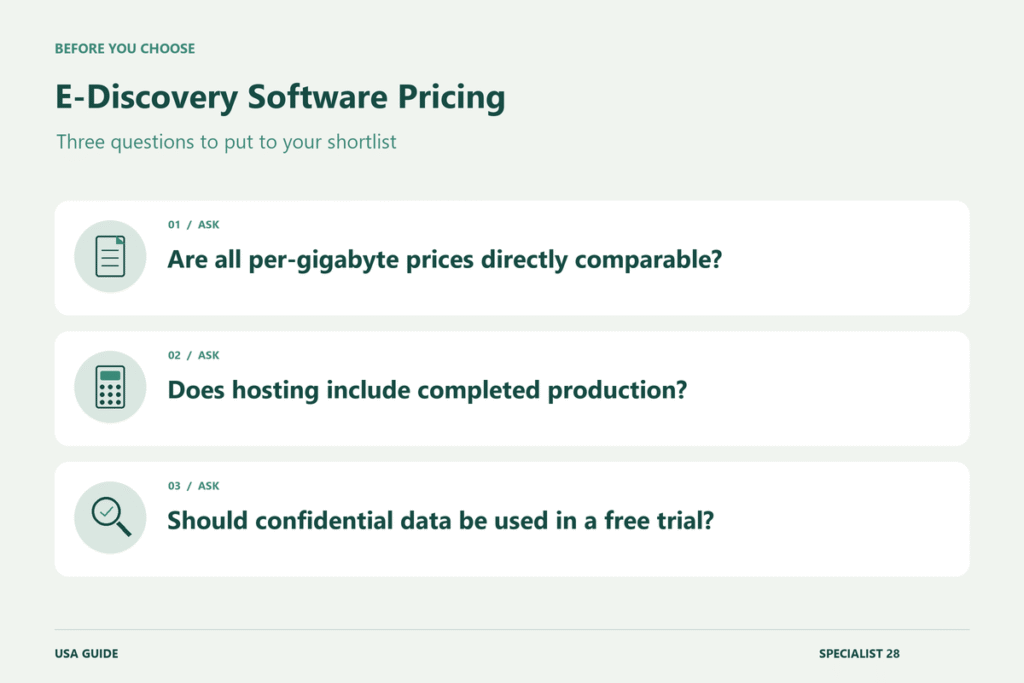
Are all per-gigabyte prices directly comparable?
No. Identify the measured stage and treatment of expanded files, duplicates and derived material. Ask each vendor to price the same scenario. A low ingestion rate can coexist with substantial processing, hosting or export charges elsewhere in the workflow.
Does hosting include completed production?
Only if the scope says so. Define formats, redaction handling, metadata, quality checks and secure delivery. Ask who prepares and verifies the output and whether corrections or additional productions create separate service charges.
Should confidential data be used in a free trial?
Only after appropriate authorisation and assessment of the trial’s handling terms and controls. Use suitable test material where possible. Evaluation convenience should not override client obligations, legal requirements or the organisation’s information governance procedures.
Further reading
Related reading
- Manufacturing ERP Software: Comparing Implementation, Migration and Licence Costs (USA)
- Contact Centre Software Pricing: Comparing Dialler, Recording and Usage Charges (USA)
- Employer of Record Services: Comparing Employment Costs, Deposits and Exit Fees (UK)
- Construction Estimating Software: Comparing Takeoff Tools, Licences and Training Costs (UK)
Explore more in Business Software and Outsourcing.