After a fire, restoration proposals can combine urgent protection, cleaning, contents handling and reconstruction. Those services need clear boundaries so a household understands what it is authorising and who will pay. This guide helps US property owners compare professional contracts after emergency services have addressed immediate danger. It is not a guide to entering or cleaning an unsafe building. Follow official instructions, seek appropriate assistance and contact the insurer promptly. Financial paperwork should support recovery without encouraging rushed commitments to an unexplained, open-ended scope.
Separate urgent measures from the full rebuild
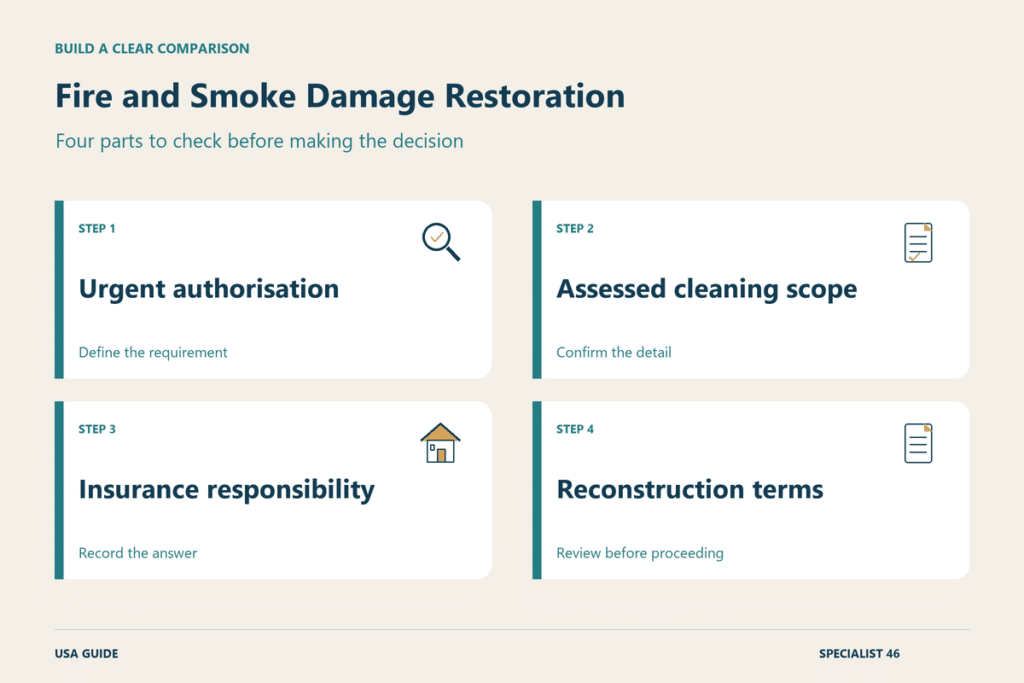
Ask what work is necessary immediately and what can wait for assessment and a more complete proposal. Temporary protection, security and measures to prevent further damage may be different instructions from full cleanup or rebuilding. The US Fire Administration advises residents not to enter damaged premises until the fire department says it is safe. Discuss access with the appropriate professionals. A contractor’s availability does not replace structural, electrical or other safety clearance required for the property and its condition.
Request a written authorisation identifying the immediate tasks, charges, equipment and conditions for additional work. An emergency visit should not silently commit the owner to every later stage. Ask whether there are minimum charges, daily equipment costs or subcontracted services. Identify who can approve changes and how the contractor records work performed. Even where urgent action is reasonable, a concise agreement can distinguish the tasks being authorised from services that still require a separate assessment and price.
Compare the assessed cleaning scope
Ask how the contractor has identified affected rooms, materials and contents. Smoke odour, visible residue and structural damage may require different assessment and methods. Request an explanation of proposed cleaning, removal and specialist involvement, without attempting technical remediation yourself. The proposal should identify assumptions and items requiring further review. A broad promise to remove all smoke damage is less useful than a documented scope with clear responsibilities and a way to evaluate whether the agreed work has been completed.
If belongings are packed out, request an inventory, condition record, storage arrangements and return process. Ask how cleaning decisions are made and what happens to items considered unsalvageable. Clarify approval before disposal and coordinate documentation with the insurer as appropriate. Contents handling can create substantial separate charges for transport, storage, cleaning and return. Those costs should be visible in the proposal rather than appearing only after belongings have left the property and the owner has limited practical alternatives.
Reconcile contractor work with insurance
Notify the insurer and ask about reporting, evidence and approval requirements. Do not assume that an insurer recommendation guarantees every contractor charge will be covered. The restoration contract and insurance policy are separate arrangements. Ask who is responsible for payment if the insurer disputes an item and whether any assignment, direct-payment or other provision changes your position. Obtain independent advice if necessary before signing documents affecting claim rights. Keep copies of estimates, authorisations, photographs supplied and communications about changes in scope.
Request itemised estimates distinguishing labour, materials, equipment, disposal and subcontractors. Ask how quantities and durations are measured and what triggers supplements. A price based on estimated conditions may change after opening affected areas, but the contract should explain approval and documentation. Compare equivalent work rather than selecting the lowest initial number that leaves obvious tasks unpriced. Keep a change record connecting additional work, the reason for it, approval and cost so the final account can be reconciled with the agreed scope.
Assess reconstruction and completion terms
If rebuilding is included, ask who designs, permits and performs it. Verify relevant contractor licensing, insurance and references for comparable work through appropriate local resources. Identify allowances, exclusions and responsibilities for code-related changes or hazardous materials requiring specialists. Cleaning and construction may follow different schedules and acceptance processes. Ask who coordinates them, what access is required and how the property is protected between stages. A single company managing the project should still make its subcontractors’ roles and the owner’s decisions understandable.
Read deposits, progress payments, cancellation, warranty and dispute terms with appropriate advice. Ask what documentation is provided at completion and how unresolved items are recorded. Include practical needs such as temporary accommodation and access to belongings in discussions with the insurer and support services. Choose a contractor offering transparent authority, evidence and payment arrangements. Recovering from a fire can make immediate certainty appealing, but a reliable plan should acknowledge what remains unknown and explain how later decisions will be made without treating the first emergency conversation as permission for unlimited work.
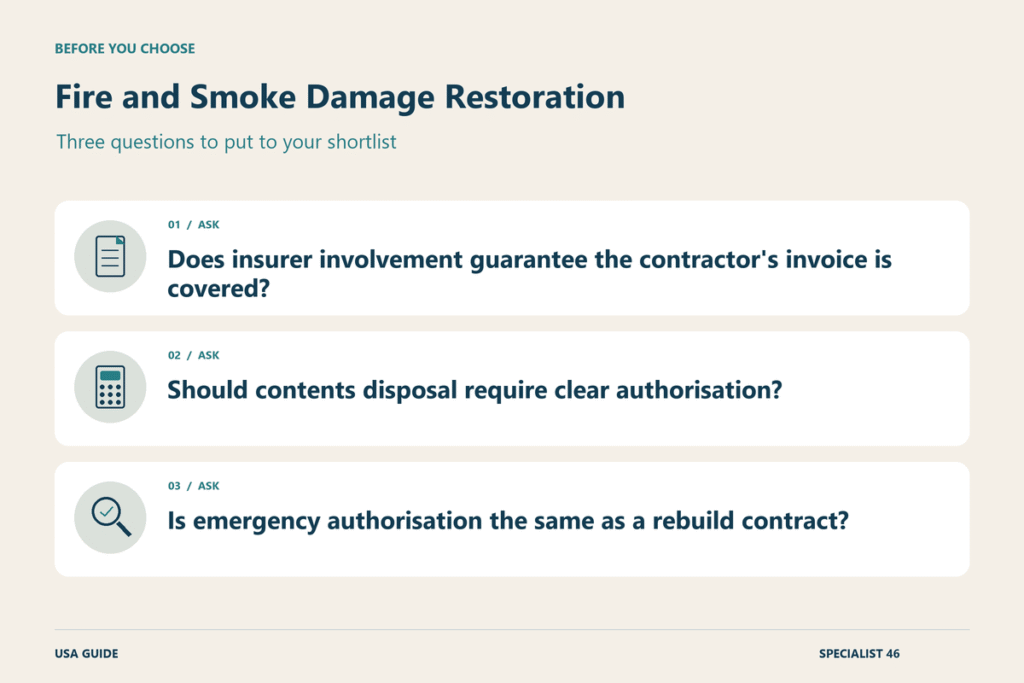
Does insurer involvement guarantee the contractor’s invoice is covered?
No. Ask the insurer about the policy and the contractor about payment responsibility. Keep both arrangements clear. A recommendation or direct communication between them should not be treated as approval of every service, charge or change.
Should contents disposal require clear authorisation?
Ask how decisions are documented and coordinated with ownership and claim requirements. Obtain inventories and condition records where appropriate. Belongings should not disappear into an unexplained process that leaves the household unable to understand what was removed or why.
Is emergency authorisation the same as a rebuild contract?
It should not be assumed. Read the scope and ask which later services require separate agreement. Urgent protection can be documented without automatically accepting an entire reconstruction plan, price structure or transfer of claim-related rights.
Further reading
Related reading
- Commercial Mold Remediation Quotes: Comparing Testing, Containment and Clearance Costs (USA)
- Trenchless Sewer Replacement Costs: Comparing Pipe Bursting, Relining and Excavation Quotes (USA)
- Commercial Asbestos Surveys and Removal: Comparing Survey Scope and Contractor Quotes (UK)
- Commercial Pest Control Contracts: Comparing Inspection Frequency, Treatment and Guarantees (UK)
Explore more in Specialist Home and Commercial Services.