Commercial mold remediation quotes should be assessed against the affected materials, moisture source and building’s use. A price for spraying a surface is not necessarily comparable with a plan addressing damaged materials, containment and follow-up. This guide helps US building managers compare professional proposals. It does not diagnose health effects or provide do-it-yourself remediation instructions. Occupant concerns, building safety and appropriate professional assessment take priority. The purchasing objective is a documented scope that addresses the actual problem without relying on alarming sales language or a promise to eliminate every mold spore.
Identify the moisture problem and affected areas
Prepare a record of leaks, maintenance history, affected rooms and complaints, distinguishing observations from unverified conclusions. Ask the assessor how the source and extent of moisture will be investigated. EPA guidance explains the importance of controlling moisture in addressing mold problems. A remediation proposal should identify who is responsible for correcting that cause. Cleaning without a workable plan for the leak, condensation or other underlying issue can leave the building exposed to recurring damage even if the initial surface work appears satisfactory.
Describe occupancy, operating hours and sensitive uses of the premises. A school, healthcare area, warehouse and ordinary office can require different practical arrangements. Ask how the contractor will assess access, disruption and the need for other specialists. If hidden damage is suspected, request the basis for investigation and how additional findings will be documented. The initial quote can acknowledge uncertainty, but it should not use uncertainty as permission to perform unlimited additional work without an agreed authorisation process and cost explanation.
Ask what testing would establish
Request the purpose of any sampling or laboratory work and how the results will affect decisions. Avoid assuming that every project requires the same test package or that a numerical result alone defines a safe building. Ask who interprets findings and what limitations apply. If the same organisation sells extensive testing and remediation, discuss how scope and acceptance will be evaluated fairly. The building manager needs an explanation tied to the actual investigation rather than a generic test bundle promoted as a universal prerequisite.
Clinical concerns should be discussed with appropriate healthcare professionals, not decided by a remediation salesperson. A building investigation can document conditions without establishing the cause of every reported symptom. Keep communications factual and provide occupants with information through the organisation’s appropriate channels. Ask the contractor how it handles confidentiality and records. The purpose is to support responsible management and professional assessment, avoiding both unsupported reassurance and exaggerated claims that turn uncertain health concerns into pressure to accept an expensive contract immediately.
Compare containment, removal and restoration scope
Ask the contractor to describe the areas, materials and tasks included in the plan, along with measures intended to protect occupants and prevent spread during work. Request relevant qualifications, experience, references and insurance. Identify whether removal, disposal, cleaning and rebuilding are separate items. A remediation contractor may not repair the original leak or reinstate finishes, so those responsibilities need explicit ownership. Compare the complete project rather than assuming one proposal is cheaper when it simply excludes work another contractor has included.
Itemise labour, equipment, setup, disposal, monitoring and specialist services. Ask how equipment days are measured and how changes are approved if hidden conditions differ from the estimate. Identify obligations for access, utilities, temporary relocation and work outside business hours. A commercial facility may incur disruption costs beyond the contractor’s invoice. Build those into planning and discuss how the proposed sequence limits avoidable interruption without compromising appropriate assessment or professional work. The schedule should reflect the actual use of the premises.

Define completion before work begins
Ask what evidence will show that the agreed work is complete and who evaluates it. Completion criteria should be appropriate to the project and explained in advance, including any independent assessment where warranted. Do not rely on a vague guarantee that the building will be mold-free forever. EPA notes that indoor mold control concerns moisture management rather than the elimination of all spores. Request records of findings, work performed and unresolved conditions so facilities staff can maintain the building after the contractor leaves.
Review payment, warranty, exclusions and dispute terms. If insurance may apply, obtain advice on the actual policy rather than assuming all moisture or mold work is covered. Keep estimates, change records and relevant evidence. Choose a proposal that makes the cause, scope, disruption and acceptance understandable. A strong project leaves the organisation with a clearer building-management plan and documented responsibilities, rather than only a treatment certificate or an expensive invoice that does not explain whether the underlying moisture problem has been corrected.
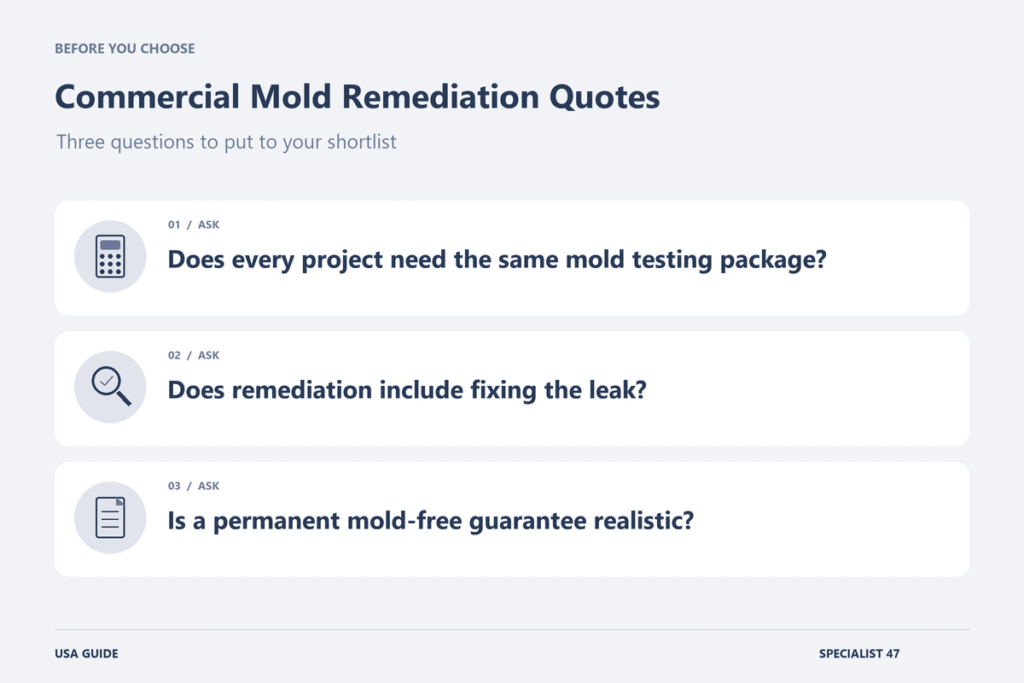
Does every project need the same mold testing package?
No standard sales bundle should replace professional assessment. Ask what question testing will answer, how it affects scope and what limitations apply. The appropriate investigation depends on the actual building conditions and decisions that need to be made.
Does remediation include fixing the leak?
Only if that responsibility is explicitly included. Identify who corrects the moisture source and who reinstates removed finishes. A cleaning scope can be incomplete as a total project when the cause and subsequent repairs remain unassigned.
Is a permanent mold-free guarantee realistic?
Treat such language carefully. Ask what the contract actually promises and what maintenance or moisture conditions affect it. Completion should be assessed against defined work and evidence, with an ongoing plan for controlling the conditions that supported growth.
Further reading
- EPA: Mold remediation in schools and commercial buildings
- EPA: Commercial building remediation guidelines
Related reading
- Fire and Smoke Damage Restoration: Comparing Cleanup Quotes and Reconstruction Contracts (USA)
- Trenchless Sewer Replacement Costs: Comparing Pipe Bursting, Relining and Excavation Quotes (USA)
- Commercial Asbestos Surveys and Removal: Comparing Survey Scope and Contractor Quotes (UK)
- Commercial Pest Control Contracts: Comparing Inspection Frequency, Treatment and Guarantees (UK)
Explore more in Specialist Home and Commercial Services.