Trenchless sewer work can reduce some surface excavation, but it does not describe one standard repair or eliminate every need to dig. Pipe bursting, lining and open excavation have different purposes and suitability limits. This guide helps US property owners compare professional quotes after an appropriate inspection. It is not a repair procedure or a determination of which method fits a pipe. Local permits, ownership boundaries and technical conditions need assessment by qualified professionals. A useful proposal explains why the method addresses the documented defect and what the complete price includes.
Start with evidence of the pipe problem
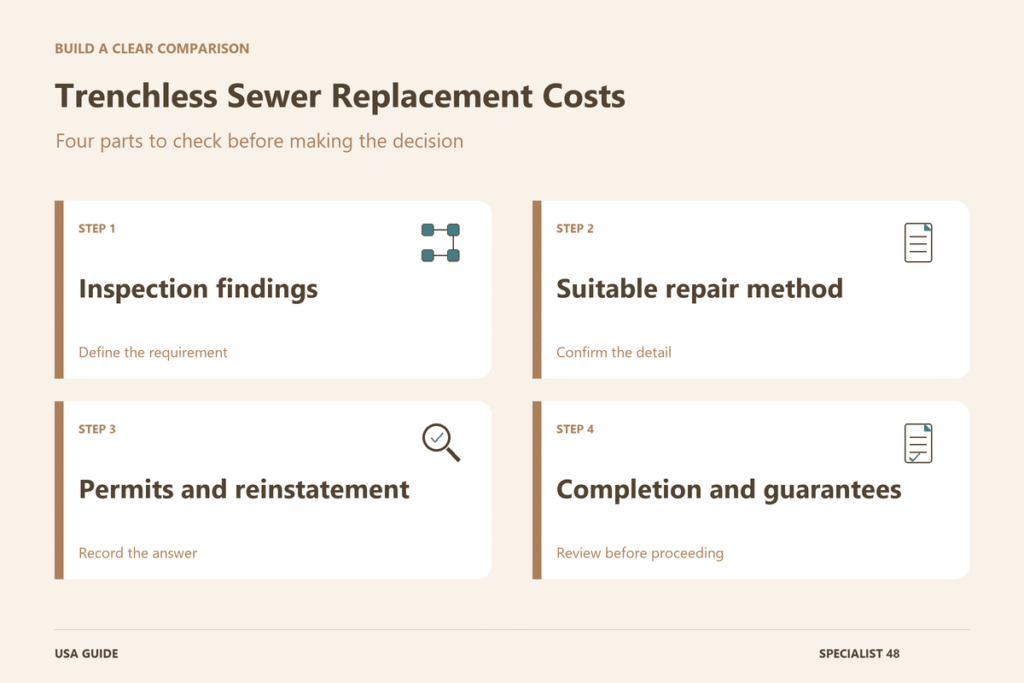
Ask for a clear explanation of inspection findings, including the affected location and the basis for recommending repair or replacement. Request access to available camera footage or reports and ask how the pipe route and depth were established. A blockage does not automatically establish that the whole line needs replacement. Have the contractor distinguish observed defects from areas not yet assessed. If quotes recommend different methods, compare their understanding of the problem before assuming the lower price represents the same technical outcome.
Identify which sections belong to the property owner, utility or another party. Boundaries and responsibilities vary locally, so confirm them with the relevant authority rather than adopting an example from another city. Ask about shared lines, easements, rights of access and work in public space. A contractor’s price may exclude a section outside the assumed property boundary. Clarifying ownership early helps avoid signing a limited repair contract while believing it resolves the entire connection to the public sewer.
Compare methods without treating labels as equivalents
Ask the professional to explain why lining, bursting, a local repair or excavation is suitable for the assessed condition. Municipal descriptions illustrate that these methods perform different work: lining creates a liner inside an existing pipe, while bursting involves replacement using a different process. Suitability depends on actual conditions. Do not select a method simply because trenchless sounds less disruptive. Ask what limitations, remaining defects or changes in dimensions should be understood and whether more than one method is proposed for different sections.
Request the precise length and endpoints included in each quote. Identify connections, branches, access openings and any areas needing excavation. Ask whether the method addresses all documented problems or leaves sections requiring later work. A per-foot figure is difficult to compare if one contractor assumes a different length or excludes difficult access. The complete scope should connect to the inspection findings, with uncertainty and possible additional work explained before the owner decides which proposal offers suitable value.
Include preparation, permits and reinstatement
Ask who obtains permits, arranges required inspections and complies with local utility requirements. Municipal rules differ, and an example from Seattle or Portland should not be treated as a nationwide rule. Identify preparation, cleaning, temporary service arrangements and handling of unexpected obstructions. Ask what happens if the proposed method cannot proceed after work begins. The contract should explain approval, cost and alternatives for that situation rather than leave the owner with an unclear obligation to accept whatever additional work is then suggested.
Itemise excavation, disposal, pipe work, testing and surface restoration. Ask whether landscaping, paving, floors or other finishes are returned to an agreed condition and whether specialist reinstatement is excluded. Trenchless work can still require access pits or local digging. Compare the total disruption and restoration cost rather than assuming the surface is untouched. Identify the expected service interruption and how the household or business will manage it, including any additional accommodation or operating cost outside the contractor’s invoice.
Review completion evidence and guarantees
Request the completion documentation, inspection outcomes and any post-work footage or testing appropriate to the project. Ask who confirms that the agreed work meets the specification and local requirements. Read warranties for labour and materials separately, including duration, exclusions and how a claim is made. A long warranty headline is incomplete without the remedy, responsible organisation and conditions. Keep the contract, reports and relevant permits together, because they may matter when a future owner, insurer or contractor needs to understand the work.
Verify relevant licensing, insurance and experience with the proposed method through appropriate local resources. Compare payment schedules and avoid assuming a deposit creates a completed technical plan. Where another contractor’s recommendation differs substantially, seek clarification or an independent assessment. The strongest quote explains the defect, suitable method, full scope and finished result. Its value is the resolution of the assessed problem with clear responsibilities and costs, rather than a low per-foot number or a promise that a familiar trenchless label means identical work at every property.
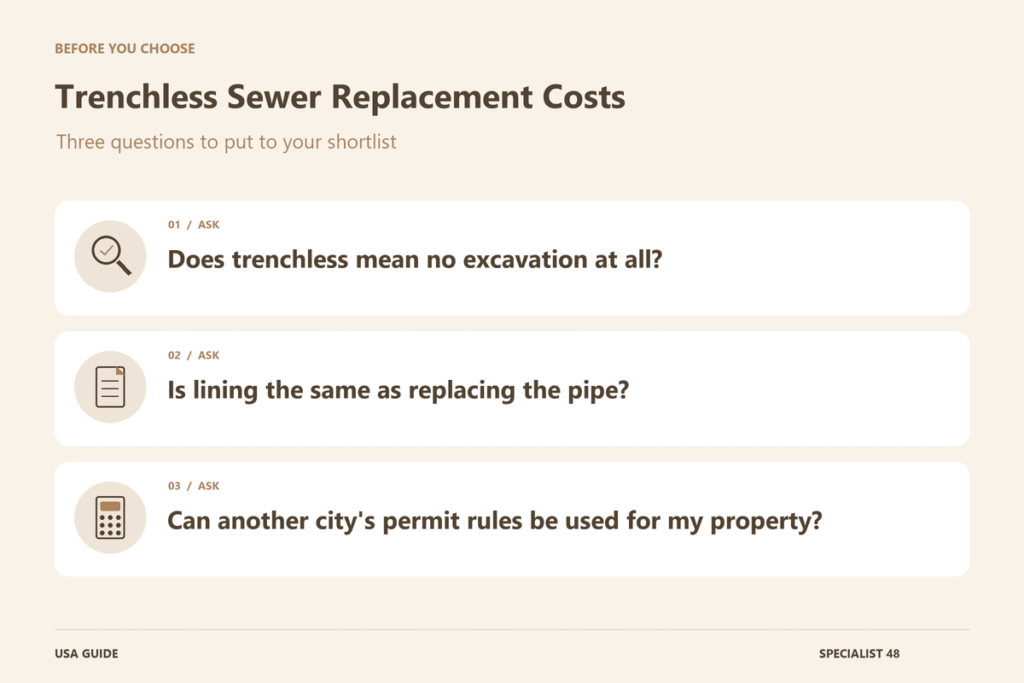
Does trenchless mean no excavation at all?
Not necessarily. Access pits, connections or difficult sections may still require digging. Ask the contractor to show where work occurs and what restoration is included, rather than interpreting the method’s name as a guarantee of no surface disturbance.
Is lining the same as replacing the pipe?
They are different approaches. Ask a qualified professional to explain what the proposed method does and why it suits the documented condition. Compare the expected result and limitations instead of assuming every quote provides equivalent replacement work.
Can another city’s permit rules be used for my property?
Confirm requirements with your own utility and local authority. Public examples can explain methods but do not establish ownership, permissions or inspection rules everywhere. The contractor should identify the actual requirements and responsibilities for the proposed location.
Further reading
Related reading
- Commercial Mold Remediation Quotes: Comparing Testing, Containment and Clearance Costs (USA)
- Fire and Smoke Damage Restoration: Comparing Cleanup Quotes and Reconstruction Contracts (USA)
- Commercial Asbestos Surveys and Removal: Comparing Survey Scope and Contractor Quotes (UK)
- Commercial Pest Control Contracts: Comparing Inspection Frequency, Treatment and Guarantees (UK)
Explore more in Specialist Home and Commercial Services.