A commercial pest control contract should describe the site, relevant pests, prevention work and response service, rather than simply promise a fixed number of visits. UK businesses comparing proposals need to know what happens between routine inspections and what remains their responsibility. This guide provides a procurement framework, not instructions for applying pesticides or handling an infestation. Use competent professionals and obtain advice suited to the premises. The aim is an effective, documented service that supports the business’s obligations without relying on a broad guarantee that no pest will ever appear.
Define the premises and operational risk
Describe the building, activities, opening hours, storage, food handling and surrounding conditions. Identify previous problems and available records without assuming that all sightings represent the same species or source. Ask the provider to inspect and explain the relevant risks before pricing a standard package. A food operation, office and distribution warehouse may need different arrangements. The comparison should be based on the actual site and its activities, rather than on a generic label such as commercial premises or a simple floor-area calculation.
Clarify which pests and areas the contract includes. Rodents, insects, birds and other issues may require different services, and some can be excluded or separately quoted. Ask how a newly identified problem is assessed and priced. Identify external areas, shared facilities and responsibilities of landlords or neighbouring occupiers. A service can be well performed within a narrow scope while leaving an important area unaddressed. Record those boundaries before deciding that two providers offer equivalent cover for the business.
Compare inspection and prevention work
Ask what a routine visit involves: inspection, review of activity, agreed monitoring and recommendations as appropriate. The visit count alone does not establish quality. Request an explanation of how frequency is determined and whether it changes with risk, season or findings. A programme should have a reasoned basis and a process for review. Do not assume that more visits automatically compensate for an unresolved access, hygiene or building condition problem that needs action by the business or another contractor.
Discuss prevention and proofing responsibilities explicitly. Ask which recommendations the provider supplies, which minor work is included and which repairs require a separate quote or building contractor. Identify who acts on recommendations and how completion is recorded. A pest service cannot necessarily control conditions it has repeatedly reported but is not authorised to change. The contract should help management understand those dependencies, rather than allow each party to assume the other has accepted responsibility for structural or operational improvements.
Define response, treatment and safety arrangements
Ask how sightings are reported, what information staff should record and what response is included between scheduled visits. Identify emergency availability, attendance targets and additional charges. An acknowledgement target is not necessarily a promise to resolve an infestation within that period. Request escalation arrangements and clear communication after attendance. The business needs practical advice from the provider about immediate site actions, while professional treatment decisions should remain with competent people operating within applicable product and legal requirements.
Ask about relevant training, insurance, professional memberships and any product-specific competence needed. HSE guidance explains requirements for using biocides; avoid assuming that all pest work uses the same licensing or certification framework. Request the provider’s arrangements for safe work around staff, customers, food, pets or other sensitive areas where relevant. The purpose is appropriate diligence and coordination, not a request for untrained staff to apply professional products. Clarify access restrictions and follow the provider’s instructions for the actual treatment proposed.

Assess records, guarantees and contract costs
Request the reporting format, site records, recommendations and evidence available for management review or relevant audits. Ask who can access a digital portal and whether data can be exported. If the business has a particular standard or customer requirement, describe it precisely and confirm what the provider supports. A general audit-ready claim does not establish compliance with every scheme. The organisation remains responsible for understanding its own obligations and using the contractor’s records as part of a broader management process.
Compare annual cost, visit scope, call-outs, treatments, proofing, reporting and renewal terms. Read any guarantee’s conditions, exclusions and remedy, and ask what happens when problems recur or require further work. Identify notice periods, price review and access to records on termination. A strong contract creates clear responsibilities and a service that adapts to evidence at the premises. It should support prevention and timely response, rather than reward the lowest visit price while leaving management unaware of excluded pests, chargeable attendances or unresolved recommendations.
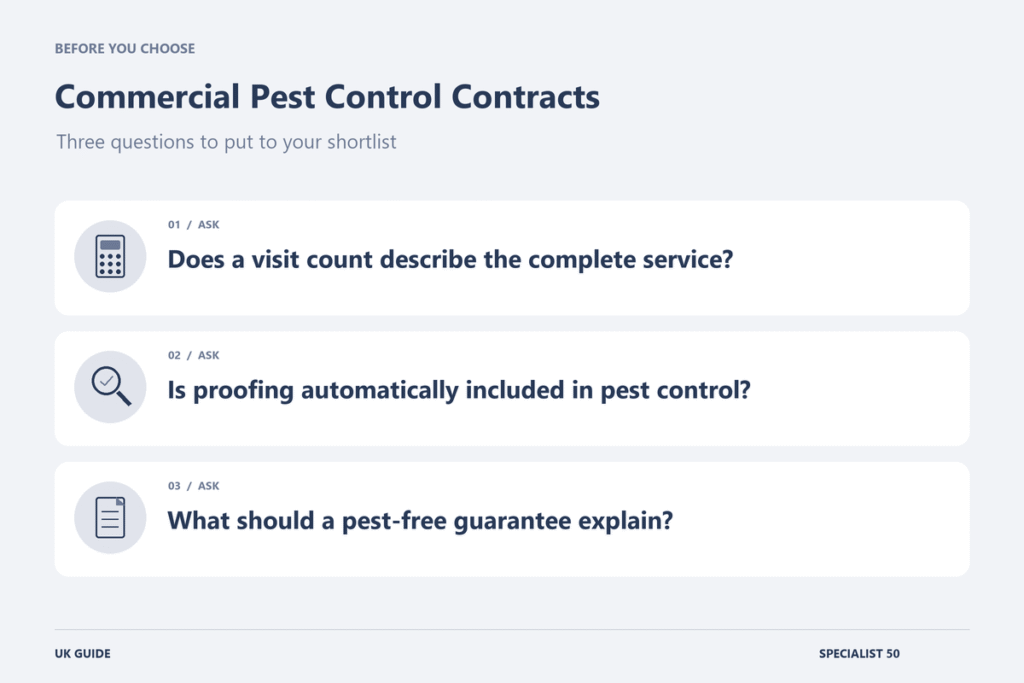
Does a visit count describe the complete service?
No. Ask what is inspected, recorded and recommended, along with response between visits. Frequency should be considered with site risk and the work performed. A standard number of visits does not prove that every relevant pest or area is included.
Is proofing automatically included in pest control?
Check the scope. Inspection recommendations, minor work and substantial building repairs can be different services. Identify who commissions and pays for each task so recurring problems are not left unresolved because responsibilities were assumed rather than agreed.
What should a pest-free guarantee explain?
Look for covered pests and areas, required customer actions, response obligations, exclusions and the remedy offered. A commercial promise should be read as a defined contract term, not proof that every future sighting can be prevented.
Further reading
Related reading
- Commercial Asbestos Surveys and Removal: Comparing Survey Scope and Contractor Quotes (UK)
- Trenchless Sewer Replacement Costs: Comparing Pipe Bursting, Relining and Excavation Quotes (USA)
- Commercial Mold Remediation Quotes: Comparing Testing, Containment and Clearance Costs (USA)
- Fire and Smoke Damage Restoration: Comparing Cleanup Quotes and Reconstruction Contracts (USA)
Explore more in Specialist Home and Commercial Services.