A DSCR rental property loan is commonly marketed around the relationship between rental income and debt service, but lenders can calculate that relationship differently. A quoted rate does not reveal assumptions about rent, expenses or loan restrictions. This guide helps US property investors compare actual debt service coverage ratio loan proposals. It does not assess whether an investment is profitable or determine regulatory treatment. A business-purpose lending structure can involve different disclosures and protections from a consumer home mortgage, so obtain appropriate legal and financial advice.
Request the lender’s actual calculation
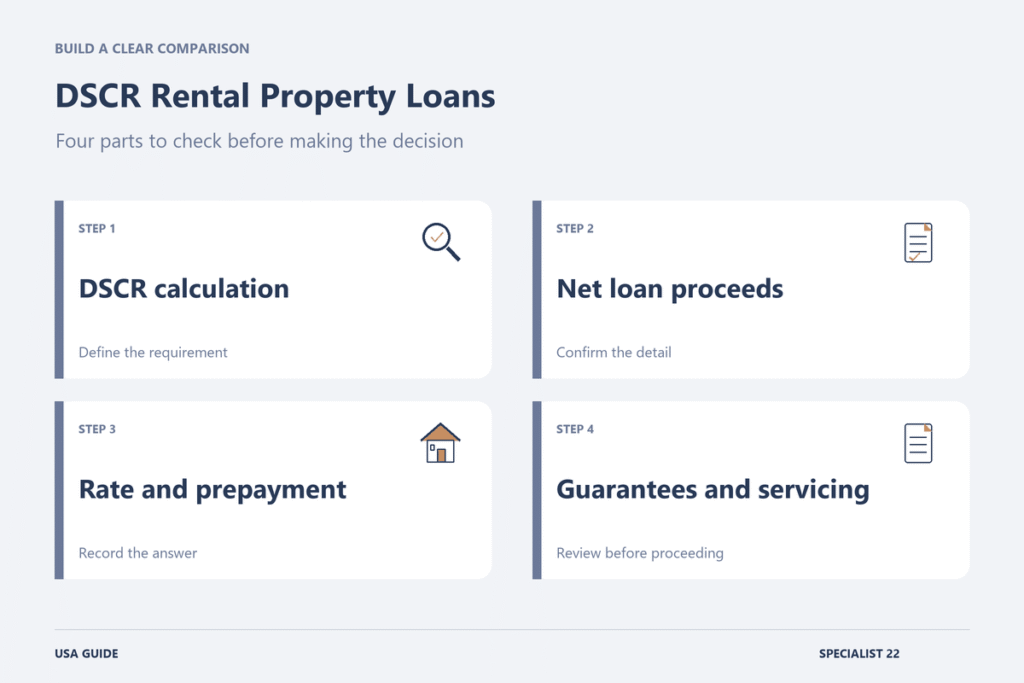
Ask which rent figure the lender uses: an existing lease, a market assessment or another accepted measure. Identify the payments and property expenses included in the denominator and request a written illustration for the proposed property. A quoted ratio is meaningful only when the inputs are clear. Do not compare two approvals as equivalent if one uses a different rental estimate or expense treatment. The lender’s underwriting calculation should also be distinguished from your own operating cash-flow forecast.
Provide accurate information about occupancy, leases, property type and the intended borrower. Short-term accommodation, vacant property and a conventional long-term tenancy may receive different treatment. Ask whether the lender accepts the planned use and whether legal permissions, insurance or association rules affect that use. A loan marketed for investors is not approval to operate the property in any manner. The investor still needs independent diligence on local requirements, condition and the actual ability to obtain and retain paying tenants.
Compare loan proceeds and property-level costs
Record purchase price or refinance value, proposed advance, deposits, reserves and costs paid at closing. Ask which valuation determines the available loan and what happens if it is below the price or your expectation. The quoted maximum loan is not the same as net cash after fees and any existing debt repayment. For a refinance, request a statement reconciling gross proceeds, deductions and the amount actually released. That makes competing offers easier to compare on an equal basis.
Build a separate operating model covering vacancy, repairs, management, taxes, insurance, association charges and capital expenditure. Include costs even if the lender excludes them from its ratio. Stress-test lower rent, unexpected maintenance and periods without income. Passing a lender’s DSCR threshold does not establish that the property produces an acceptable return after all investor expenses. The funding decision should remain workable when conditions are less favourable than the rent and occupancy assumptions used to obtain the original quote.
Examine rate, term and prepayment provisions
Identify whether payments are fully amortising, interest-only for a period or structured with a later balance due. Ask for the complete schedule and how payments change. If the rate can adjust, obtain the adjustment terms and illustrations needed to understand risk. A lower initial payment can reflect deferred principal rather than a lower total cost. Compare offers over your expected holding period and also consider what happens if you retain the property longer than originally planned.
Request the precise prepayment provision, including any schedule, minimum interest or other exit charge. Ask how a sale, refinance or partial repayment is treated. A loan with a lower rate and a restrictive exit can behave differently from a more flexible offer when the investor sells early. Do not assume a future refinance will be available on favourable terms. Include an adverse exit scenario in the comparison so the investment does not depend entirely on one planned refinancing date.
Review guarantees, entity terms and servicing
Ask which legal entity borrows, what security is granted and whether an individual guarantee is required. Obtain advice on what the documents mean rather than relying on the term business-purpose as a description of limited liability. Check reporting, insurance, occupancy and payment obligations. Identify the servicer and procedures for notices or payoff requests. An investor should know where to obtain accurate balances and how a future sale will be processed, particularly if the originating lender does not retain servicing.
Compare proposals using the same rent, value, closing date and ownership plan. Request itemised charges in writing even where consumer mortgage forms are not applicable. Distinguish a lender’s marketing explanation from the binding offer and read all final documents with advisers. The soundest decision combines transparent underwriting, affordable debt service and manageable exit terms. A DSCR label can describe a useful financing approach, but it does not replace assessment of the property’s risks or the investor’s ability to fund a difficult operating period.
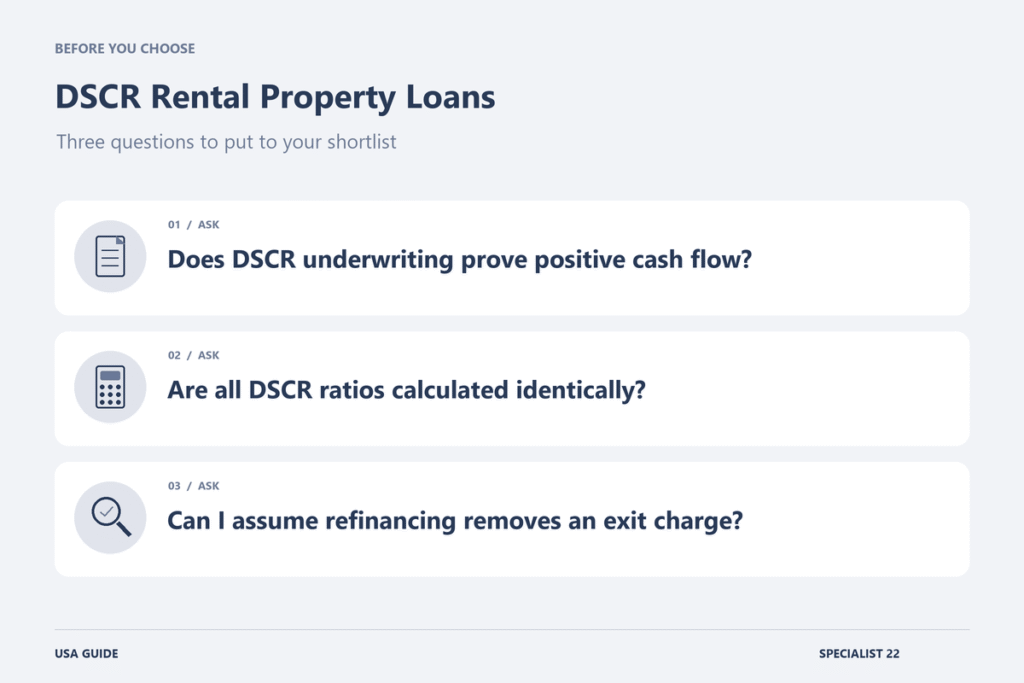
Does DSCR underwriting prove positive cash flow?
No. The lender’s inputs may exclude costs that matter to the investor. Prepare a full operating budget with vacancy, management, repairs and capital spending, then compare it with actual debt payments under less favourable conditions.
Are all DSCR ratios calculated identically?
Ask for each provider’s method and input values. Rental estimates, expense treatment and payment assumptions can vary. Comparing the displayed ratio without those details can conceal meaningful differences between offers for the same property.
Can I assume refinancing removes an exit charge?
No. Read the prepayment terms and ask how refinancing is treated at the relevant time. Model the cost before choosing the loan, and avoid treating an unapproved future refinance as a guaranteed way to reduce payments.
Further reading
Related reading
- Physician Mortgage Loans: Comparing Down Payments, Mortgage Insurance and Lender Fees (USA)
- Non-QM Mortgages for Self-Employed Borrowers: Comparing Bank Statement Loan Offers (USA)
- Mixed-Use Commercial Mortgages: Comparing Deposit Requirements, Valuations and Broker Fees (UK)
- Expat Mortgages for UK Property: Comparing Currency Requirements and Lender Charges (UK)
Explore more in Specialist Mortgages.