Physician mortgage programmes can offer underwriting features designed for certain medical professionals, but the programme name does not establish the lowest borrowing cost. Eligibility, down payment, mortgage insurance and employment documentation can differ between lenders. This guide helps US borrowers compare actual proposals with conventional alternatives. It does not recommend a lender or quote current rates. Medical qualifications do not remove the need to assess affordability, property costs and the consequences of borrowing a large amount early in a career.
Confirm eligibility before comparing benefits
Ask which qualifications, training stages and employment arrangements the programme accepts. A medical resident, newly employed physician, dentist and established practice owner may face different criteria. Provide accurate information about licensing, job start, contract conditions and the state where the property is located. Ask whether the programme applies to the intended occupancy and property type. An attractive national advertisement may not describe an available loan for your particular combination of profession, location and purchase.
Discuss the documentation needed if the purchase precedes a new job. Ask which employment agreements are acceptable, how probation or contract contingencies are considered and whether funds are required to cover the period before salary begins. Clarify how student loans and other obligations are treated without assuming they disappear from the analysis. Lender-specific flexibility should be understood as a set of underwriting rules, not permission to ignore a debt that will still affect household cash flow after closing.
Compare down payment and insurance together
Request a physician programme offer and a suitable alternative using the same purchase price, loan term and date assumptions. Record down payment, closing cash, rate, lender charges and any mortgage insurance. A proposal without mortgage insurance may still have a different interest rate or other costs. Keep those components visible rather than treating one advertised saving as the final result. If placing more cash down changes the terms, request that illustration too and consider the liquidity left for emergencies and relocation.
Look beyond principal and interest. Include property taxes, homeowners insurance, association dues and maintenance in the household budget. Ask whether quoted payments include escrow amounts and how estimates were obtained. A low-down-payment arrangement may leave a borrower with a high debt relative to the property’s value. Consider the practical position if the job changes or the home must be sold sooner than expected. The lender’s approval is not a substitute for your own plan for those possibilities.
Review rate structure and relationship conditions
Identify whether the offer has a fixed or adjustable rate and how any later adjustment operates. Ask about the initial period, index, margin, caps and the payment information available for comparison. If a discount depends on deposits, investments or other banking relationships, obtain the conditions and consequences of withdrawing them. A relationship discount can have value, but the borrower should understand associated commitments and fees rather than moving substantial assets solely to reduce one line of the mortgage quote.
For covered consumer mortgages, use the Loan Estimate and final disclosures to compare the actual transaction. Request an explanation of discount points, lender credits and rate-lock terms. A quote from a different day or for a different lock period may not be directly comparable. Ask what happens if closing is delayed because employment or property conditions remain outstanding. Keep dated proposals so changes in terms can be identified and discussed rather than disappearing into a sequence of informal messages.

Plan the purchase around career uncertainty
Consider how location, training, partnership plans or practice ownership might change during the expected ownership period. Ask whether early repayment charges or other restrictions apply. A mortgage requiring substantial refinancing later should be assessed without assuming future rates will improve or a new lender will approve the application. Where complex compensation or self-employment is involved, ask what happens when underwriting moves from projected employment income to evidence of established earnings. Different career stages can create different documentation challenges.
Compare lenders using eligibility, cash required, total payment, rate risk, fees and service during closing. Confirm licensing and the identity of the organisation actually originating the loan. Before committing, reconcile final documents with the programme you were offered and request clarification of unexpected changes. A physician mortgage may be useful when its features suit the borrower, but the sensible comparison remains the complete loan and the household’s financial resilience, rather than a profession-specific label or a promise that a doctor can borrow more.
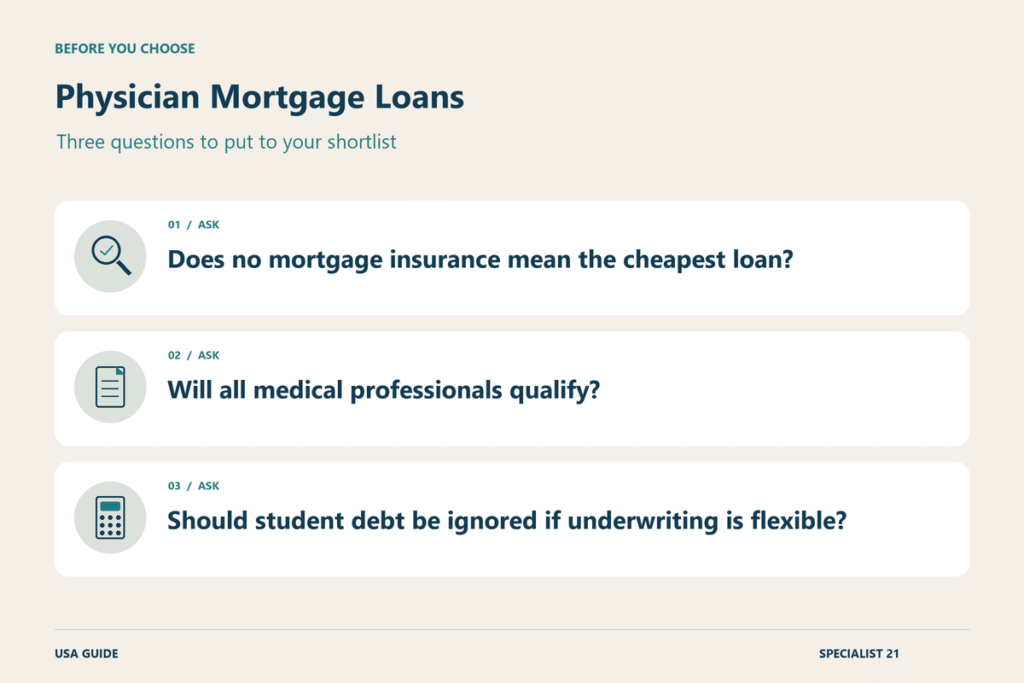
Does no mortgage insurance mean the cheapest loan?
Not automatically. Compare rate, fees, loan size and total payments with alternatives. Removing one charge can coexist with higher costs elsewhere, so assess the full offer using consistent dates, terms and purchase assumptions.
Will all medical professionals qualify?
Programmes define eligible qualifications, career stages and locations differently. Ask the lender to confirm your position before relying on advertised features. A colleague’s approval does not establish that the same terms apply to your employment or property.
Should student debt be ignored if underwriting is flexible?
No. Ask how the lender treats it for approval, then budget for your actual repayment obligations. Underwriting flexibility and household affordability are related but different questions, particularly when training income is about to change.
Further reading
Related reading
- DSCR Rental Property Loans: Comparing Rental Income Tests, Rates and Prepayment Terms (USA)
- Non-QM Mortgages for Self-Employed Borrowers: Comparing Bank Statement Loan Offers (USA)
- Mixed-Use Commercial Mortgages: Comparing Deposit Requirements, Valuations and Broker Fees (UK)
- Expat Mortgages for UK Property: Comparing Currency Requirements and Lender Charges (UK)
Explore more in Specialist Mortgages.