Self-employed borrowers can have substantial business receipts without the straightforward pay documents used by a salaried applicant. Some non-QM mortgage offers use alternative income documentation, including bank statements, but their methods and pricing differ. This guide helps US borrowers compare those proposals with available alternatives. Non-QM is not a promise of approval, a definition of one standard product or permission to misstate income. Ask qualified professionals to assess the proposed loan, applicable requirements and the actual ability to meet repayments.
Organise the business income evidence
Prepare a clear account of ownership, business activity, operating history and how money moves between business and personal accounts. Ask lenders which statement period, accounts and supporting documents they require. Identify transfers, refunds, borrowed funds and other deposits that are not ordinary business revenue. A high deposit total does not automatically equal income available for mortgage payments. Accurate explanations make the comparison more useful and reduce the risk of a quote being based on an unrealistic initial estimate.
Ask how business expenses are assessed and whether the lender uses a standard assumption or accepts supporting analysis. The accepted approach can materially change the income used in underwriting. Where an accountant’s information is requested, clarify the scope and obtain it through proper professional channels. Do not ask anyone to certify figures they cannot support. A lender offering flexibility should still explain its method transparently, rather than suggesting that documentation can be shaped solely to reach the desired loan size.
Compare alternative documentation with other routes
Ask whether conventional or other mortgage options are available using your records. A non-QM product may address a particular underwriting need, but it should not be selected simply because the borrower is self-employed. Compare the amount, term, payment structure and closing assumptions across realistic alternatives. Include the time and professional cost needed to prepare each application. The objective is to identify a suitable loan, rather than assume the most specialised label is the only route for someone with business income.
Find out how recent changes in revenue, ownership or industry are treated. Provide information about seasonality, exceptional contracts and debts the business services. Explain any personal guarantees or obligations that could affect available household cash. Ask which conditions remain after an initial quote and whether updated statements will be required before closing. An early estimate can change when the full records are assessed, so keep the purchase timetable aligned with the lender’s actual documentation and approval process.
Evaluate rate structure and closing charges
Request the rate basis, repayment schedule, lender charges, points, credits and all relevant third-party estimates. Identify whether the rate can adjust and how future payments would be determined. For a covered consumer mortgage, compare the official Loan Estimate and later disclosures rather than relying only on an email payment quote. Ask about rate-lock periods and extension costs. Use consistent dates and assumptions because differences in locking or upfront points can make two advertised rates misleadingly difficult to compare.
Include the down payment, reserves and money needed after closing. A borrower may qualify for a loan while leaving the business or household short of operating cash. Model lower income, delayed customer payments and business expenses that cannot easily be reduced. Ask an adviser to help separate company funds from genuinely available personal resources. A mortgage payment should be evaluated against sustainable cash flow, not simply against a lender’s maximum accepted income figure or the most successful period visible in the statements.
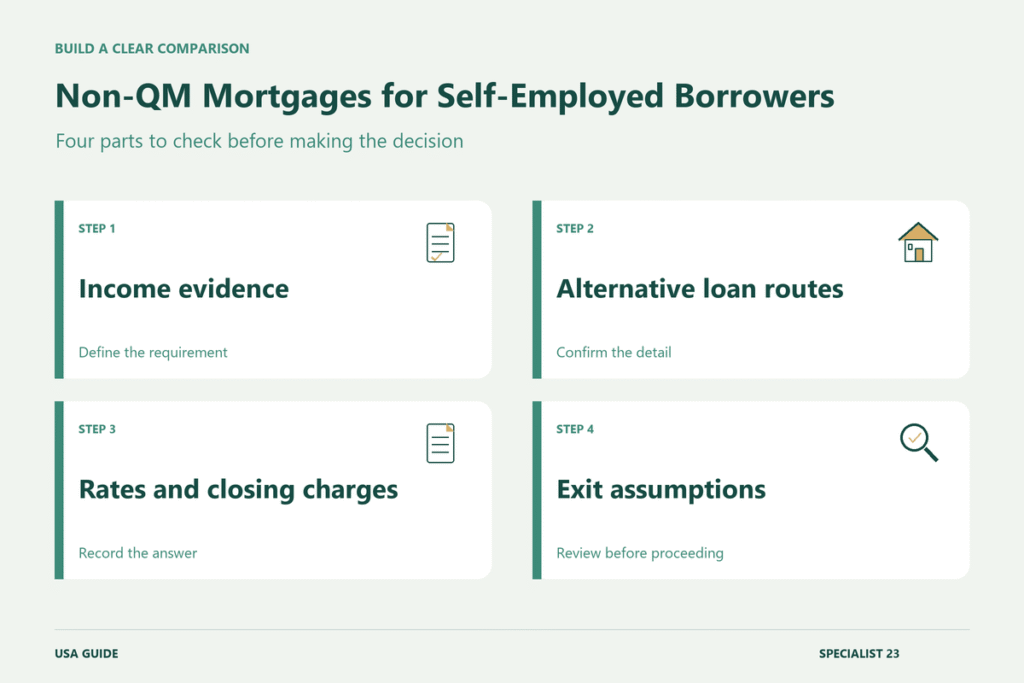
Review exit assumptions and broker incentives
Do not base affordability on a promise that refinancing will become easy after a short period. Future rates, property value, credit and income documentation can change. Ask about early repayment terms and the cost of holding the loan for its full intended period. If a broker recommends one lender, request an explanation of the alternatives considered, the services provided and how the broker is paid. The borrower should understand whether an apparent convenience comes with fees or commitments elsewhere in the transaction.
Compare offers in writing, with a record of the income method and outstanding conditions as well as price. Confirm lender or broker licensing through appropriate resources. Review final documents and question changes before closing, particularly a different rate structure or unexpected charge. A defensible choice connects documented income, realistic household and business needs, and an affordable loan over more than an optimistic initial year. Alternative documentation can help describe complex finances, but it does not make borrowing risk disappear.
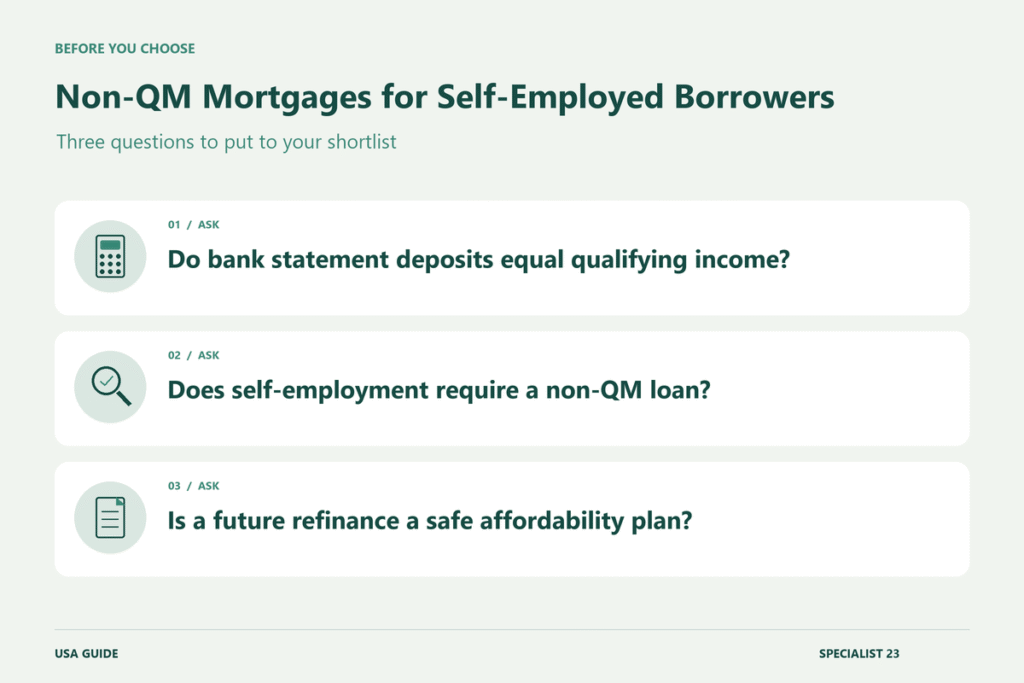
Do bank statement deposits equal qualifying income?
Not necessarily. Transfers, expenses and other non-income items can matter. Ask the lender to explain its calculation for your actual accounts and identify which supporting information could change the assessment before relying on an initial quote.
Does self-employment require a non-QM loan?
No automatic conclusion follows from employment status alone. Ask about available routes using your documentation and compare their full costs. A specialised programme should solve a genuine underwriting need rather than replace consideration of other suitable options.
Is a future refinance a safe affordability plan?
Treat it as uncertain. Evaluate whether you can manage the offered loan if refinancing is delayed or unavailable. Ask about payment changes and early exit costs, and keep sufficient resources for business and household contingencies.
Further reading
Related reading
- DSCR Rental Property Loans: Comparing Rental Income Tests, Rates and Prepayment Terms (USA)
- Physician Mortgage Loans: Comparing Down Payments, Mortgage Insurance and Lender Fees (USA)
- Mixed-Use Commercial Mortgages: Comparing Deposit Requirements, Valuations and Broker Fees (UK)
- Expat Mortgages for UK Property: Comparing Currency Requirements and Lender Charges (UK)
Explore more in Specialist Mortgages.