Choosing a nursing home abuse attorney involves two separate priorities: protecting the resident and investigating a potential civil claim. A legal consultation should not delay medical attention or reporting an immediate danger. For the claim itself, families need a team that can examine care records, identify responsible organisations and explain the cost of developing evidence. This US guide focuses on comparing that service. A poor outcome, an alarming photograph or a complaint about a facility does not by itself establish legal liability.
Clarify authority to instruct the lawyer
Start by establishing who the client would be and who may act on the resident’s behalf. A relative’s concern does not necessarily provide legal authority to sign agreements or obtain all medical information. Bring available powers of attorney, guardianship documents or estate papers, if relevant, and ask the lawyer to assess them. The firm should identify any further authority required. This discussion can prevent delays later, particularly when several relatives disagree or a resident’s ability to make decisions has changed.
Describe the care setting accurately. A nursing facility, assisted living community and home-care arrangement can involve different duties and evidence. Record the facility’s name, admission dates, important incidents, changes in condition and the people informed. Separate direct observations from information another person supplied. Keep original messages and photographs with their dates rather than editing them into a dramatic presentation. A concise, factual timeline is more useful for an initial legal assessment than an accusation assembled from incomplete records.
Compare how firms obtain care evidence
Ask which documents the firm expects to review first: care plans, medication records, incident reports, assessments, staffing information or hospital records. It should explain why those materials matter to the alleged problem. For example, a concern about pressure injury prevention may require a different clinical investigation from an allegation of financial exploitation. Find out how record requests are managed, how missing entries are addressed and whether the attorney uses clinicians with experience in the relevant type of care.
An effective review also considers events outside the facility. Existing illness, earlier injuries and treatment elsewhere may be important to understanding causation and loss. Be cautious of a firm that promises success without asking about that background. Ask how experts distinguish an avoidable care failure from complications that can occur despite appropriate care. The purpose of expert review is to investigate the evidence fairly. It is not simply to obtain a supportive opinion after the firm has already decided what happened.
Understand case funding and possible deductions
Request the proposed legal fee, expense provisions and any charges associated with obtaining records or expert opinions. If representation is offered on contingency, ask how expenses affect a recovery and who owes them if the case ends without payment. Discuss whether different stages change the fee. Where an estate, public benefits or medical reimbursement interests may be involved, ask who evaluates those issues. A clear account of possible deductions is more useful than a headline percentage presented without the surrounding terms.
The identity of the responsible organisation can affect investigation. The operating company, property owner, management company and individual clinicians may have different roles; the lawyer should assess the relevant facts rather than assume every name belongs in a claim. Ask about the cost and purpose of investigating corporate arrangements or insurance. If the firm anticipates referral or co-counsel, identify who will lead the matter and whether those arrangements change the client’s obligations. Families should know who is actually accountable for their case.

Evaluate resident-centred communication
Discuss how the firm will communicate with the resident where possible, accommodate disability and avoid making the person feel excluded from decisions. Agree on one authorised family contact if that would help, while preserving the client’s rights and confidentiality. Ask how the team handles visits, interviews and emotionally difficult records. The appropriate service is respectful and fact-focused. Aggressive advertising language can be a poor guide to whether an attorney will explain uncertainty, listen carefully and help the family understand procedural choices.
Civil litigation and regulatory reporting serve different functions. The Department of Justice’s elder justice resources describe abuse and reporting options, but a report does not automatically create or resolve a private damages claim. Ask counsel which routes may operate alongside one another and what information can be shared. Keep records of reports already made. Do not assume that a regulator’s investigation pauses a civil deadline or that a favourable finding establishes every element required in court; obtain advice about those questions for the particular case.
Before selecting a firm, compare its proposed first steps, care-setting experience, expert review process and written funding agreement. Check lawyer licensing through the relevant regulator. Ask what additional information could change the initial assessment and when the firm expects to make an acceptance decision. A dependable legal team explains what it knows, what remains uncertain and how it will investigate. That is a more useful basis for hiring than comparing advertised settlements from residents with different injuries and circumstances.
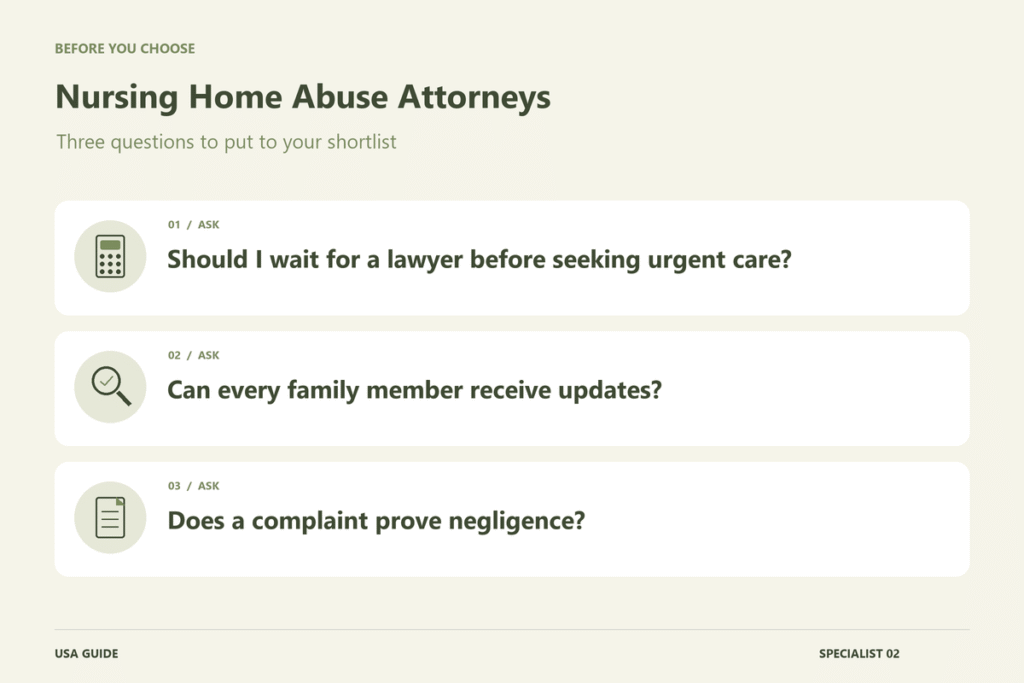
Should I wait for a lawyer before seeking urgent care?
No. Arrange appropriate medical assistance and address immediate danger promptly. A potential claim can be investigated separately. Keep a factual record of what happened and the assistance sought without allowing document collection to delay necessary care.
Can every family member receive updates?
Access depends on the client’s instructions, legal authority and confidentiality obligations. Agree on a communication arrangement with the firm early, particularly where multiple relatives are involved or formal decision-making authority needs clarification.
Does a complaint prove negligence?
A complaint is information for investigation. Ask the attorney how it relates to the evidence needed for a civil case, including duty, causation and loss. The firm should explain its assessment without treating an allegation as a finding.
Further reading
Related reading
- Maritime Injury Lawyers: Jones Act Experience, Investigation Costs and Legal Fees (USA)
- Aviation Accident Law Firms: Comparing Jurisdiction Experience and Investigation Resources (USA)
- Defective Medical Device Claims: Comparing Solicitor Fees and Expert Evidence (England & Wales)
- Holiday Accident Solicitors: Overseas Claims, Legal Costs and Representation (England & Wales)
Explore more in Specialist Injury and Product Liability.