Aviation accident claims can involve operators, maintenance organisations, manufacturers, insurers and people in several jurisdictions. For a family comparing law firms, the central question is how a proposed legal team will turn that complexity into a coherent investigation. A firm should explain its responsibilities, technical resources and funding arrangement before asking you to rely on its reputation. This guide addresses US legal service comparisons after an aviation accident; it does not decide jurisdiction, liability, filing deadlines or the value of an individual claim.
Identify the flight and the legal questions
Prepare an initial summary identifying the aircraft, operator, route, date, accident location and the injured person’s connection with the flight. Explain whether the person was a passenger, crew member, contractor or someone on the ground. Record the countries and states involved without assuming that the accident location determines every issue. Ask each prospective firm which additional facts it needs to assess applicable law, possible defendants and the courts that could hear a claim. Those questions should precede confident predictions about compensation.
International travel, a private charter and a domestic general aviation flight may raise different issues. Ask the attorney to explain the significance of the particular itinerary and contractual documents rather than applying a single passenger-claim formula. Bring tickets, booking confirmations, employment records where relevant, and correspondence received from insurers or operators. If another firm is needed outside the attorney’s home jurisdiction, ask how it will be selected, who instructs it and how the combined work will be coordinated for the client.
Distinguish safety investigation from representation
The National Transportation Safety Board investigates accidents to determine probable cause and improve transportation safety. Its work is not your private legal representation. Ask the firm how it obtains and analyses available factual material and how its civil investigation fits alongside the official process. The NTSB’s party system has specific technical participation rules; a lawyer should not imply that retaining the firm buys privileged participation for a family. An accurate explanation of those boundaries is a useful sign of professional judgment.
Discuss the records and technical issues likely to matter: maintenance history, operations, weather, training, aircraft systems and available recorded information. The firm should identify an evidence-preservation plan that respects official control of accident material. Ask who reviews technical documents and how conclusions are checked against the record. Specialists should be selected for the disputed question, not simply listed to make the investigation sound impressive. It is reasonable for the initial plan to evolve when reliable new information becomes available.
Compare technical resources and funding
Ask which aviation experts may be required and which expenses the firm expects to advance. Possible categories include engineering, operational analysis, medical assessment and financial loss evidence, depending on the case. Request the client’s responsibility for those costs in writing. If a contingency arrangement is proposed, compare the fee calculation and the treatment of expenses together. Have the firm explain the financial position if no recovery occurs, if a claim is declined after investigation or if the representation ends early.
Large aviation matters may use several firms or a coordinated legal structure. Establish who holds your engagement, who makes recommendations and who has authority to incur expenses. Ask whether the advertised attorney will personally remain involved and which team members handle routine communication. If the firm anticipates working with other claimants’ lawyers, discuss how shared work, confidentiality and individual interests will be managed. A collective investigation can still require a clear explanation of your own representation and decisions.

Judge the family’s day-to-day experience
An accident investigation can involve long periods with little public information. Ask how the firm updates clients during those periods and distinguishes verified developments from speculation. Agree on a contact person, preferred communication method and arrangements for relatives with different access needs. If the client is an estate or an authorised representative, clarify who may receive information and give instructions. The firm’s ability to explain uncertainty without making dramatic claims matters as much as its ability to describe technical evidence.
Keep a record of proposals using the same categories: jurisdiction assessment, investigation plan, responsible lawyers, anticipated expenses and communication. Verify professional standing with the appropriate lawyer regulator. Request the full engagement and time to read it. Advertised verdicts may demonstrate that a firm has handled substantial litigation, but they do not establish that the same circumstances exist here. The strongest proposal connects the actual flight and available evidence to a practical legal plan while acknowledging what remains unknown.
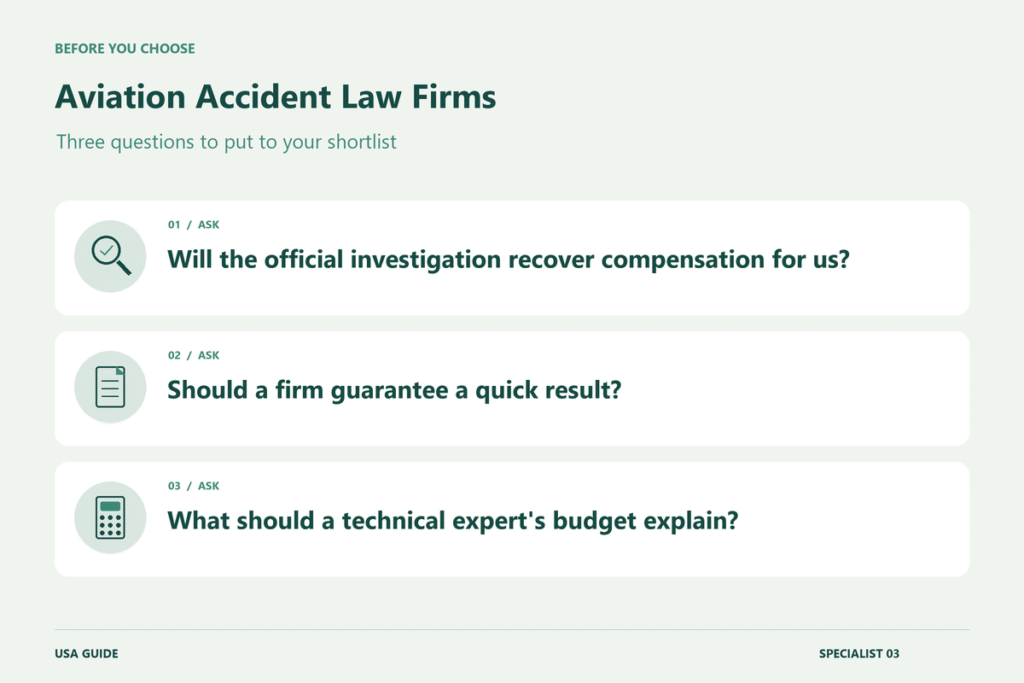
Will the official investigation recover compensation for us?
An official safety investigation is different from a private compensation claim. Ask counsel to explain the available legal routes and any timing requirements independently of the expected official report. Do not assume one process automatically completes the other.
Should a firm guarantee a quick result?
No reliable timetable can be promised without regard to evidence, jurisdiction and disputed issues. Ask for an explanation of likely stages, factors that could cause delay and how decisions will be communicated as the investigation progresses.
What should a technical expert’s budget explain?
It should identify the question being investigated, the proposed work and the client’s expense obligations. Ask how additional work is approved and how shared investigation costs are accounted for if several firms or claimants are involved.
Further reading
Related reading
- Nursing Home Abuse Attorneys: Evidence, Expert Costs and Case Funding (USA)
- Maritime Injury Lawyers: Jones Act Experience, Investigation Costs and Legal Fees (USA)
- Defective Medical Device Claims: Comparing Solicitor Fees and Expert Evidence (England & Wales)
- Holiday Accident Solicitors: Overseas Claims, Legal Costs and Representation (England & Wales)
Explore more in Specialist Injury and Product Liability.