Directors and officers insurance is bought to address certain claims connected with management decisions, but its value depends on who is protected and how the wording responds. A board comparing proposals needs more than a headline limit and annual premium. Defence costs, exclusions and the relationship between individual and company protection can change the practical result. This US guide provides questions for a broker-led comparison. It does not interpret a specific policy or promise protection for any allegation, investigation or business failure.
Identify the people and entities needing protection
Start with the corporate structure, ownership, board membership, subsidiaries and significant outside appointments. Describe whether the organisation is privately held, publicly traded or nonprofit and identify planned transactions. Give brokers the same factual information so proposals are based on comparable assumptions. Ask which people and organisations count as insureds, including former directors and newly appointed individuals. The answer should appear in the proposed definitions and endorsements, rather than in a general statement that everyone associated with the board is covered.
Distinguish protection for individuals from reimbursement to the company and any entity cover offered. Ask the broker to explain those functions using scenarios relevant to the organisation. For example, what would the policy do if the company could not indemnify a director, or if the company and several individuals were named together? Different sections may have different retentions or conditions. Understanding those relationships is more useful than assuming that the same sum is independently available to every insured person.
Compare how defence costs affect the limit
Ask whether defence expenses reduce the principal limit and whether any additional defence amount is included. Identify when payment or advancement becomes available and what consent is required. Find out who selects counsel, how conflicts between insured parties are handled and whether insurer-approved rates could affect the use of an existing lawyer. A policy that responds financially can still create operational difficulties if the board does not understand the appointment process. Request the relevant provisions before binding the insurance.
Review how related allegations, investigations and demands are treated. The wording’s definitions of a claim and wrongful act influence when reporting may be required. Do not assume that only a filed lawsuit matters, or that every informal enquiry qualifies. Ask the broker to map realistic notices and requests to the policy language. Establish an internal escalation process so a director, finance team or company secretary knows when to seek advice about notification rather than leaving papers in an ordinary correspondence queue.
Examine exclusions without broad assurances
Request explanations of conduct, prior matters, insured-versus-insured and other exclusions relevant to the organisation. Ask when a conduct exclusion takes effect and how the position of an innocent insured is addressed. The answer can depend on precise language and applicable law. A statement that fraud is excluded, by itself, does not explain how defence costs for an allegation are treated before any determination. Have the broker identify the provision and explain uncertainty rather than compressing it into a reassuring slogan.
Check the boundary with employment practices, fiduciary, professional liability and cyber cover where those are relevant. A management liability package may combine sections without making them interchangeable. Ask which section responds to each scenario and whether shared limits could be consumed by another type of claim. Record any important gap or overlap. The business should make an informed decision about retained risks rather than assume that buying several policies necessarily prevents all gaps between their definitions.
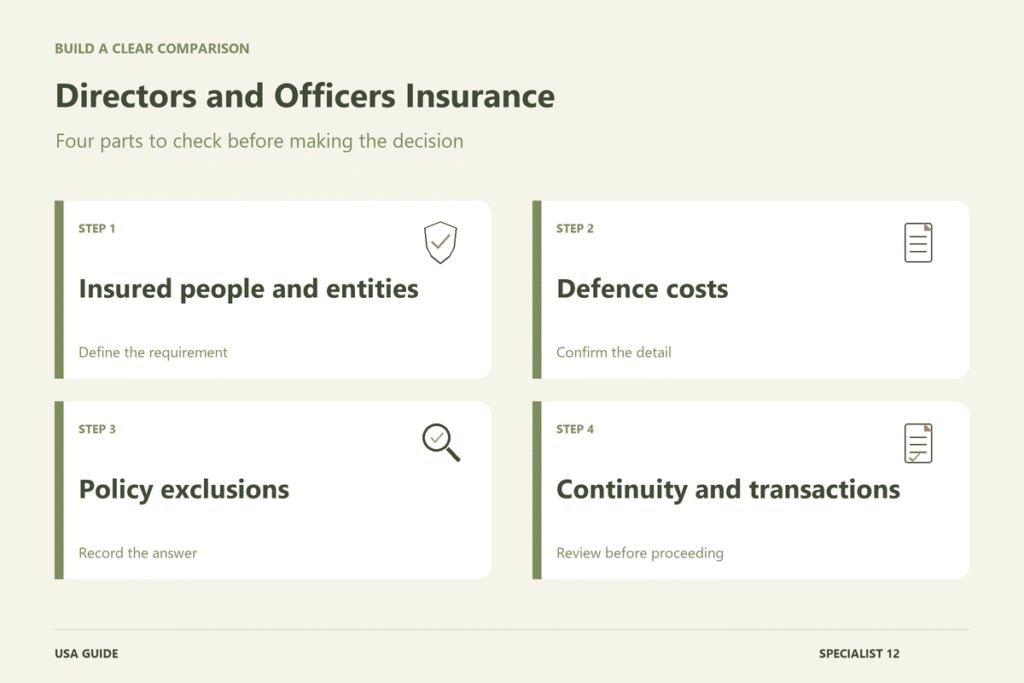
Plan continuity and organisational changes
Discuss reporting and continuity before changing insurers or completing a sale, merger or significant financing. Ask about prior acts, known matters, transaction provisions and any available extended reporting arrangements. The purpose is to understand the proposed cover for decisions made at different times, not to assume that keeping a policy in force solves every timing issue. Maintain records of applications, disclosures and material changes. If something is unclear, seek written advice before the transaction creates a different risk profile.
Present the board with a comparison covering insureds, limits, retentions, defence treatment, key exclusions, counsel arrangements and continuity. Explain unresolved questions rather than recommending a proposal solely because its premium is lower. Confirm the final wording matches the agreed terms and identify who manages future notifications. Public descriptions from insurers can help explain product categories, but the organisation’s own schedule and policy control. A disciplined review allows directors to understand both the protection purchased and the circumstances in which they may still need separate advice.
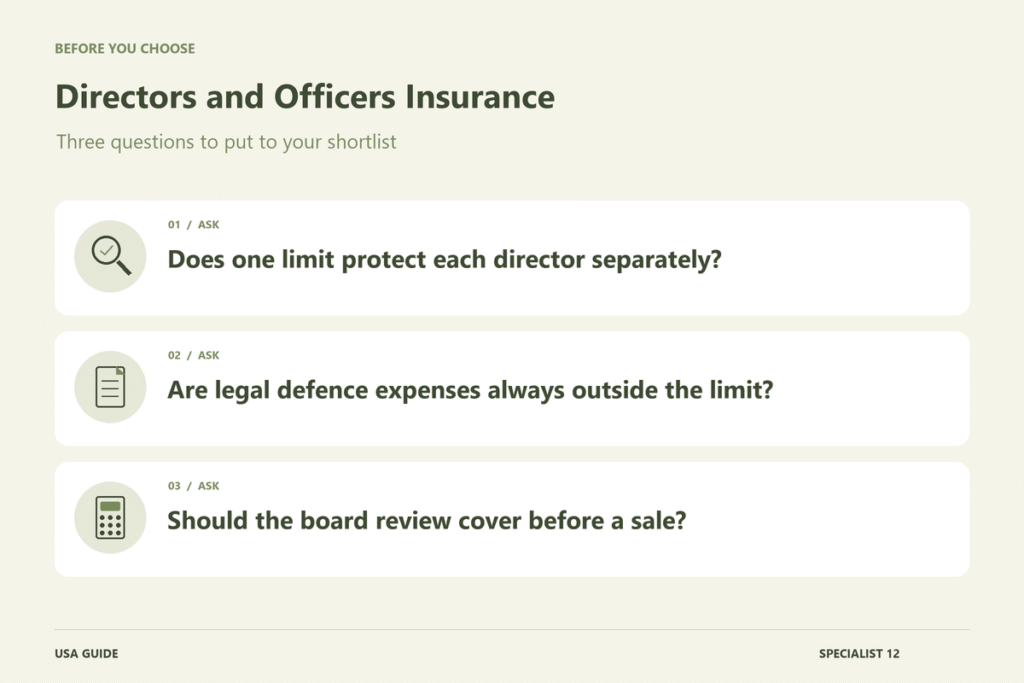
Does one limit protect each director separately?
Not necessarily. Ask how aggregate and shared limits operate, which costs erode them and whether any dedicated individual protection is included. The policy schedule should be read alongside the definitions and relevant coverage sections.
Are legal defence expenses always outside the limit?
No. Different wording can treat them differently. Request the precise arrangement, including additional defence provisions if any, and consider how a lengthy investigation or multiple insured parties could affect the amount remaining.
Should the board review cover before a sale?
Yes, request advice about the proposed transaction and timing provisions before completion. Identify who arranges any additional protection and who will retain records and receive later claims. A routine renewal process may not address transaction-specific questions.
Further reading
Related reading
- Cyber Liability Insurance Quotes: Comparing Ransomware Cover, Exclusions and Deductibles (USA)
- Product Liability Insurance for Manufacturers: Comparing Recall Exclusions and Coverage (USA)
- Key Person Insurance for Limited Companies: Comparing Premiums and Policy Structures (UK)
- Warehouse Insurance Quotes: Comparing Buildings, Stock and Business Interruption Cover (UK)
Explore more in Specialist Business Insurance.